and it was he who invented the oud plectrum made from the pinion-feathers of the eagle. Perhaps the most remarkable thing he accomplished was his school of music. This school was so distinguished in its day that its pupils were looked upon with respect. In this school of his he followed a new method of teaching song, dividing the musical program into three parts, the first of them the teaching of the words of the song to the accompaniment of any musical instrument, versification and meter included.
Ziryab so won the confidence of the people of Andalusia that his dress, his food, and his habits — his and his family's — became a measure of beauty and refinement and a model to be imitated. Among the things he taught the Andalusians was a new way of dressing and arranging the hair. When the Andalusians saw the family of Ziryab cutting their hair short to their ears and letting it fall over their temples, they took a fancy to this fashion and adopted it.
Among the dishes he introduced into Andalusia was asparagus, called in their tongue isfaraj. He likewise taught them a new dish, known among them as al-taqaya, prepared with the juice of fresh coriander and garnished with sanbusak and kebab..
As for the manners and arrangement of the table, Ziryab worked wonders there. For up to that time the Andalusians had used vessels of gold and silver, and he guided them to the use of fine glassware. They used to spread cloths of linen upon their tables, but he preferred instead the spreading of soft, supple leather. It appears that this singer was exceedingly elegant in his dress — so much so that he laid down for the Andalusians themselves rules for the wearing of clothes, which were followed in
that age. For he held that every kind of garment should be worn in the season that befits it.
Such is Ziryab: the artist who
consecrated his life to art, and to whom art in turn consecrated a page of its immortal book — each did the other justice.
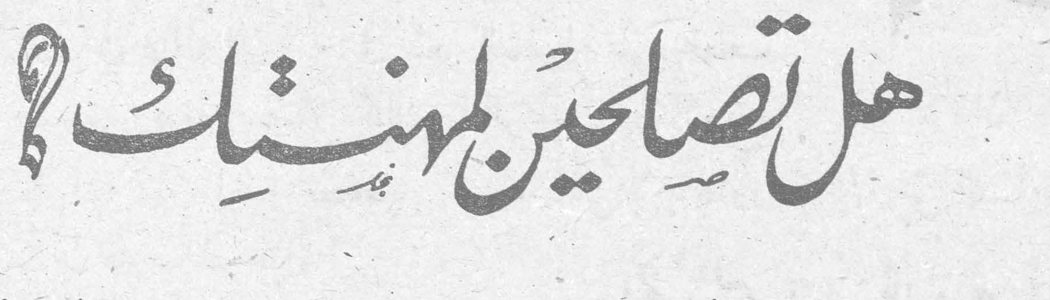
You may be entirely successful in your profession; yet there are subtle matters that only the specialists perceive, which may disclose to you truths that were obscure and vague even to yourself. Are you respected and honored? Are you suited to a second profession other than the one you practice? Here are questions that throw light on the facts; answer them privately, between yourself and yourself, and perhaps you will arrive at a satisfying conclusion.
1 — Do you talk to your friends about your work and the little things that happen in it? If you speak of your work with eagerness, that is proof of your harmony with the position; if the talk is all criticism, and full of nerves, that is proof that you are not entirely satisfied, and it may be that your chief does not meet you with the appreciation you deserve.
2 — Do you go to your work with desire and enthusiasm? And when working hours are over, do you toss the unfinished work over to the next day, or do you carry it home with you to finish it outside working hours? If you do, then you were made for this work; if not, you are only feigning the desire.
3 — Does your mind wander, during working hours, outside the bounds of the work? That is proof of your boredom and your lack of desire — and the reverse holds in reverse.
4 — Do you feel that your chief
bears down on you? Look for the reason; and if it points to his lack of confidence in your ability, try to prove the contrary to him. You will then stand well in his opinion, and he will change his negative manner of his own accord.
5 — Do you feel superior to your colleagues at work, or the opposite? If you feel you hold a special place among your colleagues, that is proof of your competence, and it may mean you are fitted for a higher post. And if you feel that, in spirit, you are at the rear, that means one of two things: either you still need training and testing, or you are suited to a position other than this one.
6 — Did circumstances drive you to this position, or did you pursue it long and hard? The position that comes by chance is generally not quite the right one; the position you strive after is without doubt closer to your inclination.
7 — Would you like your children to inherit your profession and take up your work? An affirmative answer is proof of your conviction of the position's worth and fitness; otherwise it is better that you find yourself another...
These are questions that throw light on your way of thinking and your own analysis of your attitude toward your work: are you suited to your present profession? Or are you suited to a second one, other than it?