She thinks of nothing but her home and her children. She cuts out clothes and sews them herself. She has only two maids. A woman of the utmost simplicity.
The Labour Party has returned to power in England for a second time. And few are the women who know anything about the wife of the leader of this great party and head of the British government.
She took her husband by car to Buckingham Palace the first time, and took him a second time in the same car.
On the day the British Labour Party won that dazzling victory in the parliamentary elections, only two hours after Mr. Clement Attlee, the Labour leader, had learned the official results, the telephone rang at party headquarters in London. It was Mrs. Attlee, asking to speak to her husband:
"I am very happy at your victory. I will come to take you in the car."
Then she came indeed, and carried him in her small black car of the "Austin" make to Buckingham Palace, where the King was waiting for him, to entrust him with forming the government.
Mrs. Attlee applies in her life three rules which she believes necessary to guarantee that family life runs in the best possible way. These rules are:
1 – That a wife should in no circumstances interfere in her husband's work.
2 – That she should think of nothing but her home and her children.
3 – That she should live a purely domestic life, avoiding as far as possible large receptions and sumptuous banquets.
In justification of this she says: "Is not my husband of the Labour Party? Must I not, for that very reason, set people a good example?"
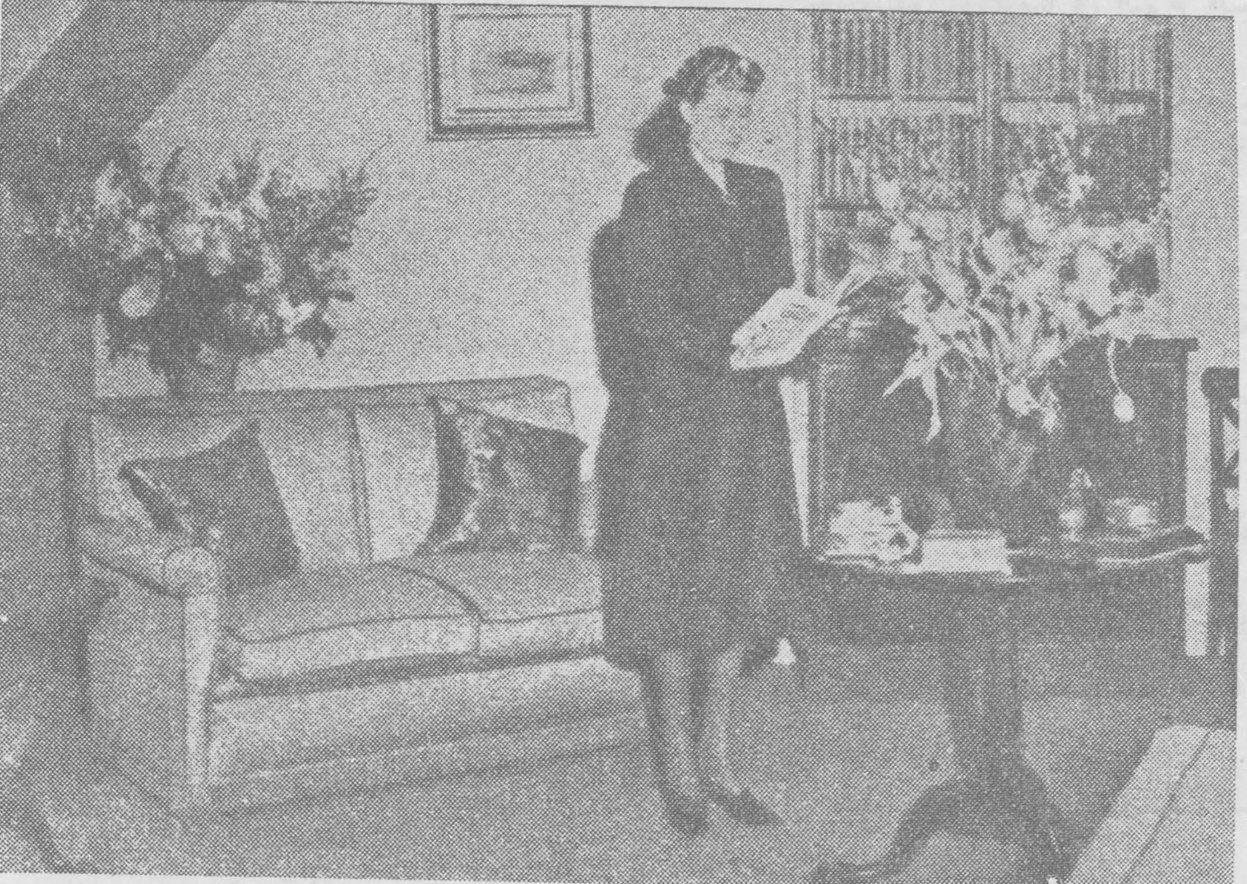
When Mrs. Attlee moved into No. 10 Downing Street, the house appointed as the Prime Minister's residence, she was appalled by what she saw there of comforts and luxury; the wife of Churchill, the former Prime Minister, had furnished it before her in that house. So Mrs. Attlee set about
restoring everything to the level of ordinary simplicity, dispensing with all that necessity did not call for. She turned the upper floor into a modest dwelling, to which she moved from her country house a number of family furnishings dear to her.
Thus, thanks to this wife, the Prime Minister keeps, amid his official cares, what the English call a "home" — a word that stands for "the family house." In that "home" the Premier does not feel himself in an atmosphere strange to the one he has lived in; he stays with his wife and four children in an atmosphere where the conversation never once extends to political affairs, for the Prime Minister's wife does not talk politics with him, nor does she want anyone to talk politics in her presence!
Mrs. Violet Attlee dislikes society, and very few are the visitors she invites to take a meal in her house.
They usually take, at half past
eight in the morning, a modest breakfast, then go out together for a stroll in St. James's Park. At half past nine, Clement Attlee — or "Clem," as his wife calls him — goes to his office and begins his work.
At that hour Mrs. Attlee goes about the house, placing flowers here and there, and goes down to the kitchen to draw up the day's menu. And since food supply in England is still subject to the exceptional laws of wartime, Mr. Attlee and his wife take care that nothing bought on the black market should be served to them at table.
In mid-morning Mrs. Attlee goes out to the London markets, and often visits the popular quarters, especially the district of "Lambeth," to see for herself the prices of foodstuffs.
At half past one comes the hour of lunch. Mrs. Attlee watches over the lunch closely and watches over its hour. At table, the food is served first to Mr. Attlee, then to the children, then