"Had you put Egyptian statues in place of Rodin — there is in them something that carries one off to distant horizons."
"Are you the one who possesses that force in the Arab world that would drive it toward suicide?"
Miss Salwa Rawda has been pursuing her art studies in Paris for some years now, drinking deep of its beautiful museums, nourishing her mind and spirit on the canvases of the great artists, and working with diligence and energy at study and learning. A beautiful letter has arrived from Miss Rawda in which she gives her bold and sincere opinion of the book The Lost Anthem by Miss Thurayya Malhas. The Woman's Voice has chosen to pass on to its readers some paragraphs of this letter.
Miss Salwa Rawda said:
"I do not know exactly what effect your book has had on readers... As for me, its music has accompanied me and accompanies me still... I read it and read it again in my room to the strains of the music rising from the radio, and I find between the two a kinship and a harmony...
I can well imagine that public which sees no meaning in the book... Perhaps that is because such a public does not appreciate the meaning of life, or perhaps because it does not live life with its whole being... There is no knot that occupies its mind... no hope for which it lives...
And I do not know whether I can apply this judgment to the Arab public as a whole — this public which, in my eyes, does not possess even the force that would drive it toward suicide...
My friend: what are homelands? What are frontiers? — science mocks them... What are customs? What is society? — printing and the radio and the cinema mock them... The world is hurrying on:
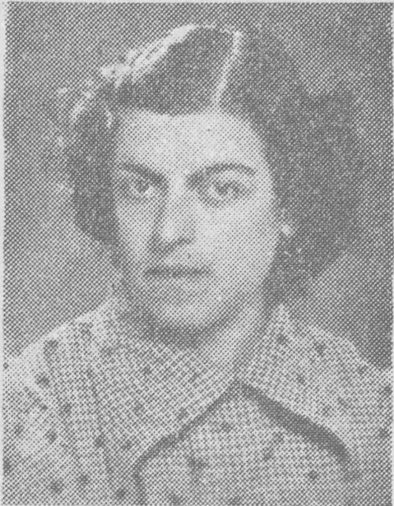
Miss Salwa Rawda
must we always be in the rear? A child dragged by the hand, who does not know where he is being led?
But let us return to your book. There is nothing new in my saying that it pleased me. I loved you as you sang in 'A Song' or chanted in 'The Chant'; in these two poems I loved the music — especially in 'A Song.'
If I wished to count up everything in the book that pleased me, I should have to name all the poems except three or four...
The poems 'Reverie' and 'Faith' and 'Rebellion' still hold a tender place in my heart; I read them and admired them before they appeared in a book...
Your style is fresh and very delicious. What pleased me in it is that original concision which lends the sentence its grace, so that it comes clipped, with the power of a magnet drawing waves of intelligence from the 'intelligent' reader. And you did well to dispense with many of the particles of condition and conjunction and the relative pronouns; the space that took their place was full of meanings...
I find a delight in reading 'Prayer,' for in it states of soul are embodied — it is not a description of states...
In it, as in many of the other poems, there is terseness and strength and steadfastness... It scoffs at flowing tears and watery sentiment and vulgar realism. All this in a style we have not known before — not even among those who set themselves up as innovators...
Why did you begrudge your book wide margins? Especially on the right-hand side — indeed it is huddled in upon itself, as though you meant it in your own words:
'I folded you... as the petals of flowers fold their color into their breast...'
Do you wish it not to open even to one who reads it with delight and love and confidence!...
And finally, why did you put two