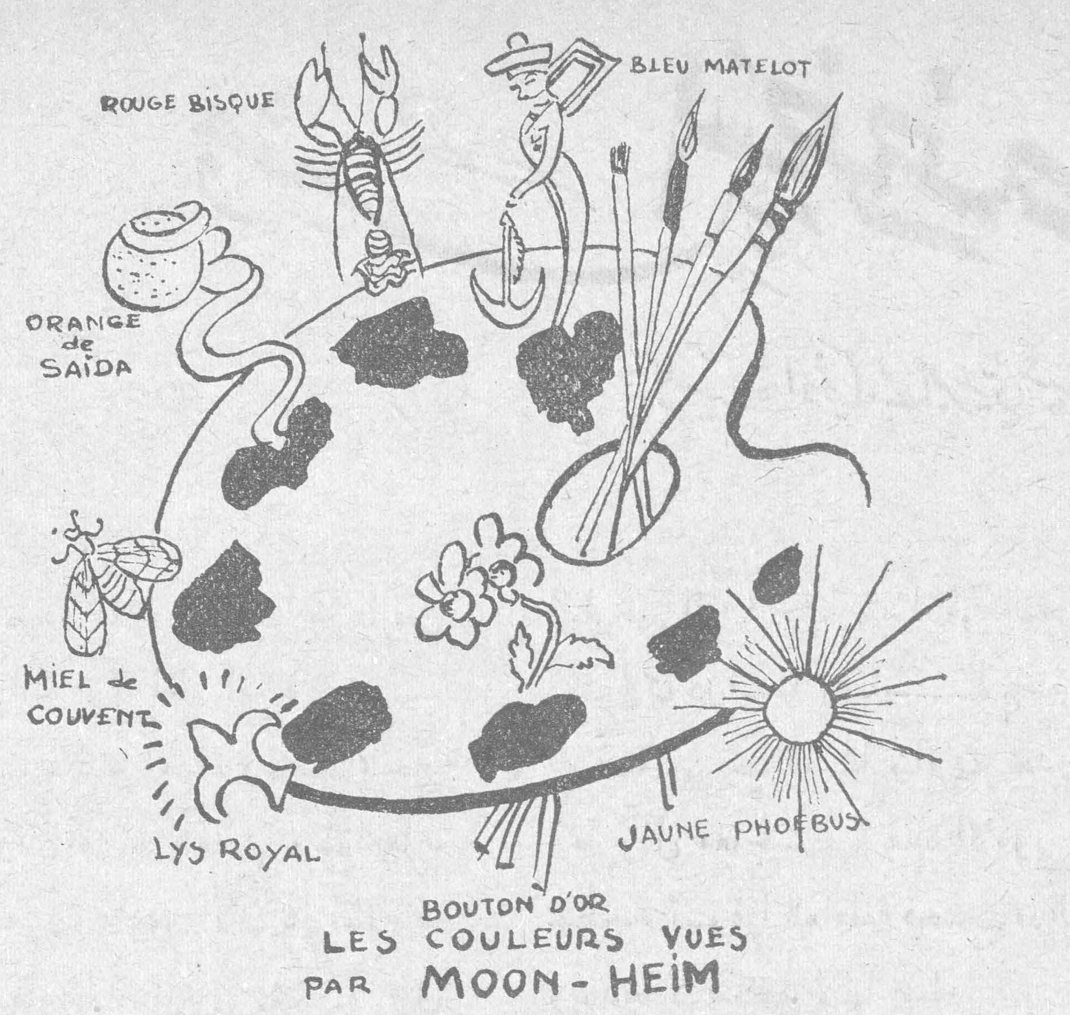
BISQUE RED
SAILOR BLUE
SIDON ORANGE
CONVENT HONEY
ROYAL LILY
PHOEBUS YELLOW
BUTTERCUP
THE COLORS AS SEEN BY MOON — HEIM
"Heim" sprang forward calling for "the Mid-Century Voyage" — that voyage which will last no more than the months of spring, and each of whose bewitching models he gave an Eastern name to set it apart from the rest: there was the India Bag, the Magic Carpet, Toboggan, and other Oriental names that accord with the charms and the mysteries of these costumes.
This does not mean, of course, that the Mid-Century Voyage is a counter-reaction against the mid-century fashion. It is rather a renewal and a continuation of it. The garçonne, on this happy voyage, has grown more elegant and more mannered, and has become like the dandy, with no care but to deck herself out and strut with her high, stiffened collar, her gray neckband, her shirt-front and her buttons; over these ensembles pours a black mousseline écharpe that winds coquettishly about the neck and then falls from it, languishing, upon the breast.
Heim's spring dresses are marked by their simplicity, their harmony, and their artistry. Their shoulders are at once rounded and loose. Their bodice is rich in pockets and turned-back flaps. Their sleeves are wide: they begin low and end like shirt sleeves or like
an inverted funnel. Then follows a straight skirt tending to shortness (40 cm), its sides enriched with charming pockets.
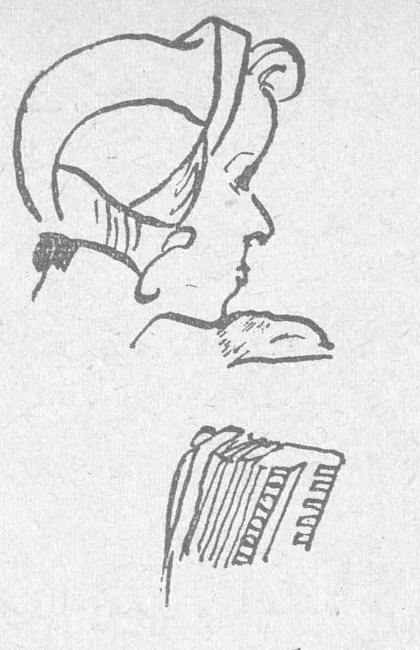
Another new costume steps out to meet the spring, launched by "Jeanne Lafaurie," who calls it Cupidon 1950. Among the traits of this costume is that it is full of charm, full of mystery and allure. In it the lady appears young, free, supple, with a wide bodice pleated like an accordion, its sides sloping toward the hips with a soft, hidden slope, so that the eye is deceived and intoxicated; then the eye descends to the skirt and is deceived again, taking it to be narrow and tight — when in fact it is wrapped to the back and fastened with a button. For fair days Jeanne Lafaurie has set aside two-piece dresses — a blouse drawn in at the waist by a belt, followed by an accordion-pleated skirt — and cotton dresses with wide or doubled sleeves, in which two different colors are set against each other.
"Molyneux" chose to free woman's neck... from the collar, of course. So he devised a new costume he called the Star costume, in which the slope of the shoulders stands out, and whose skirt hesitates between wrapping, flaring, and pleating. Yet he lengthened the cape at times and
shortened it at others, so that it came from under his hands either short to the waist or long as a coat, down to the knees.
"Rochas" goes further still, calling for woman's liberation from the fetters of the dress, saying that fashion must take the mid-century as its point of departure and must accord with the spirit of the age — the atomic age. And his dresses came as the best illustration of his word: sleeves puffed to the elbow and drawn in by a high cuff, high waved jackets, contrasting colors, a non-classical tailored suit, and a skirt of moderate width, buttoned in front or on one side.
As for the costume heralded by "Jacques Griffe," it is the lozenge costume. Among its features: a bodice in the shape of a lozenge, and angles like a lozenge too; short sleeves sloping off the shoulder, or kimono sleeves narrowing little by little to turn back at the elbow, and sometimes at the shoulders; a wide jacket; and a whistle-shaped skirt whose height from the ground ranges between 38 and 40 centimeters. His geometric lines have won great favor in the eyes of the ladies.
It goes without saying that I must not leave the colors unmentioned, nor be categorical in classifying and defining them, for they escape all counting and definition. But the most current among them are those with the blue of the sea, or the gold of the iris, or the pallor of the orange, or the clarity of convent honey. As for pure white — the white of the lily and the jasmine — it is spring's best-loved color.