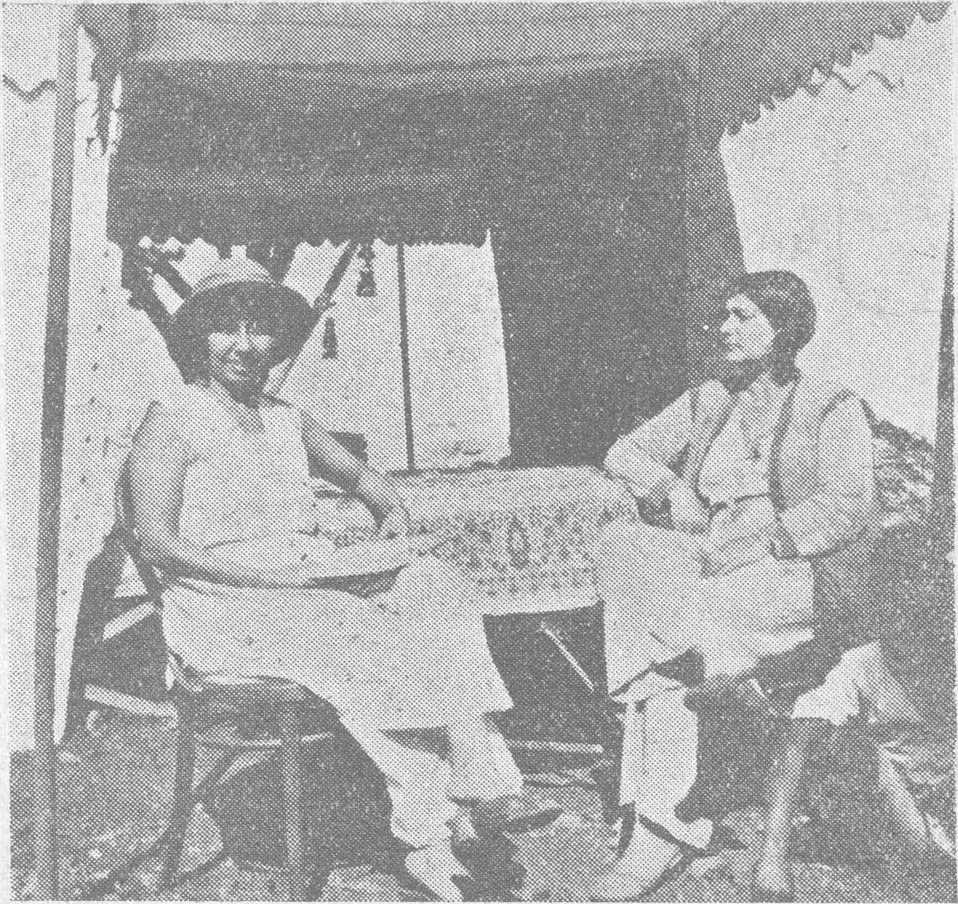
Mrs. Beyhum at the farm
peace in life, and the feeling that you have attained the happiness you were seeking?
A — For all the tranquility of mind and ease of conscience I feel, I found the happiness I sought only at a distance of twenty kilometers from Damascus. There, on my farm "al-Zarbaqiyya," where I saw the fruits of my services. In its breeze I breathed the fragrance of praise for my efforts. Yes — there, where I never performed a duty but was rewarded with something better. The tree I gave my care filled my house with its delicious fruit; the grain I sowed with my affection repaid me grains for the one grain; and the flower I weeded around refreshed my spirit with its scent. There the livestock shower me with their generosity: I drink of the best of their milk and enjoy their natural affection and their sense of gratitude. If I call the daughters of my sex to work, my excuse is that I reap its fruits; and if I call them to the fields, my excuse is that I taste their sweetness. Agriculture is the most important resource of our country, and in the measure of our care for it we shall enjoy all the prosperity we want and wish for.
And I call you, my sisters, to the land — I am committing no heresy, for woman has been man's partner in working the land since creation, and remains so to this day. As for abandoning the village and migrating from it to the city in search of work, that is a social disease of which the West complains and whose consequences it dreads. The Arab woman has begun to think of serious work, whether we will or no; so, out of regard for social life and in keeping with the spirit of the age, I see a wide field before me to call to her in the language of love and tenderness, and to summon her to the field, to the farm, to the land. Here she will find her daily bread, here she will find wealth, and here she will find independence. Indeed, in the land alone can the sought-for happiness almost be grasped.
Q — And the liberal professions — do you advise woman to take
them up? And which of them, in your view, is the most fitting?
A — As for the other liberal occupations — medicine, pharmacy, letters, art, journalism — these are works of limited scope, and before long we shall be raising our voices to say: enough women of letters, enough women doctors, enough women teachers. But we shall never say: enough women planters and tillers; and we shall never say: the poultry and the livestock have keepers enough.
Agriculture is the most fitting professional work for woman, whom God has endowed with instincts suited to rearing and growth. Tenderness, affection, and patience are qualities woman enjoys, and they make the office of motherhood easy for her. And they are the very qualities that those who practice agriculture require, for the plant, the tree, the flower, the livestock, and the poultry all need what the child needs of care, affection, and long patience. I can almost see certain readers, men and women, making light of my call; I can almost see certain educated girls mocking my wishes, saying: Is it for the likes of this that we spent the long years in study and learning?
Is it on the likes of this that we pinned our great hopes for the future?
Q — How did you come to take this direction, and who planted the love of the land in you?
A — My late father wished to test my ambition on a farm of his called Hazrama, on the outskirts of Damascus. When I sensed success in myself, I wanted my efforts to be spent on a farm that was mine and no one else's. It was as though he wished to turn me away from politics, so he made me owner of a farm nearby, large in area but with salt-barren soil, which had defied my grandfather Holo Pasha, a man known for his firmness and resolve. He gave me this farm certain that I would find solace in it, and would find in it the broad field for my ambitions — and certain, too, that I would spend upon it without being able to subdue it and make it bear, and that in the end I would come round to his opinion and forsake agriculture in the face of the difficulties I met.
Q — Did you retreat, and how did you overcome the obstacles that stood in your way?
A —