instruments;
which is the mind, the mighty weapon to which everyone resorts ... with victory. You are able to ... upon it ... and wade through this life, which does not demand much cunning and craft. It requires only a little. You are able to distinguish in it between virtue and vice, so that you shun whoever deserves banishment, and keep clear affection for whoever deserves it. ...
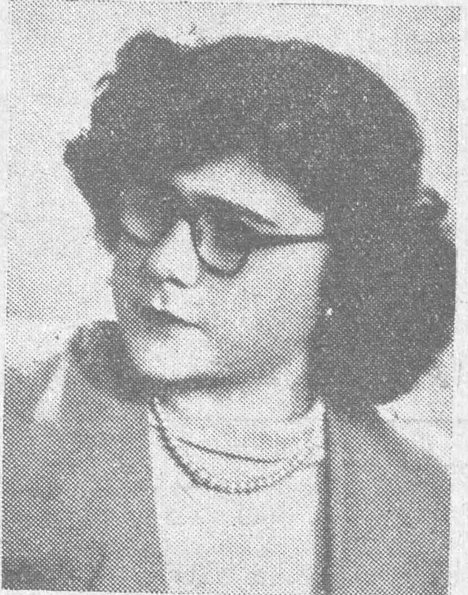
Ismail Arqawi Student of philosophy
The debate has grown heated, and remains heated, among the wielders of pens throughout the
world over woman's place in society. Some have set her in a place rivaling man's, making of her an instrument that lifts man to the loftiest ranks and leads him to glory and honor; others have gone to extremes in disparaging her, belittled her influence, and held her responsible for most of the calamities that befall humanity. Yet society is an edifice with two pillars: it stands only upon them and lives only by means of them, and these two pillars are man and woman.
Man has his field, where woman comes in second place, and woman has her field, where man comes in second place. If man knows his duty and does not overstep it, and woman knows her limit and does not cross it, society will move along the straight road of progress, and humanity will stride toward civilization and light with broad steps that no obstacle can hinder. Life is not exalted by one of them alone, but by the two together. —
As for woman—and I mean the cultured, upright woman—she is the head of every movement in the world, whether for good or for evil.
Woman is to the nation as the ray is to the lamp: does the lamp's light grow scant when it is full of
oil? A house without a woman is like a body without a soul. The upright woman is nature's lamp, the flower of life, the light of the soul, and the cradle of refined morals and lofty cultivation. From woman's sensitive heart springs mankind's happiness, and from the emotions of her noble soul are born the emotions of their souls. It is she who shows us the rays
of liberty and raises us to a lofty station. Woman is a smile on the
Your letter is quite charming; we thank you for your sincerity and your confidence in the magazine. Your poem "Fragments of a Heart" has feeling in it, and tenderness, but it lacks style; taken as a whole it is disjointed, its meters faulty. Feeling alone is not enough in poetry.
Nor is the desire to compose verse enough, either...
You write prose better than verse—so why not write us prose??
We do not wish to dampen your ardor; but it is more to your advantage not to think of publishing what you compose today..
mouth of this universe, a flower in the garden of this existence; she is a spirit that breathes life into the frame of society, an inspiration that lights the darkness of hearts; she is a dewy breeze, like love,
that blows upon us from the morning of life, reviving what has wilted of our hopes and strengthening what has weakened of our expectation. —
Woman must learn and be cultured, for the homeland—or the world—rests upon the family, and only woman can set the family right.
Woman must learn for the home, not for the cafés and offices; for education, not for wantonness; to raise a sound generation, not to corrupt a present one??