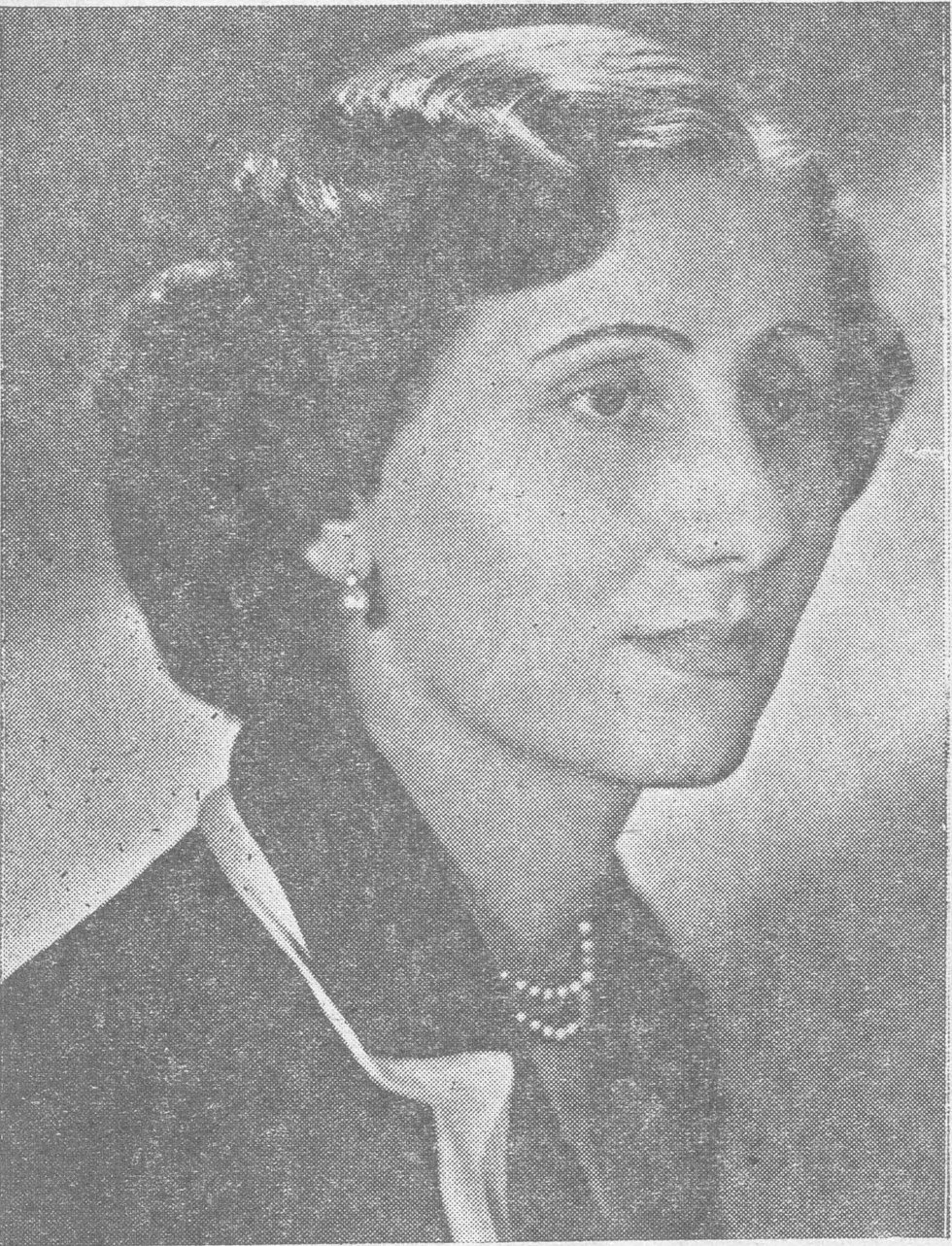
Mrs. Rina Abou Khater, wife of His Excellency Joseph Abou Khater, Lebanon's Minister Plenipotentiary in Mexico, speaks of the Lebanese woman in Mexico.
*
I should like to set before the eyes
of the Lebanese women at home a brief picture of the Lebanese woman in Mexico and of her social life, making no distinction between the woman born in Lebanon and the one who first saw the light in this vast foreign environment and who from the very beginning drank in its traditions and was influenced by them to a great degree.
Before I do so, it pleases me to salute this fine magazine, which carries across the seas much that strengthens the bond between the two halves, and which revives in the hearts of its Lebanese emigrant readers the pure national spirit.
At the beginning of the era of Lebanese emigration to the American continent, and through the long years that followed, there was no difference between the life of the Lebanese woman at home and the life of her emigrant sister. The Lebanese woman emigrated with the customs and traditions of the old homeland deeply rooted in her, and she lived in foreign lands holding to those customs as firmly as could be — the more so since emigration in its beginnings was a temporary expatriation, from which the emigrant would soon return to the homeland after attaining even a small measure of success.
But as emigration grew older, as Lebanese men and women settled little by little into a final settlement in the lands of their expatriation, blended completely into the new environment, and saw their descendants succeed one another there, the woman of Lebanese birth and origin took on a new stamp; the force of circumstances drew her away from many Lebanese customs and traditions and all but dissolved her into her present surroundings — had it not been for the national spirit rooted in the Lebanese people, a rootedness owed to many particular causes, which enabled it to preserve itself despite the assaults and trials of time.
As for the present period — the most delicate and most critical period through which relations between the two halves of Lebanon have passed, since during it the emigrant is torn by several forces: sentiment never ceases to draw him toward the mother country, while interest and hard reality draw him toward the land of his emigration — this period has, in spite of what I have mentioned, kept alive in the breast of the emigrant woman many of the national traditions. Perhaps foremost among the causes of this happy phenomenon is Lebanon's new international standing, which has sent a wave of pride into the hearts of its sons beyond the seas and made them glory in belonging to it.
This is a brief picture of the state of the Lebanese woman in the Mahjar, and particularly in Mexico,
where I have lived for three years, and where it has been given me to mingle with Lebanese women's circles generally, to appreciate the noble inherited character that is theirs, and to touch with my own hand the extent of the broad assistance the woman here renders her husband by supervising the raising of the family in a sound Lebanese way.
As for the field of the Lebanese women's charitable and social activity here, I should like to mention in particular the work of the societies of the Lebanese Ladies, the Lebanese Young Ladies, the Lebanese Red Cross, and the Ladies of Zgharta — all of which aim at helping the poor of the colony and showing compassion to the needy, and which expend praiseworthy efforts to that end by holding many charity fêtes and collecting money from the colony for this purpose. They have also aided, and continue steadily to aid, charitable works in the mother country.
To these generous societies, and to the Lebanese woman in Mexico, who has surrounded me and surrounds me still with every mark of sincere friendship, I address my greeting and my thanks, wishing them one and all continued progress and prosperity.