There are among men those who give a little of the much they have—and they give it for the sake of fame, and their hidden desire for vain renown spoils the benefit of their gifts.
And there are those who possess little and give it all.
And there are the believers in life and in the bounty of life; the chests of these are never empty, and their coffers remain full forever.
And there are among men those who give with joy, and their joy is their reward.
And there are those who give with pain, and their pain is their baptism.
And there are those who give and know no meaning of pain in their giving; they ask for no joy, nor do they wish to broadcast their virtues. These give of what they have as the myrtle gives its fragrant perfume in yonder valley.
Through the hands of such as these God speaks, and through their eyes He smiles upon the earth.
*
It is beautiful to give to him who asks of you what he needs;
but more beautiful still is to give to him who does not ask, when you know his need. For he who opens his hands and his heart to give finds, in seeking out the one who will receive his gifts and in finding his way to him, a joy greater than the giving itself.
And is there anything in your wealth that you can keep back for yourself?
For all that you possess today will without doubt be scattered one day;
therefore give of it now, that the season of giving may be one of the seasons of your own life, and not your heirs'.
From The Prophet
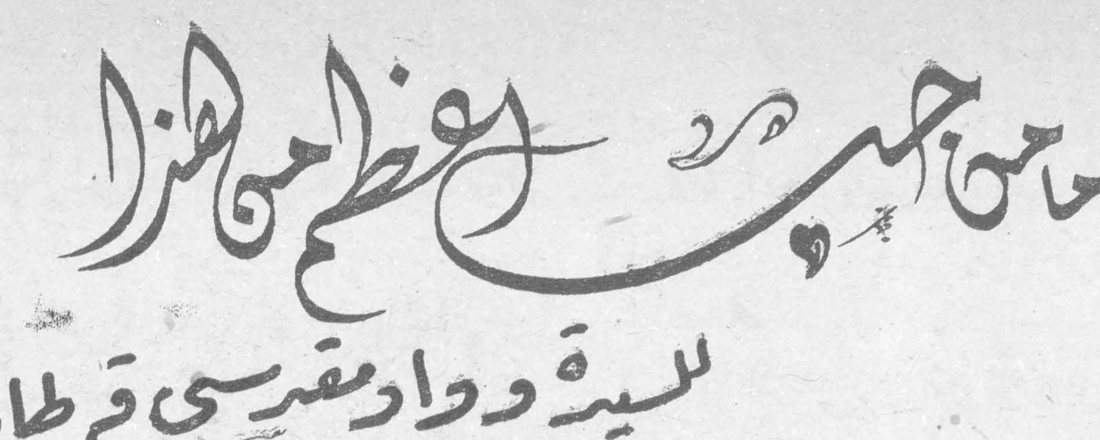
"I was asked, in my student days in the West, 'Who is the greatest woman in your country today?' I answered at once, without the least hesitation: Emily Sursock... And today I still feel, with truth and sincerity, that Emily Sursock was the greatest woman Lebanon has known."
Among the most beautiful meanings of dedication ceremonies are the living influences they carry within them, which lift us from our limited world to the abodes of the immortal spirit.
I was asked in my student days in the West who the greatest woman in my country was today. I answered at once and without the least hesitation, "Emily Sursock." I was asked why. I said: because she was rich, and did not live for herself as the rich do; because she was beautiful, and did not live for herself as beautiful women do; because she possessed influence, and never once used her influence for her own private personal ends. And today, after the test of my own experience over a number of years, I still feel, with truth and sincerity, that Emily Sursock was the greatest woman Lebanon has known.
Does not each of us imagine, as he contemplates this silent marble statue that has stood for thirty-six years in the courtyard of this noble institute, that here was a woman whose life overflowed with the radiance of a love embracing all who were weaker than she?
Did not Emily consecrate her youth, her heart, her mind, her money, and her health to the cause of charity and good works?
Did she not scorn influence, prestige, and power, feeling that life had a claim upon her to rebel against a milieu whose possibilities were plundered by the bonds of destructive selfishness, whose talents were strangled by the demands of brute matter—a quarrelsome, idle milieu whose strength is sacrificed on the altar of sloth and stagnation?
Was she not the only rich woman of her age who felt that life had a claim upon her to use her wealth for the relief of those less fortunate than she and weaker in faith than her own faith? She would send a flood of hope to hearts that had despaired of life, grant resolve to breasts whose steadfastness had betrayed them, and light the path of suffering, bewildered souls.
Emily lived in an age whose faith in the education of girls was as weak as its faith in the principles of mercy and charity—an individualistic age, shrunken in upon itself. She had nothing but the faith that shone upon Daniel in the lions' den; so she rose to muster all her spiritual forces until she attained her purpose, with the help of that venerable woman who supported her most mightily—I mean Sister Mariam Jahshan.
Here is the school to which she consecrated every minute of her life; here is the orphanage for whose founding she labored night and day; here is the religious order for which she secured the field of continuous service; here are the churches she built in her life and after her death—living tongues proclaiming the merit of this woman of rare example.
We all know how Emily sacrificed the comfort and security of the