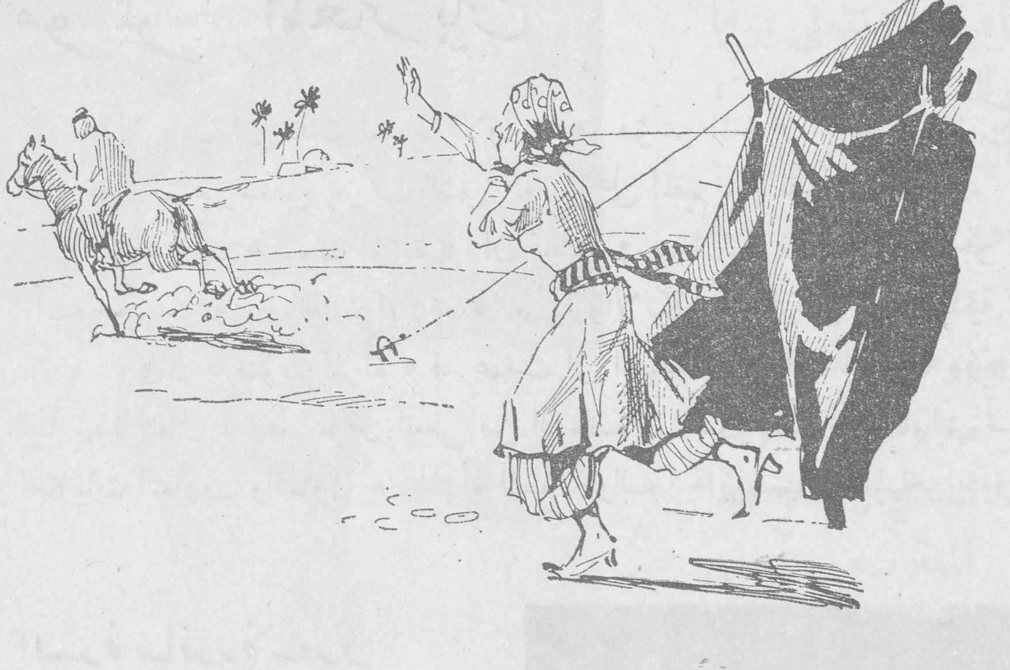
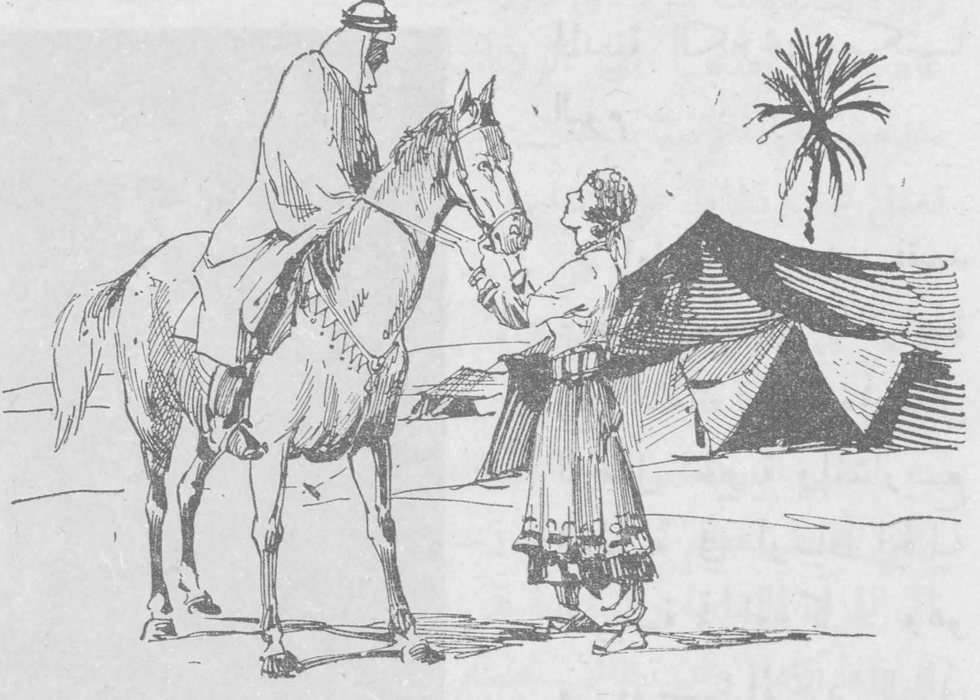
appeared to her, from the side of the bend, a surge of light whose brilliance dazzles, and a lord — as though her beloved were looking out from his eye, gazing. He shouted at her: Enough from you — turn back! I am none other than Hubal the Greatest. This is harlotry's punishment: let whoever sins take warning, should he taste the taste of love.
*
Anahid loosed her hair before him and flung herself down, weeping and begging forgiveness, asking the god, in abasement, that her tomorrow might be made pure of her yesterday.
She is his jinniyya — as he calls her — the name being an Arabization of the word "muse" in his 'Amiri lexicon. He says — in one of his poems — that she gathers the stars for him and tucks them under his pillow.
God sends to every budding poet a jinniyya who soars with him in the hour he rises toward the heaven of art, to gather for him the moons and the planets.
*
It remains for us to dispute with al-Jahiz his claim that Anahid "was transformed into a star" as punishment; the poet has anticipated us, placing in the mouth of Hubal this verse:
Your love, O woman, such as you have willed it — the breast of the heavens is worthier of it!
Had the god of mythology truly been angry, Anahid would today be a viper or an owl — not a star blazing in the breast of the heavens!
Nor, for that matter, were the Greeks alone in possessing the legend of Venus, or the Arabs the legend of Anahid: the goddess of love among the Armenians is named "Anahid," and perhaps they took her from the Arabs. The legend may be, for all peoples, the story of every "Magdalene" — that is, the story of the spirit on the day it triumphs over matter, and of the life of good on the day it conquers evil. Were there not in the Magdalene's body seven demons taking their orders from carnal love? Was she not degraded, despised, and stoned beneath the eyes of the lovers of her ideal body? Then the spirituality of the Nazarene swept through her animal life, and she rose soaring as none of his followers ever soared: she defied the temporal and the religious authorities, accompanied him even to Golgotha, stood — her heartstrings tearing — before the spectacle of that great martyrdom until he gave up the spirit, and became, after Saint Paul, the greatest apostle of the delights of the spirit.
In the Christian world there is a religious order called "the Order of the Good Shepherd," among whose most glorious works is the gathering up of penitent women and their restoration to the world of dignity, in obedience to Jesus on the day he forgave the sinning woman and said, "Go free, and sin no more." These penitents are known as the Magdalenes.
Is not every "Magdalene" an "Anahid"?
Love becomes everlasting upon her eyelid, and what is abominable is folded away in her heart. Then Hubal inclined toward her, saying — while gentleness dripped from his brow — "Your love, O woman, such as you have willed it: the heart of the heavens is worthier of it." And a fire flared out, and with it there twisted across the breadth of the deserts a howling gale, and it plunged into the breast of the heights, bearing the soul of Anahid as a kindled blaze, and there shone in the sky, before the forenoon, over all creatures, a luminous star! That is Anahid: from on high she keeps an eye that watches over the people of love.
*
And now, my reader: this is a fertile poetic genius and a delightful literature — a poetic genius open upon lofty horizons, weaving, upon the poet's skill, a legend unique of its kind, with music in it, and coloring, and melody; a literature that struts in freshness and youth; and a philosophy of far-reaching aims.
And this Chafic Maalouf, son of Lebanon and dweller in the city of Saint Paul, is dean of a band of letters, all of whom are:
Bright of face, noble their lineage, proud of nose, of the first mold.
One word remains, which I whisper into the ears of the young ladies who will be charmed by "Anahid" and by her composer... it is that Chafic Maalouf has a partner in life... who has smoothed for him a life of ease and created around him an atmosphere in which it is sweet to give oneself over to letters and to soar in the heaven of art.