her two legs like the legs of a duck, and her narrow waist, and you will discover that she must stand on the tips of her toes to obtain a kiss from the beloved..."
The poet Ovid has passages of surpassing beauty in the description of hair and its magic. Most of the poets of Rome treated this theme and dwelt with artistry on the beauty of hair.
The Roman women took great care of the health and cleanliness of their bodies. The playwright Plautus relates that every Roman family had a special servant whose sole task was to massage the body of the mistress of the house after the bath. In the early days of the Empire these masseurs used ordinary olive oil; but as civilization began to invade the country, they took to mixing the oil with various sorts of perfumes. Petronius likewise relates that vessels of perfume were offered to the guests after the meal for them to wash with, as hands are washed today with water and soap.
Cleanliness led on to the use of powders. Perhaps there has never existed in the history of peoples anyone with such taste in the use of perfumes and powders as the Romans had in the period extending from the reign of Nero to Marcus Aurelius. The ascetics of that age rose up in fury against that worship of the body, as they rise up in every generation — and in vain, as in every generation too.
Juvenal describes one of the operations of beautification: "She changes her face every month: she soaks it and paints it, covers it with grease, and consecrates that night to her husband. He sips from her kisses that are all fat, and the sticky substances all but come away in his mouth. But on the nights of the lover she comes out of the bath gleaming and radiant, breathing the scents of the precious oils imported
from the lands of the Arabs and distant India."
Pliny says that the Roman woman spent enormous sums to bring perfumes and powders from far countries. Poppaea, Nero's mistress, was an expert in these matters: to her is attributed the invention of a preparation of rice for removing the hardenings of the face, and a preparation of dough mixed with asses' milk for coating the face at night. Petronius mentions that the Roman women used artificial eyebrows, which they would wear at one time and remove at another, putting them away in boxes made especially for them.
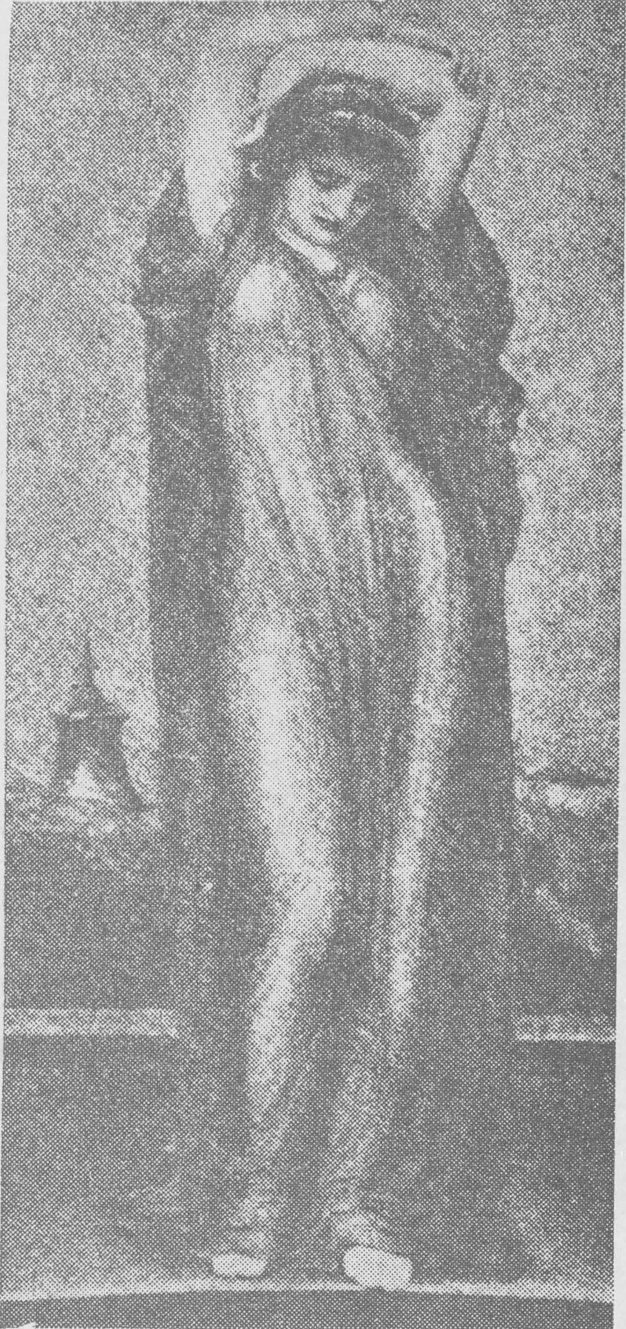
The Roman women cared for dress as well. At first they wore the long robes that wrapped their bodies round and round; but as refinement and luxury increased, they came to wear transparent robes — or airy robes, as one writer calls them. In the wearing of them there was much boldness — a boldness that appalled the thinkers and the ascetics; and the philosopher Seneca wrote, describing a woman wearing one: "She wore a silken robe — if I may call a robe that which neither hides her body nor protects her modesty, and of which she cannot say, while wearing it, that she is not naked. She buys it at an enormous price and imports it from remote places — and why? To display before the whole world what she displays to her lover in her chamber..."
These robes, on which was bestowed the name of woven air, were sold for their weight in gold. Pliny relates that he saw one of the aristocratic ladies wearing a robe studded from top to bottom with jewels and rubies, and that it cost the equivalent of 25 million lira in Lebanese currency — and that that lady always carried the receipt in her purse, lest anyone doubt the price she had paid for that robe.
I close this rapid survey with a picture of the beautiful Roman woman as Petronius described her. He said: "More perfect than any statue in the universe — woman... There are no words that can express her beauty, and whatever I say, I shall not do her justice. Her naturally curling hair flows down over her shoulders. Her forehead is short. Her eyebrows run down to the line of her cheeks and almost meet at the corners of her eyes. Her eyes shine brighter than the stars in a sky the moon has left. Her nose is delicately aquiline. Her lips are like the lips of Diana in the statue of Praxiteles. As for her chin... and as for her neck... and as for her hands... and as for her feet, clasped by the elegant golden sandal... she makes the splendid marble statues look pale beside her."