collar be like a shirt collar and that the waist and skirt be finely, softly pleated. And if it is for the evening, its first condition is that it bare the shoulders, dispensing with the bretelles; it may be completed by a bodice of black velvet and then a billowing skirt of white tulle.
And there are frocks that have begun to step toward the coming autumn. They are most often of two pieces of colored wool, the loveliest being pink striped with green and white.
For excursions and the weekend there are light, graceful frocks which change, wholly or in part, with the change of time, place, and climate, and are worn all at once — in the automobile, on the shore, and in the mountains — needing no passport from one place to another; they are like a problem in arithmetic, in which the pieces of the frock are added together or subtracted as the lady wishes and wherever she wishes. My example of this is the fresco suit, whose jacket one removes to find beneath it a fine buttoned blouse. Or the suit of checked colors, which dispenses with the cape. Or the suit that replaces its jacket with a slit scarf thrown straight over the blouse at noon and at the tea hours.
With Jacques Heim, cotton fabrics pass from the kitchen to the casino, and behold, they roam the city and countryside alike, then take first place on the beach. Their colors and the fineness of their weave have contributed to their swift vogue. Another reason for their vogue is that Heim, besides the beauties he bestows upon his frocks, gives them, each season, lovely names by which they are
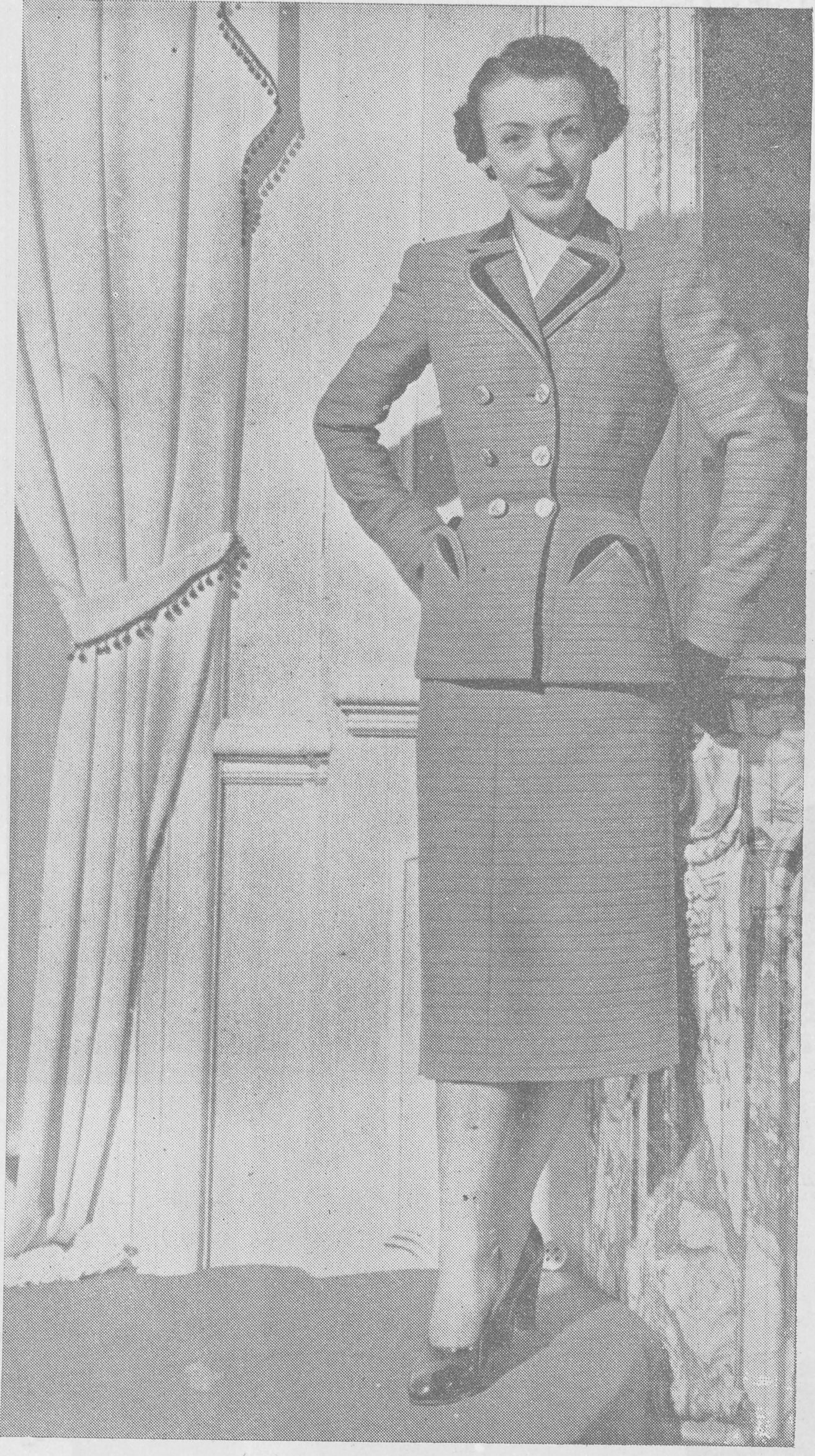
A striped gray wool suit. Turnbacks and pockets edged in gray velvet... made by: (Raphael)