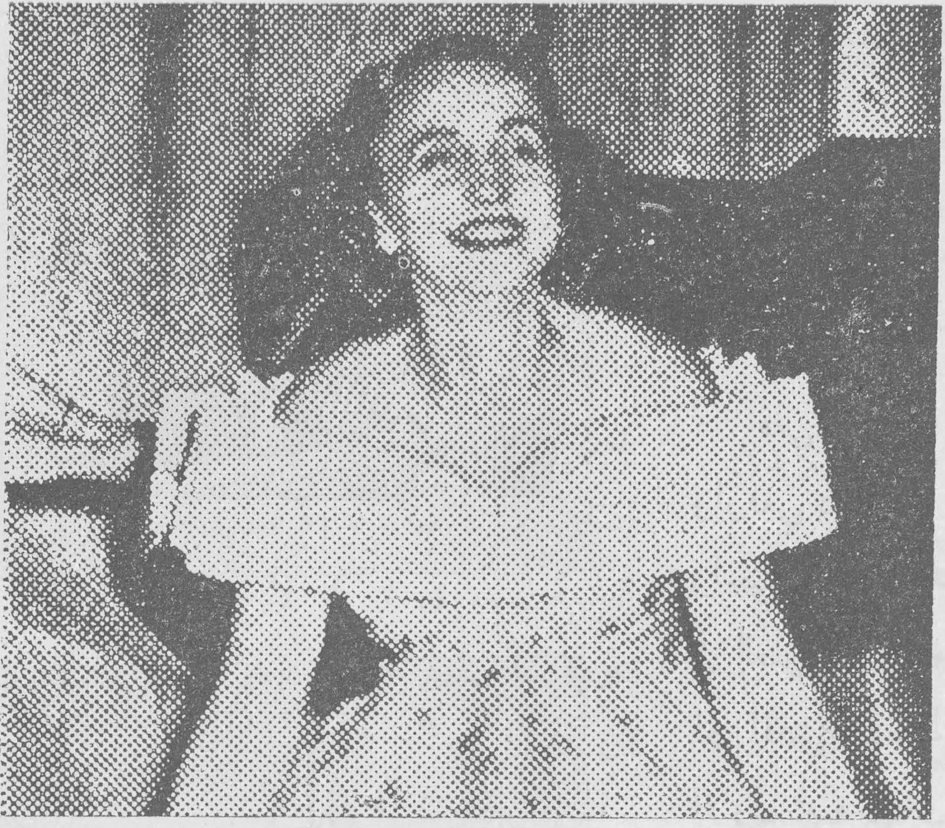
In this article the singer Margaret Truman, whose income for this year comes to about 75 thousand dollars, replies to the many who direct criticism at her for having taken singing as her profession, and to those who hold that she has exploited her father's name and position to reach a standing she would not have reached without them; and she recounts the history of her passion for music and singing, and how her inclination toward them grew until she took singing as her life's profession.
On the 27th of last November I went with my parents to Constitution Hall, as we had been accustomed to do every Sunday for 15 years. But that Sunday's concert was unlike the others: my parents sat in their box, and I stood at the other end of the hall — stood singing. That was my twenty-fifth concert, and the first public concert at which my parents listened to me.
Before me sat 3,800 people — among them a number of prominent men of government, members of the diplomatic corps, lovers of music, and also those who had come out of curiosity, full of doubt about my gift for singing. My one concern as I sang was to convince the audience that I had not been working to exploit my father's name and position to bring me to the place I had striven to attain since my girlhood.
Some believe that the desire to become a singer came to me
suddenly after my father became President of the United States, and that I began trying to exploit the name of the White House. The fact is that singing is the one goal I have ever aspired to reach, and my father and I used to discuss it long before that house became our residence.
I began taking singing lessons when I was sixteen years old. I registered under the name Margaret Wallace (my mother's family name) so as to make sure I would be judged by my talent and not by other considerations, and my teacher remained ignorant of my identity.
As for my passion for music in general, it goes back to 1932, when I had not yet turned eight. On my birthday that year my father gave me a piano, and he was the first of my teachers on it. My father is in fact a skilled player; I fancy there is no amateur in Washington to match him. What helped me fall in love with music is that I was born and grew up in a house most of whose members, on my father's side and my mother's, were inclined to music, so that it became, as it were, a part of me.
There is no doubt that music has had a great influence on my life. Almost all that I remember of the days of my girlhood are incidents connected with the music lessons I took from my teachers in Missouri, where my father worked. When he was elected a member of the
Senate we moved — reluctantly, on my part — to Washington. I hated that city intensely, and my hatred was increased by my loathing for the school I entered, where I could not win the friendship of my schoolmates until they discovered my gift for singing, whereupon I became one of the notable pupils.
In 1940 I set about studying singing, and I went on taking a lesson every week until 1947. Before long I discovered that my real gift was not playing the piano, as I had believed before, but singing. When I graduated from my college in 1942, my parents and I held a conference at which I explained to them my inclination to make singing my profession. My parents agreed, on condition that I take the university degree first. But by the time I obtained that degree in 1946, the general circumstances had changed: our family had become national public property, and I had become the daughter of the President of the Republic, not merely of a member of the Senate.
I do not deny any of the privileges I enjoy through being the daughter of the country's President. But anxiety began to take hold of me when I fell to thinking that politics would play its part if I made singing my profession. My father's opponents would make it a means of striking at him; the critics, in reviewing my art, would