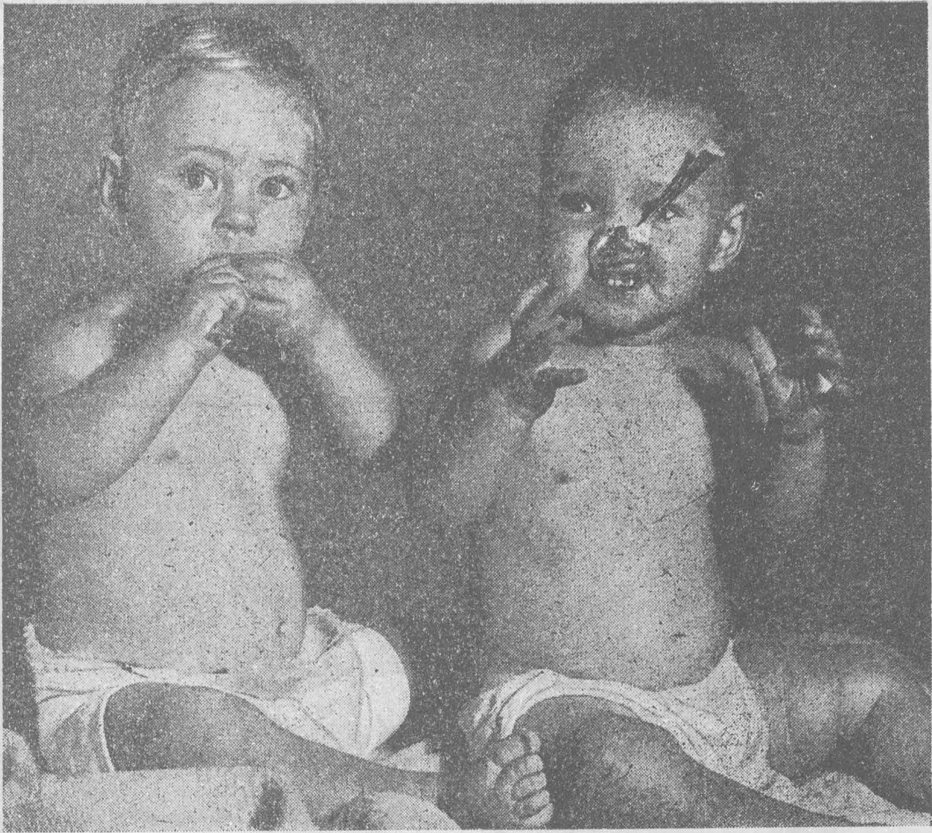

"...Raising twins is harder than raising a single child — no argument about that. But there is more pleasure in it than in raising one, too..." "...And if one day, dear reader, you become the mother of twins, you will wish you were two; but you will never wish that one of them had not been born..."
When the doctor showed me the X-ray picture he had taken of me, I could hardly believe my eyes. There are no twins in my husband's family, nor in mine. Yet the picture showed, with a clarity beyond all clarity, two heads and two spines within me. My two daughters were born two months after that, and a few days ago they completed their second year. And I believe that my experience with them holds benefit and delight for new mothers.
When I learned I was to bear twins, I hastened to gather all the information I could about twins. I learned that the birth of twins is to a large extent hereditary, though their absence from the family is no bar to their coming. I learned that in every 80 births twins come once; that 70 percent of twin births come early, before term; that at birth twins are smaller than if there had been but one; that one of them is born a few minutes before the other; that their delivery is easier on the mother than the delivery of one; and that the rate of deaths among twins is higher than in ordinary cases.
My husband and I sat down to talk over the matter of the two coming guests. After long thought we decided to adopt the following as our foundations in raising them:
Our two babies must enjoy all the possibilities and advantages a single child enjoys — care, attention, and love; each of the twins must be granted the same care granted the other, with not the slightest difference in the way we look at either; we must regard each of them as a person in her own right, thus barring the seeds of jealousy and the feeling of belittlement from creeping into their souls; we must not encourage one of them to depend on the other; and we must raise them to acknowledge the fact that they are twins, and make them understand the problems that may truly arise from it, so that they will look upon these with understanding.
To guarantee each of them the care and attention she needed, I set about cutting down, as far as I could, my other household duties and my outside activities. To that end I was compelled to reduce expenses in other quarters of the house, and to deny myself some things I had wanted to buy. Often I hesitated to take them along to the market when shopping, knowing that I could go to the market and return in the very time it took to get them ready to go with me. But then I would remember the first
rule my husband and I had settled on, and remember that had they been one child I would have taken him along on my rounds; so I would get them ready and take them with me.
The second rule calls for constant attention. So during their infancy my husband and I made a practice of exchanging them when we fed them, lest a preference for one over the other should grow in either of us. Indeed, even now we take care to exchange them when we dress them, and to change their places from time to time at the dining table, in the car, and elsewhere.
I was always careful not to give one of them more care than the other. Often I attended to them together, even in matters where care usually goes toward one alone: when I bathed one, I would bring the other along and talk with her. I always noticed that the first and I enjoyed the bath more when the second was watching us and chatting with us. That is far better than leaving her alone in a neighboring room.
Applying the third rule was no difficult matter. But I believe attention to it will be more important in the future, when my daughters grow up. If I find that one of them would like to wear a red dress, I must let her do so, and not make her put on a blue dress