and subduer of the gods, hear my petition. Long did I deny you and the graces you bestow; long did I strive to belittle you, and so I counterfeited the secret you enfold within your creatures. Yet the more my endeavor succeeded, the more I felt something within me draw back, and felt your hand closing upon my neck. Long did I mock you; but here I am, returning to the fold... So have pity on me, O fairest of the fair, O daughter of the waves, O you who strew the earth beneath the tread of your feet with lilies and jasmine...
Have pity on me, this once, and grant my petition...
He drew still nearer the statue, and continued his supplication in a wounded voice: You know this woman whom we joined together to make. I did my part, and brought her forth as best I could, in a form I had never dreamed of; but you withheld the completion of your aid, and denied her the most important thing in her, and the thing I most ardently longed to breathe into her: that she be a woman who lives and loves... She is beautiful as a dream; yet when I touch her, instead of the warmth coursing through her body I feel a bitter, grievous frost.
Breathe into her, then, of your flame... Bid her rosy lips move, and her golden hair ripple... Send the soul into her, and turn her into a woman...
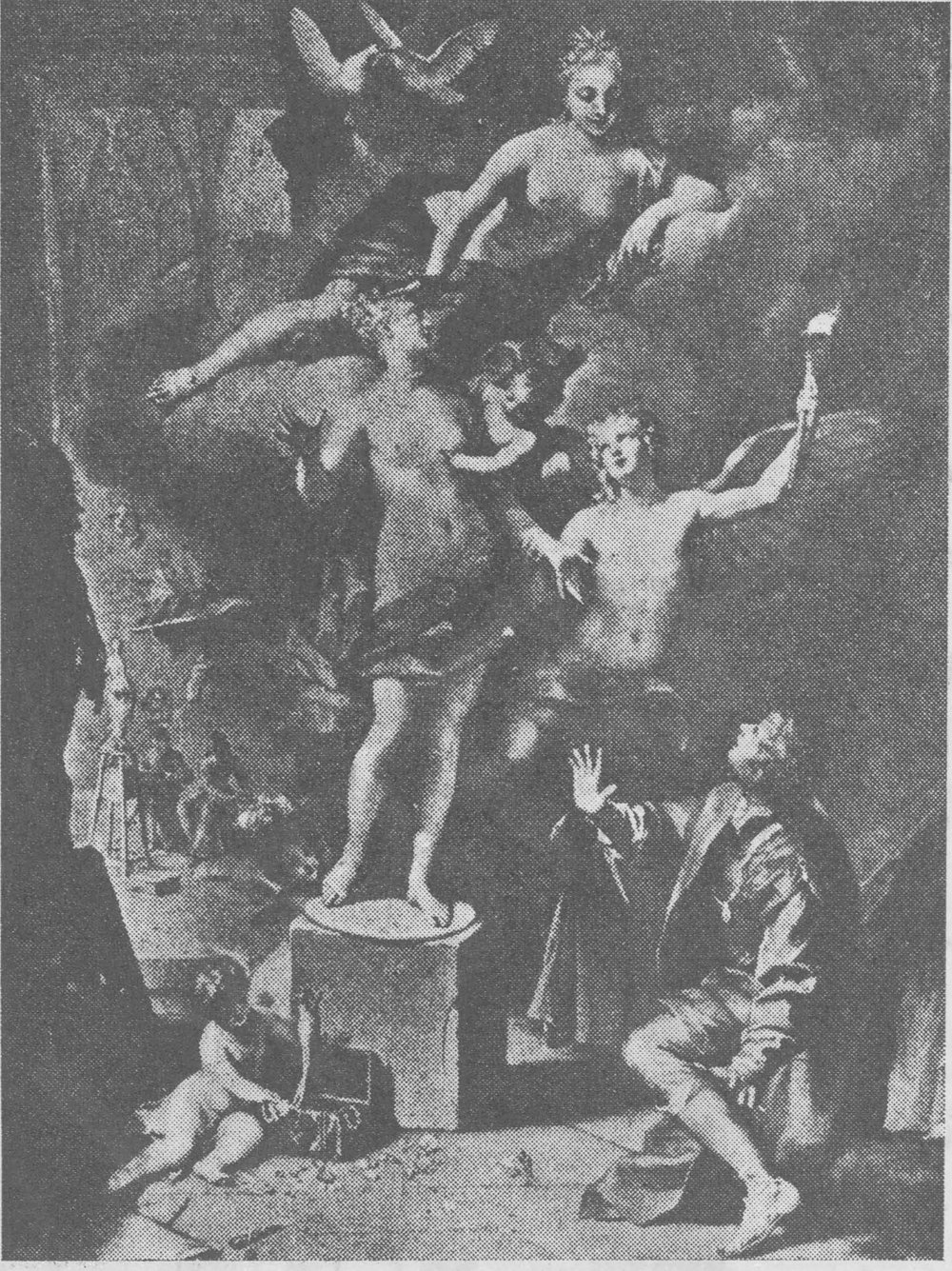
So he spoke; and he poured the incense upon the altar, and washed the feet of the statue with perfumes. And Aphrodite smiled from her heights, for she had won her victory. She drew up the incense and perfumes he had poured out into three ascending columns; Pygmalion understood them to be the sign of favor, and prostrated himself anew, praying and giving thanks.
And Aphrodite hastened, like a drowsy breeze, to the cold statue in Pygmalion's room. She touched it with her fingers of light, and said:
— O beautiful creature, whom your maker fashioned after my own likeness, yet wished not to remain as you are, preferring a living beauty that withers to a rigid beauty that never fades: let your artistic beauty be changed into living beauty... Let the golden locks of your hair turn to a gold that with the days will turn to gray... Let your silent lips forsake their everlasting beauty for a beauty that lives out its span and then passes... Let your hard arms grow soft, and let the blood run in them before they grow cold once more,
and forever... And let your heart — the woman's heart within you — wake from the slumber of peace in which it lies, to the struggle of life, to love and gladness, and to pain...
And when Pygmalion entered his room, a sweet hope amid the tremors of anxiety within him, he looked at his statue and found a smile upon its lips. But he stood without moving, wiping his brow as though to wipe away the tangled visions of a dream.
— Pygmalion!
He turned to see the source of the sweet voice that had broken loose in the bitter stillness of the room, but he saw no human being. And the voice came again:
— Pygmalion... It is I... Will you not come near
me, O partner of my new life?
It was the statue... his statue speaking... the work of his hands conversing with him... Aphrodite had listened to his prayer, and the miracle had come to pass, and the statue had become a woman! He threw himself upon the statue, touching it, hardly believing, passing his hand over the body, here and there — and behold, he felt the warmth gathered within its limbs; and behold, he believed, and cried out:
— Galatea, my wife!
...And Aphrodite blessed their marriage.
"... And let your heart — the woman's heart within you — wake from the slumber of peace in which it lies, to the struggle of life, to love and gladness, and to pain..."