This is the third installment in the series 'The Beautiful Woman through the Ages'; we shall follow it in the coming issue with the fourth installment, on the beauties of the eighteenth century.
Thanks be to the men of letters and the historians: they have left us, between the covers of their books, and in their poems and their confessions, a great deal about the fair women of France and England in the seventeenth century. So that when we come to speak of the beautiful woman of that age, we do not confine our talk to one woman and no other, but recount in it the charms of a number of women who were the pearls upon the necklaces of beauty, and whose fame rose high on men's tongues, and in their thoughts, and their dreams.
Among the beautiful Frenchwomen was Aubré de La Vallière, whose
slenderness of figure reached a point that amazed the men of the court, who tried in vain to understand the secret of the King's attachment to her. We read one critic commenting on her beauty by saying that she had no bosom! She limped slightly in her walk, and had two black eyes, and appeared at her best when she wore the coat she used for riding, since it hid her chest, while the neckcloth made it look fuller.
There was also Madame de Montespan, whom Madame de Sévigné, that connoisseur of beauty, described as blonde, golden-haired, suggestive of
majesty and strength. She wrote of her: "Here is haughty beauty, opulent beauty. Here is an abundance of fair hair, and a blueness of eye that seems to hold fire; here are marvelous features, and a white, gleaming skin. She is a woman filled with desire, not with love; with splendor, not with poetry. And I believe her back is much too flat; but her beauty is astonishing beyond dispute... She dresses, from the crown of her head to the soles of her feet, in the French fashion. Her hair is full of a thousand curls, and over her brow two locks glide down to the bottom of her cheeks. On her hair are black ribbons, on her head precious pearls, and she wears no hat. All in all, she is a triumphant beauty."
As for Marie de Chuzir, "she had a face oval in shape, a complexion whose whiteness dazzled the eyes, two large blue eyes skilled in expressing what they concealed, and a wealth of thick dark hair; and very few of the women with whom the court of France was blessed were more beautiful than she. Her beauty was heightened by her gaiety and mirth and by an extraordinary vivacity, which lent her personality an irresistible charm."
So much for France. In England, the court and society were adorned with a number of the century's beauties, at their head Elizabeth Hamilton. "Her figure was among the most splendid figures women ever had; she had a neck and arms than which God never created anything more beautiful or more radiant. All her movements were dignified and graceful, and the young women of society took her as a model to imitate in conduct and in dress. Her complexion had a color that the various powders found it hard to counterfeit. Her eyes were not large, but they were full of life, and capable of expressing whatever passed through her mind. Her mouth was sweet, and the lines
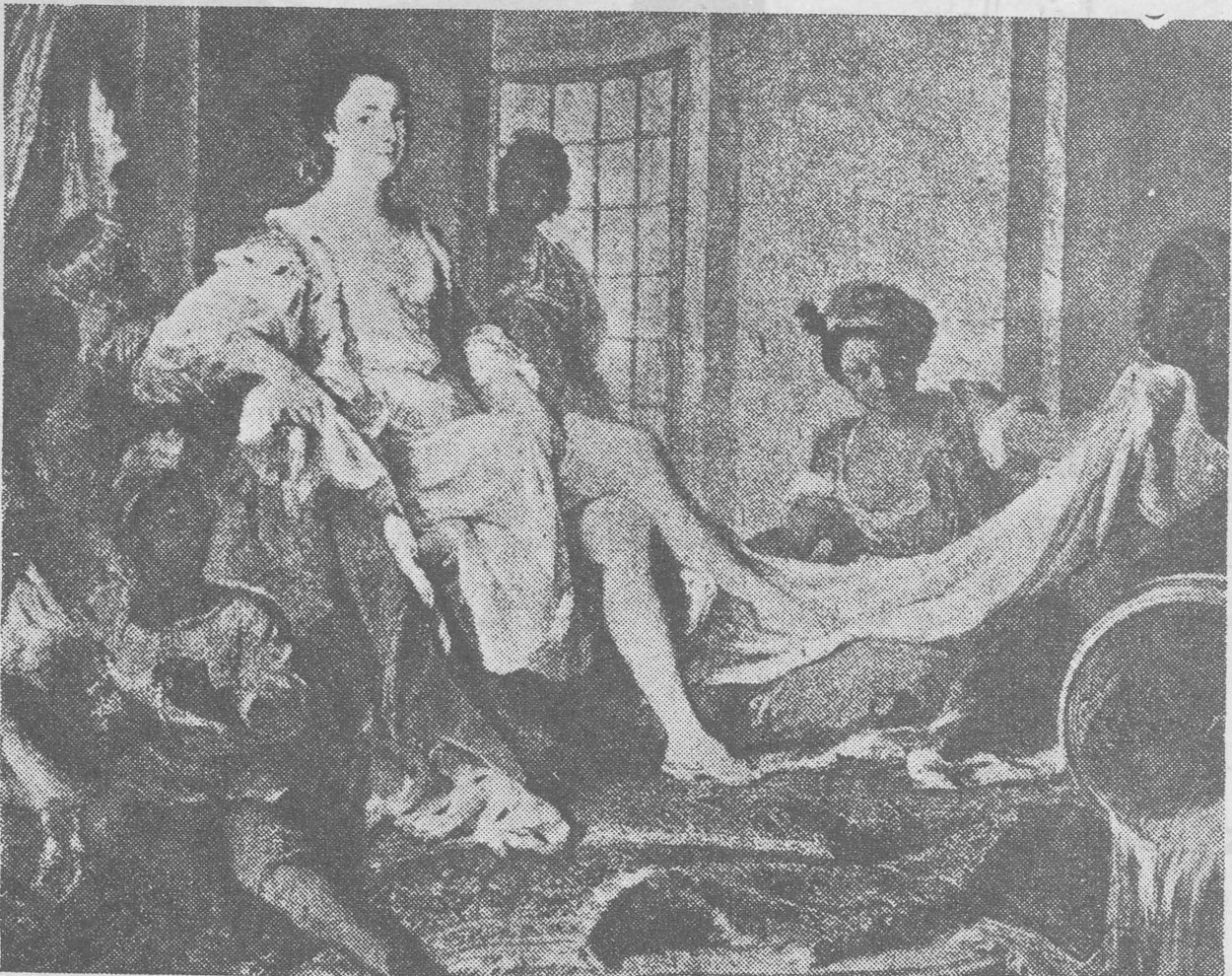
"The Bath," a painting by the artist Maltbie.
The use of baths and perfumes spread in England in the seventeenth century.