of her body attained a perfection that no other body attained... And possessing
such qualities, she was able to win love wherever she turned."
And there was Nell Gwyn, the famous comic actress of her age. Her face was long, sweet, sad. She had a fine figure, despite her shortness, and was pleasant company, without show or affectation. The great poet Dryden was among her admirers.
And there was Miss Menifer, who "was adorned with all the glittering treasures of youth." One critic left a description of her in which he dwelt on the beauty of her mouth, "which was not the smallest in the world, yet it was the sweetest of mouths... And if her arms lacked graceful length, and if her nose fell short of matching the splendor of the other parts of her body, her mouth made up for it all, piercing the heart with a thousand arrows."
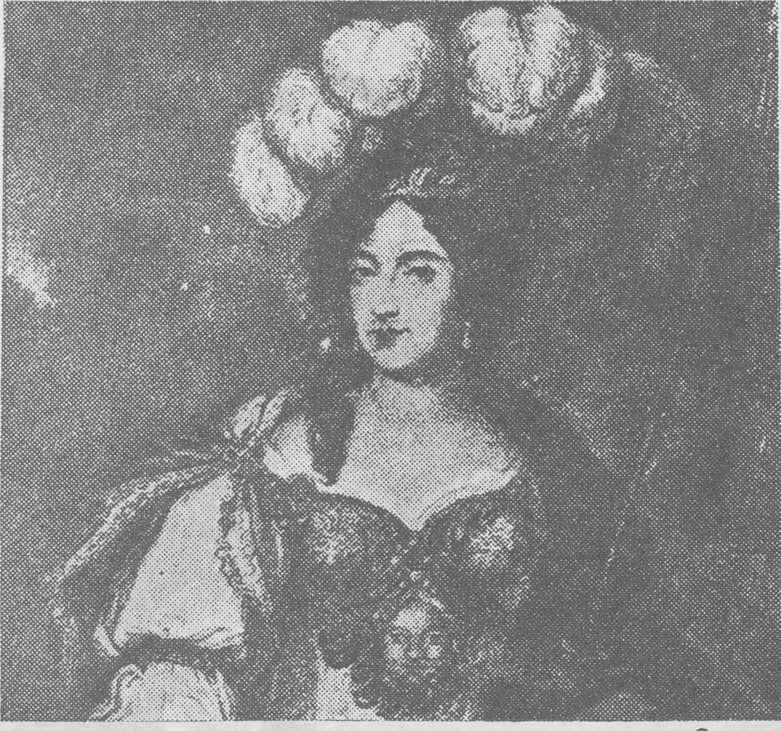
The historians of beauty agree, or nearly agree, that Frances Stuart was the summit of English beauty in the century we are considering; and that it was in consequence of this that she was chosen as the model from which was taken the figure of "Britannia," struck for the first time upon the copper coins of England. Among the factors that increased her fame and spread the renown of her beauty may have been her refusal of the King's love and her withholding of herself from him, which caused him much pain and trouble.
Samuel Pepys, author of the diary famous in the history of English literature, described her thus: "Methinks she is the most beautiful woman I ever saw in my life. She is far more beautiful than I had imagined..."
Another writer says: "It would have been impossible for any woman to have more beauty, or less wit..." And in truth she was somewhat feather-brained: her greatest delight was to sit on the floor and play with stones, building houses out of them. But this did not lessen King Charles's love for her or his attachment to her; he used to say that what interested him in a woman was neither her mind nor her soul!
The writers of the age have left us a few anecdotes about this sweet, strange belle. It appears she was narcissistic in her inclinations, loving her own beauty without being conscious of the power it held over men.
Gramont relates that one day certain Russian ambassadors arrived at the English court on an official mission. "The conversation turned to the appearance and looks of the Russians. And I know
Frances Stuart, a painting by the artist Lely.
The summit of English beauty in the seventeenth century:
"God never created a woman more beautiful,
or of less wit..."
not where the buffoon Crofts had heard that the people of Muscovy had beautiful wives, and that the Russian woman had beautiful legs. No sooner had the King heard this than he affirmed that there was no woman in existence whose leg attained the beauty of Frances Stuart's. And she, wishing to prove to the company the truth of His Majesty's word, in one swift flash had lifted her gown from her leg to a considerable height, and displayed its beauty to those present. They were taken with the sight, and some of them were on the point of casting themselves at her feet, the better to enjoy her beauty. The Duke James, however, set about criticizing her legs, claiming that they were too thin, that he personally preferred short, plump legs, and that he could not relish the beauty of legs unless they wore stockings of green..."
And Gramont says in another place that Frances Stuart "was fully conscious of the extent of her beauty and of her superiority in it over all other women; and it was therefore impossible for the name of any woman at court to be mentioned, and her arms or her legs praised, without her flaring up and setting about challenging the company that her own arms, or her own legs, were the more beautiful — joining to the word tangible, practical proof... And I believe it would not be difficult at all, if one used a little tact, to make her strip entirely naked in full view of the company, without her perceiving that she was doing anything shocking or unseemly."