And there is an opinion offered by a literary civil servant. He said: When we strike from the list of candidates every idler who fell short in all the secondary classes and reached the baccalaureate class thanks to the indulgence of a school that cares for nothing in the student's affairs except collecting the annual fee — when none remain among the candidates but the competent, then the question becomes a question of luck... How many a pupil of nervous temperament sits down in the examination chair and in a moment forgets everything he has learned. How many a student has been promised a post, or a teacher's position, upon obtaining the baccalaureate, and entered the examination hall frightened and trembling? I shall tell you my own story. I obtained the baccalaureate in 1945, and I nearly failed from joy, not from fear. The night before the examination I opened the natural-science book and studied and studied — by pure chance — and studied thoroughly, three chapters that I believed I had not fully mastered.
I did not sleep until I had learned them by heart. The next day I entered the examination hall. And oh, my joy when the proctor wrote on the board three questions from the chapters mentioned above! Then I woke from my stupor to find that I could not recall a single word of all that had been in my head. My clothes were soaked with cold sweat, I felt the hall spinning around me, and I sat before my papers convinced that I would hand them back blank. But it happened, in the final minutes, that I remembered something, and I wrote out one question — and in it lay salvation.
— It seems to me you are pointing toward abolishing the official examinations and relying on the schools to grant certificates to the competent??
— Something like that... provided that the universities institute, at the beginning of every school year, what we call entrance examinations — examen d'admission — for the branches of engineering, law, higher letters, medicine, and dentistry. And provided that the training colleges for men and women teachers take a similar step.
"The Woman's Voice": This is a thorny, grave opinion, but a sound and practical one; the specialists may approve it and they may reject it. In any case, this reportage is nothing but an exhibition of opinions.
And "The Woman's Voice" completes its rounds, reaching Mrs. Zaheya Ayoub — deputy director of Arabic studies at the Secular Girls' College and teacher of the baccalaureate class — and Mr. Rushdi Ma'alouf, a "chronic" member of the examination committees and teacher of Arabic literature at the American College for Girls.
And here is what Mrs. Ayoub says:
A — I have heard many people reproaching the schools and the country over the results of the examinations. As for us, thank God, we have nothing to complain of; the June results were an honor to us in both colleges. The Girls' College presented seven pupils, of whom six passed, five of them passing with distinction and winning the congratulations of the examining committee, Mention. As for the seventh, she passed in the October session, so that our final result for this year is one hundred percent.
Q — Would you tell us the causes of the failure and of this deterioration in school circles?
A — That is a door hard to enter. It calls for a skilled sociologist, good at diagnosing the diseases afflicting our society, which produce for us a flabby generation that does not appreciate responsibilities.
Q — I count this talk a
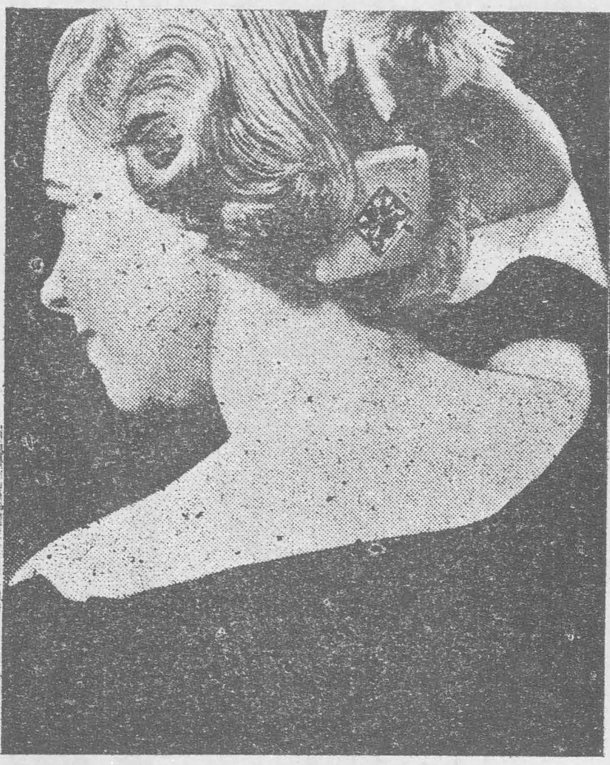
Here is good news for those ladies who complain of weakness in their hearing.
The Orbex company in Chicago has invented the device you see in the picture, to aid hearing. This device weighs two and a half ounces. It surpasses other similar devices in that it is placed in the back part of a woman's hair, where it hangs like a pin, with no wire attached to it to spoil its appearance. It looks like a piece of jewelry.
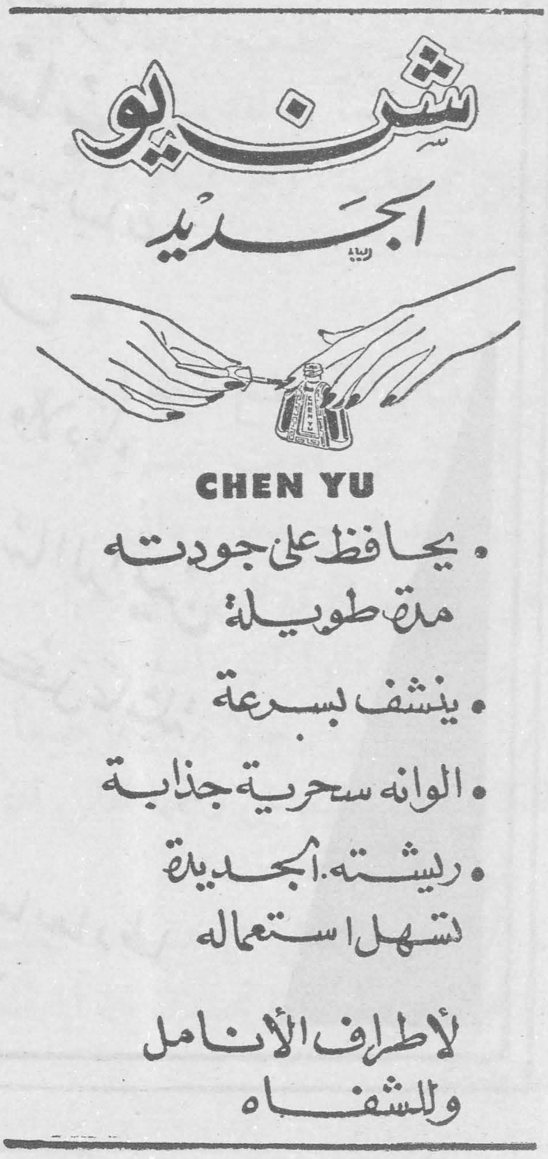
The New Chen Yu — CHEN YU
CHEN YU
• It keeps its quality for a long time
• It dries quickly
• Its colors are magical and alluring
• Its new brush makes it easy to apply
For fingertips and for lips