name "the Golden Line." In those lines there is a proportion and a harmony whose history goes back to the remotest ages of the Greeks. Architects of old made use of them in designing beautiful windows, and Heim makes use of them today in designing the ideal dress. (Here they are in detail, in the drawing that appears beside this article.)
Among the merits of this proportion is that with it the shoulders become natural, the bodice grows longer, the waist dips at the back, the hips appear taut and the skirt straight. Another of its merits is that it gives the lady the slenderness she yearns for.
Naturally, "the golden proportion" cannot meet with success unless the lady has a beautiful, well-proportioned figure.
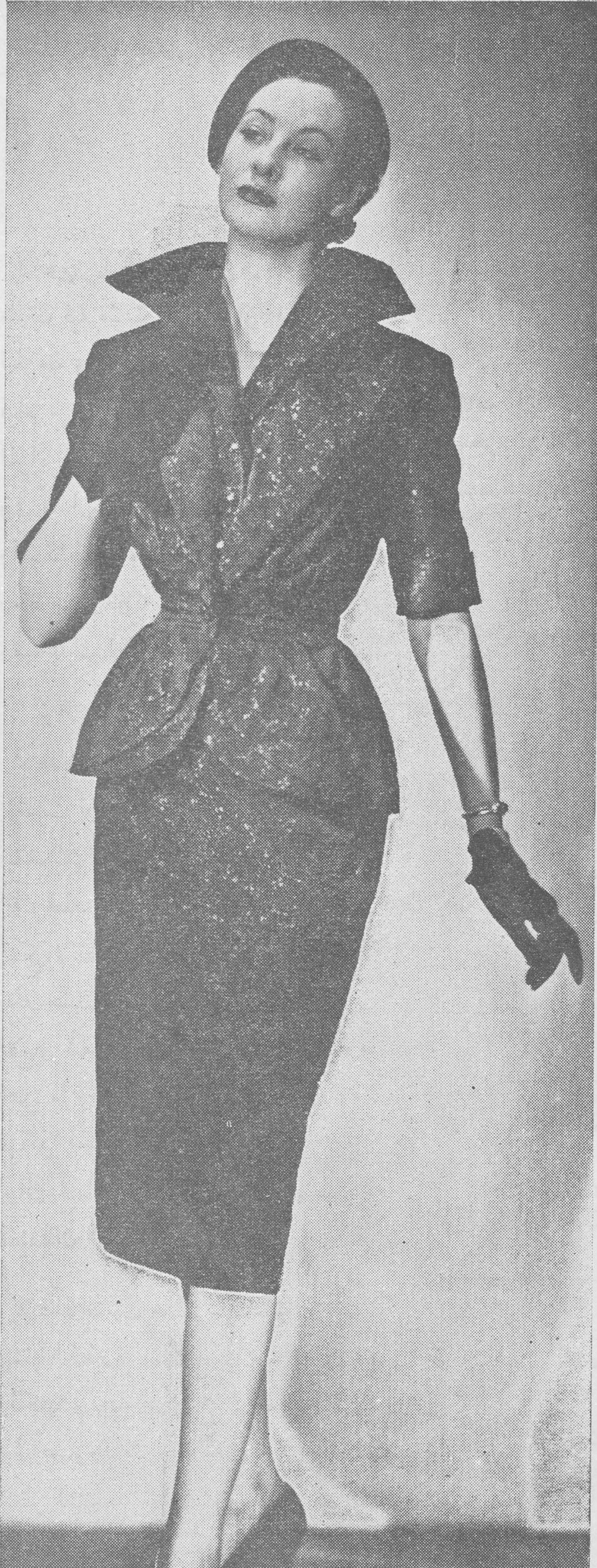
As for the tailored suit, its jacket is straight and long, wrapping itself around the hips. It has high collars, sometimes embroidered, and large lapels that may cover the throat, with trimmings of leather, ottoman, satin, or velvet.
Heim denies coats their fullness: none leaves his hands unless it is straight, adorned with large lapels and fur trimmings. Most of his dresses are supple in the back, low at the waist, taut over the hips; some break into fine pleats in front, gaining thereby in suppleness and charm.
Among the colors in vogue this year are ivory black, blue, green, lilac, and Venetian red. For evening dresses: black, white, and bronze.
There are fashions, colors, and creations I have had no opportunity to describe in this quick glimpse — so, until the next issue.
* They met in a dance hall... He asked her to dance with him... but she declined. He pressed her to know the reason, and she told him: I dance only with a man who has a future! He smiled and said nothing... Then she asked him: — And why do you want to dance with me, of all women?! He said, recovering his smile: Because I like to dance with a woman who has a past!!
A dotted tailored suit in black and chestnut... by Jacques Heim.