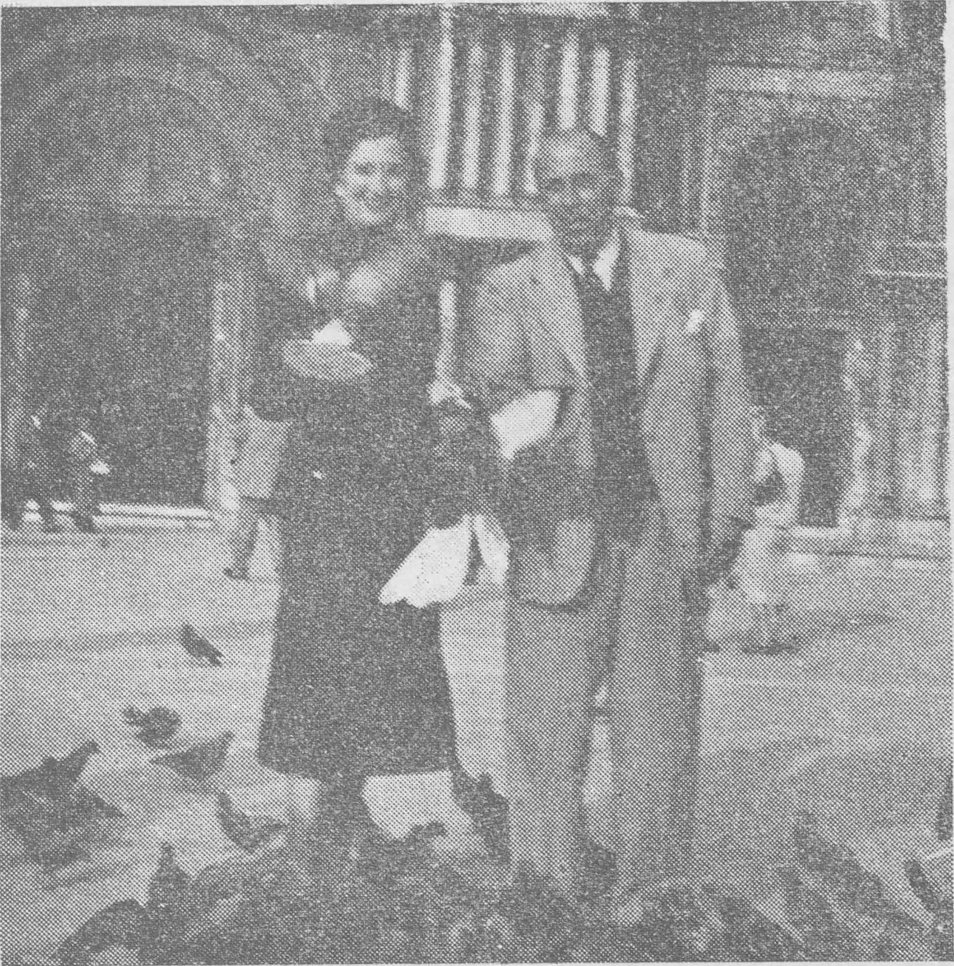
Does the reader not find this piece of news strange in this age of publicity? He is Nayef Pasha Imad, of the village of Ain al-Sindianeh — and he begrudged The Woman's Voice his photograph. He saw the young men of his town donating the work of their hands to build a school, so he gave what God had granted him: all the building materials.
Then he wished to bring light into our hearts — we women — and resolved to lighten the hardship of village life. So he tempted the municipality of Choueir, saying: bring the main lines, and the rest is on me — and the rest means the wires, the meter, the poles, and the switches — to the houses of the village and to the church and the school.
Add to this his unceasing charity to families of quiet need, and his paying the fees of fourteen boys — permanently — at the Choueir high school.
The great square at Dhour el-Choueir bears witness, and the high school in Choueir bears witness, to their love for the mother soil. And very soon the Lebanese will see how Mrs. Afifa Jafet and her children have valued the American University of Beirut's kindness toward the founder of the Lebanese community in Brazil: Mrs. Afifa has donated fifty thousand pounds toward the cost of a library at the said university, in which every student may see how the Lebanese acknowledges a favor, and how he takes his part in the spreading of culture.
The tale is a true one, my readers, men and women alike; and this note, sent by Mr. Youssef Khalil — a son of the Bekaa, born in Khirbet Anafar, and naturalized a Brazilian citizen — this note cut short, for the players in the orchestra of the medal seasons, some delicious dreams... and cheap ones... Said Youssef Khalil: I want no medal, for I have done nothing that deserves reward.
And The Woman's Voice heard him, at the house of the Marquise de Freige in Housh Snaid, confiding to the mother of Lebanon the following "brief" talk: "I am Brazilian by citizenship, but Lebanon is the homeland of my father and my forefathers. It appalls me that my village has no dispensary, no school, and no factory. I wish to take a part in improving health, spreading learning, and finding work for the girls, so that they need not go down to the city; rather let us provide them with handicrafts to help them earn what will better their lives and endear to them the staying in the villages. And here I am beginning a small project which I hope will be like a snowball...
The emigrant Mr. Youssef Khalil and Mrs. Josephine Issa Khalil
I am paying fifty thousand lira for the building of the school and the dispensary and their furnishing; it remains for the government to send the teachers to the school. As for the dispensary, I should like to entrust it to the care of the Lebanese Red Cross. I should like to draw the attention of the Marquise to the fact that I shall add nothing to the sum I have mentioned beyond some of the necessary medicines from time to time — and I should like to carry out the factory project, but here in Lebanon you must follow practical, commercial methods — yes, your handiwork is finely made, but its prices are high and it is hard to find markets for it."
Some days after this talk, Mr. Youssef Khalil laid the cornerstone of the school he had dreamed of founding, near a great oak beneath which he used to play when he was a child, at a ceremony to which were invited the princes of the Catholic Church, the Abillama Emir, the Minister of Education, and a great throng of those who prize his good feeling toward Lebanon, and the feeling of his graceful wife Josephine.
And before leaving the soil of Lebanon, this dutiful Lebanese laid a foundation for a factory project, and a second foundation for financing the village with loans to be spent on the planting of fruit orchards, relying for the carrying out of all this on the energy and devotion of that excellent friend of youth, Mr. Jean Skaff.
And now... here are the pebbles following one upon another, and schools and dispensaries and little workshops rise in our little mountain — and the jar stands firm — upon props of health, knowledge, and work. God bless you, O emigrants.