with us. We feel it in everything around us. We breathe it in as we breathe the air."
The movement of the streets goes on until a late hour of the night; the crowding is intense, people walk at a run along the wide sidewalks, and the din rises although the automobiles drive without honking. Yet with all this you feel that order surrounds you at every step; without it, traffic would be paralyzed and business would come to a standstill in this mighty city.
Underground, traffic goes by the Métro, or underground railway, which pierces the heart of the whole capital; above ground, by the autobus, which parallels the Métro along its lines, though its fares are higher. Each of its splendid cars takes on a fixed number of passengers; when the number is complete, the entrance is closed with a barrier and people stand waiting for the next car, each holding a number that shows his turn to board. The Métro, however, admits an unlimited number, and the passengers are packed into it like sardines.
Besides the Métro and the autobus there are the taxis, the carriages, and the buses belonging to the companies and the great business houses.
The names of the streets are perfectly clear, as are the numbers of houses and buildings — the even on one side and the odd on the side opposite. The sellers of newspapers, magazines, books, and other wares occupy stalls of their own on the wide sidewalks of every one of the great streets, so that you rarely find itinerant peddlers troubling people with their cries or blocking traffic with their carts. Advertisements have special columns and boards of their own, and are not permitted to disfigure the walls of buildings and the like. The letter boxes are set into the hearts of the telegraph poles, and everything is arranged in a way that saves space and preserves for the street its breadth and for the city her beauty. Every building is a great mass standing by itself, surrounded by streets on every side; there are no blind passages without outlets. Rainwater collects in drains that end underground; there are no open spouts pouring
their water on the heads of the passers-by.
In the heart of the city are gathered the most important historic monuments, eloquent of the most splendid events of the history of France: the vastly spacious Place de la Concorde, the Tuileries garden, the buildings of the Louvre, the Place de l'Étoile, the Invalides, the Opéra, the Place de la République, the Place de la Bastille; then the Madeleine, the Panthéon, the Sorbonne. Squares and monuments and buildings enormous in bulk, massive of column, beneath which lies folded a long history of heroism, ambition, revolution, and struggle.
Before these splendors so many in number, these huge statues that look down on you from every side, these wide, far-stretching streets, the solitary visitor come from a small country like Lebanon cannot help feeling awe and utter smallness before this teeming world, in which everything is like the fortress of al-Samaw'al, "impregnable — it turns back the gaze grown dim."
Paris Receives the Tourists
That is a summary description of the outward aspect of Paris. I cannot say that the interior of the houses, the dwellings, and the restaurants keeps pace with their exterior in grandeur, order, and cleanliness. There are many dirty hotels and restaurants, which serve a full meal for two hundred and fifty francs or even less. But the Parisians expect the tourists to put up at the sumptuous hotels prepared for them, and to spend their money without counting.
For Paris is forever ready to receive the tourists. She prepares for them, besides the hotels and restaurants, the night taverns and the artistic pleasure-halls beyond number, to which pleasure-seekers come from every corner of Europe and beyond, and in which, until morning, whirl the most splendid kinds of dancing, singing, frolic, and license — the taverns of Montmartre, the Latin Quarter, and Montparnasse, of worldwide fame, whose names the owners of Beirut taverns, and others everywhere, vie with one another in copying.
She makes ready for them the numerous theaters in which Paris stands alone — for there is no place on earth where the art of acting receives the care it receives there — and the tourist agencies, which prepare for them the finest comfortable motor coaches to carry them on organized excursions in the company of guides and interpreters, to visit historic Paris and modern Paris and the night taverns and the environs of Paris, such as Versailles and Fontainebleau, the châteaux of the Loire, and the cathedral of Chartres.
There are made ready for them, too, the steamboats reserved for tourists and sightseers, which cleave the Seine with them and show them the buildings and monuments along its two banks — boats decked with flowers, air-conditioned, on which food and refreshments are served to the sightseers to the strains of music, so that they delight their eyes, their ears, and their palates all at once.
Guides are provided for them, both persons and books: every museum has its guide, and every exhibition another guide; and likewise the theaters, the Métro, the autobus, the
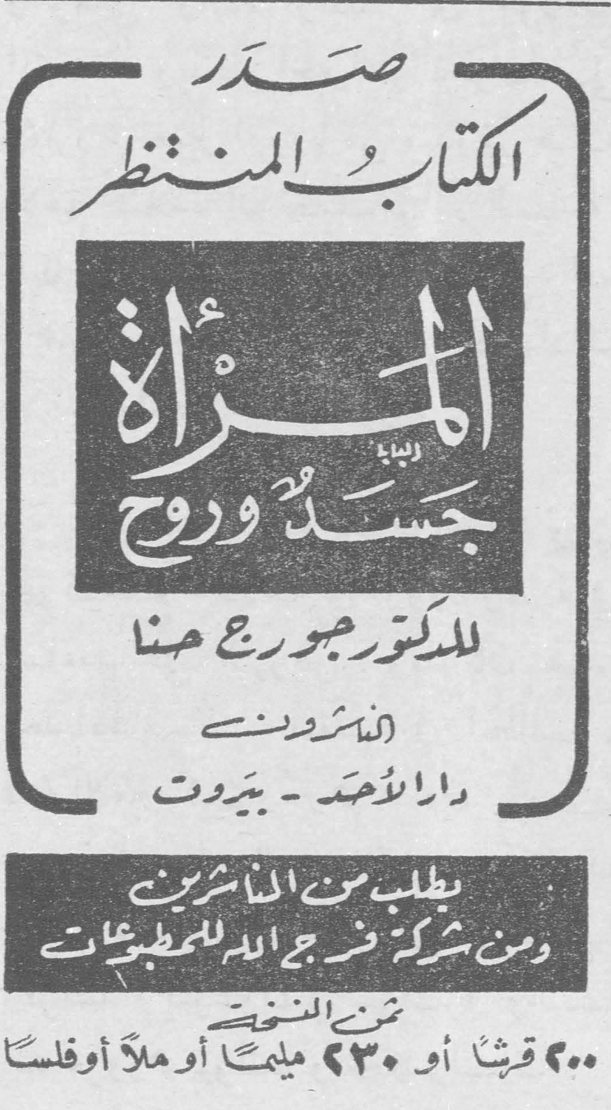
Woman: Body and Soul
The long-awaited book has appeared
Woman:
Body and Soul
by Dr. Georges Hanna
Publishers
Dar al-Ahad — Beirut
To be ordered from the publishers and from the Farajallah Publications Company
Price per copy
200 piasters, or 230 milliemes, or fils