streets, the monuments, and the organized excursions.
And in every museum and in every place there are old women who receive the tourists and take from them the belongings that weigh them down in walking — the raincoat, the parasol, the camera, the umbrella, the cloak — guarding them until the visitor's return, when they hand them back for a fee. Or they keep watch over the chairs in certain gardens and historic places, charging a fee of five francs for each chair — the old women have work to do in the city of the Seine...
Paris is like one great exhibition of art and beauty: wherever you turn, you find a museum or an exhibition or a cathedral or a square or a statue or a historic gate (Saint-Denis, Saint-Martin) or an arch or a tower or a shop front or a mirror that stops you, compels you to look and to inquire, and tempts you to visit or to buy.
And the Parisians in general have a strong sense of the proper way to treat tourists; they are exceedingly courteous with the strangers who fill their hotels and streets, and ready to direct them to whatever they ask.
A Return to the Short Skirt
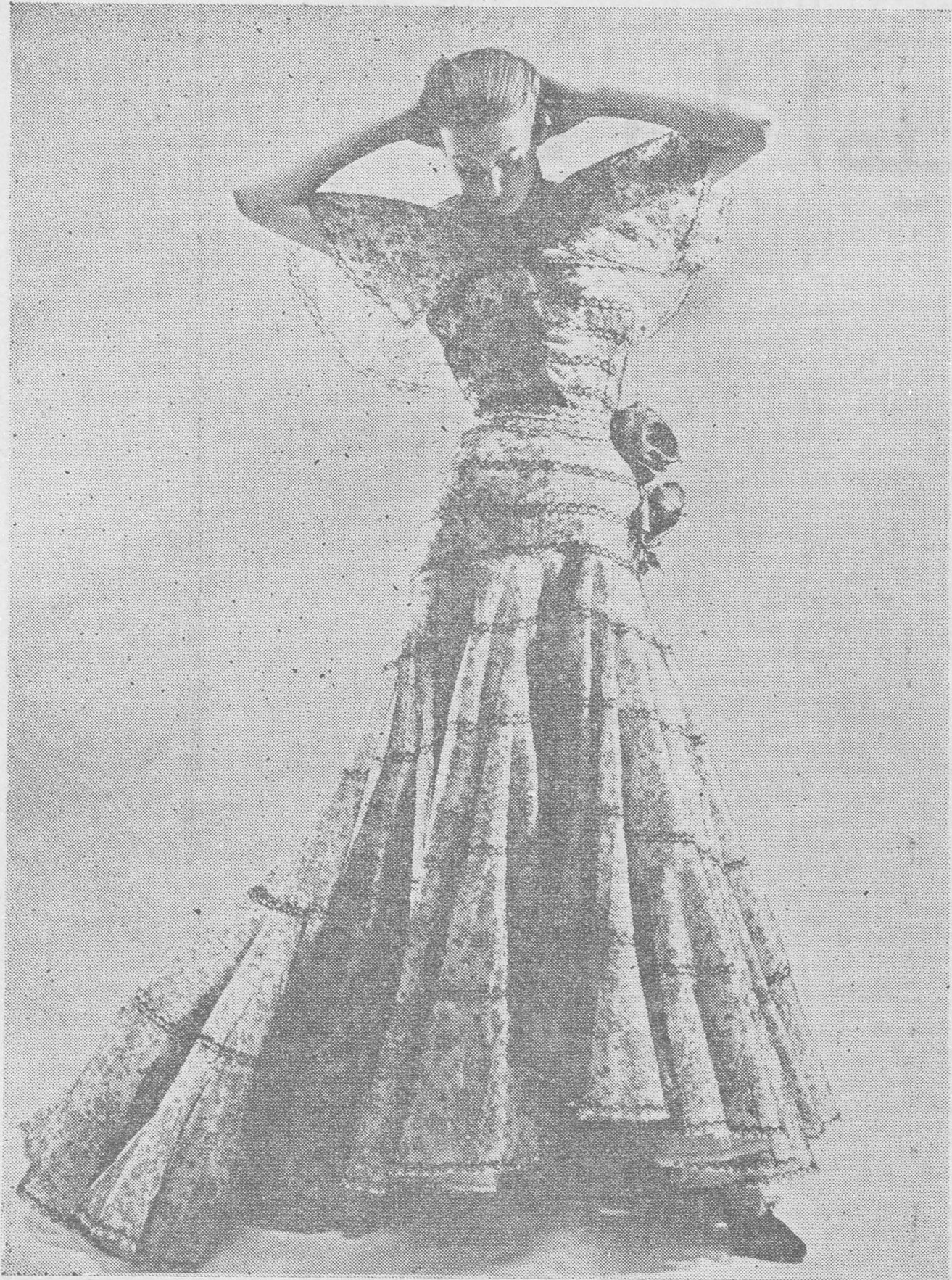
The era of long skirts has passed, and women have returned to the short skirt that goes only a little past the knee.
All the beautiful dresses displayed in the windows and galleries of the Louvre, the Lafayette, and the Bon Marché are of this kind — except evening gowns, of course.
And the woman in Paris represents all the ages and all the classes. You find among them the lady of the veiled hat and the elegant gown, excessive in rouge and perfume, whose age lies hidden beneath layers of powder, and who reminds you of the marquises of past centuries. And you find the athletic girl, bare-headed, bobbed-haired, light-shod, whose smiles can dispense with ornament and powder. And you find the working woman so given over to her work that she neglects her appearance and pays
An evening gown from Paris, white in color and veined with black lace, the creation and tailoring of Christian Dior (the Mun Hayim stores, Beirut).
no heed to the fashion. But all of them are marked by the charm of femininity and delicacy of speech. And I saw that the men are no less polished than the women; the city has smoothed their faces and their manners — outwardly, at least...
You find woman there in every office and every occupation,
above all in the work of buying and selling: she sells the newspapers, punches the tickets of the autobus and the Métro, and pulls the food cart. She works in the house and outside the house, and it is as though her devotion to work and her absorption in it distract her from meddling in politics or in public affairs.