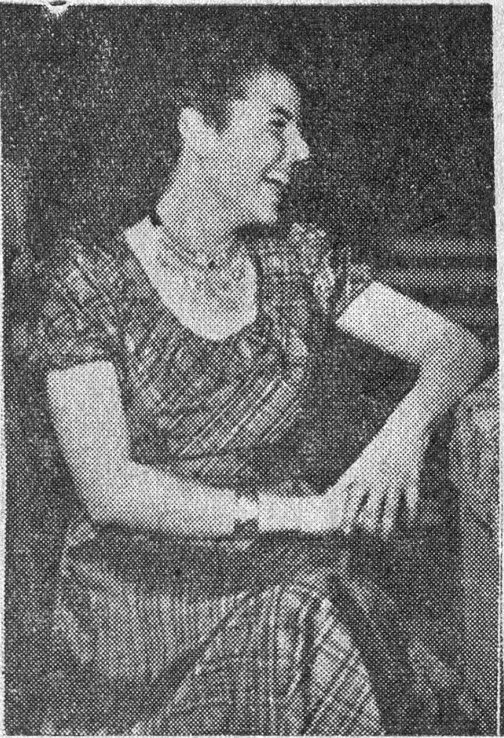
future. My first desire is art. So I shall content myself with one more year of study at school, and after that devote myself to specializing in drawing and to practicing the piano and rhythmic dancing."
It appears that her social life is bound to the traditions of family and milieu. She goes out to parties and visits only in the company of her sister or her brother, and dances only rarely, at family gatherings. I asked her mother the reason for this, which some consider old-fashioned, and she said: "We are not Europeans, that a girl among us should be raised free, far from the traditions of her milieu. Yet I do not use methods of scolding and control over my daughter's movements; rather I try to instill in her a spirit of responsibility, not toward her family alone, but toward herself. I will not hide from you that Samia may sometimes harden in her opinion on a matter of which I do not approve; but I try to persuade her, calmly and tactfully, to give it up — that is, unless she persuades me with her arguments and her adroitness!"...
I asked Samia her opinion of our young men today, and she told me that she does not much regret not going about with them, because many of them care for nothing but
dancing, merriment, and flirtation, and a girl can rarely hold a balanced, serious conversation with one of them. I asked her about the man she would prefer for her future, and she answered: she wants a mature, cultured man belonging to her own community, and possessed of some material means, so that she may devote herself to her housework instead of working outside the home to help him. And she assured me of the necessity of getting to know the man of her future, and of keeping company with him so as to test him, before her choice falls upon him!
I noticed that Samia is careful to look elegant in her appearance. She has a special fondness for choosing a dress's trimmings and accessories. She says that an embroidered silk kerchief, or a beautiful necklace, or a colored belt is enough to make a dress look elegant and attractive. Her winter wardrobe consists of two dresses for parties and formal occasions, and two everyday dresses with four skirts and several different blouses for school days. This supply is renewed once every two years. And I saw that part of her clothing stays serviceable longer, because she chooses simple styles.
Her expenses are subject to a
limited budget. Her father pays her school fee of 800 Lebanese lira in full, apart from the cost of her clothes, while she receives five Lebanese lira a week, which she spends as follows:
1: The price of a cinema ticket once a week.
2: The cost of drawing supplies for the arts-and-crafts club at school.
3: The price of a ticket to attend a concert or a theatrical program.
Samia told me her opinion on religion: "I am not a fanatic, and I truly believe that all religions are one, and that religion is how you deal with others. Although I am Druze by confession, I am wholly ignorant of the principles of my religion and of how its rites are practiced. Yet every night before sleeping I offer a short prayer of thanks to the Creator for His daily blessings."
As for politics, she rarely concerns herself with it, and seldom reads the newspapers. When I asked her about the extent of her attachment to the country, she answered: "I feel no enthusiasm for my homeland Lebanon, because the errors in which it flounders today do not help a girl like me to serve it or to grow enthusiastic for its good!"
Samia is inclined to reading books and magazines, especially French
"Life is sweet..."
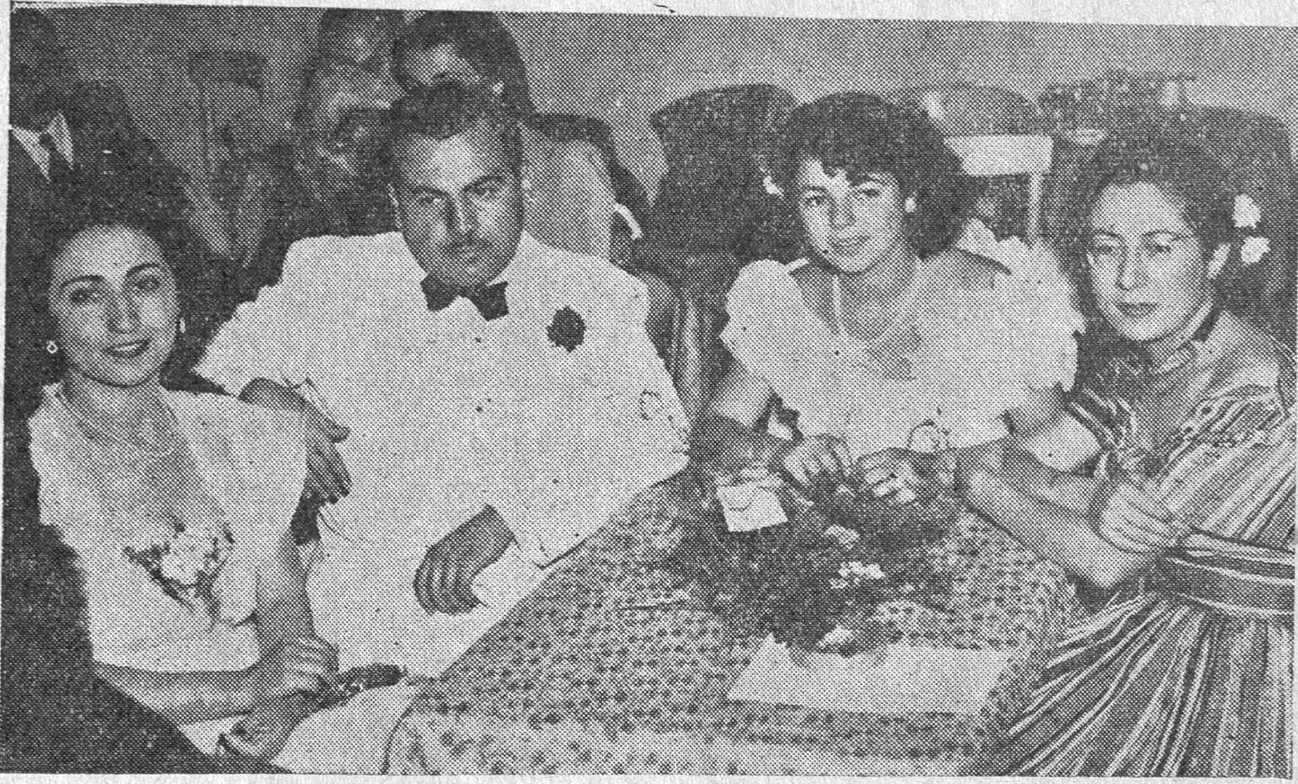
The family at a dance party.
From right: Nabila, Samia, Raja, Afaf.