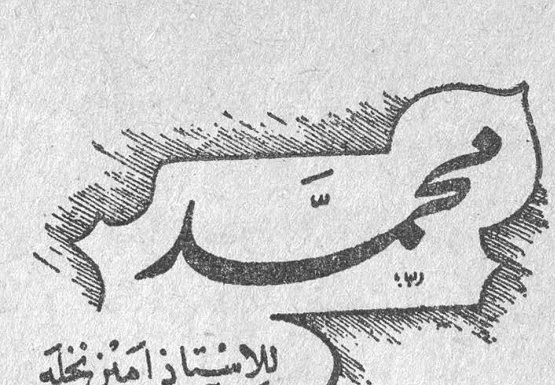
"Muhammad" is a melody, not a word — so often has it passed caressingly over the lips of mankind! It seizes the ear before it seizes the mind, and yields the lightness of its letters and the sweetness of its utterance before it yields any bond with God! There is no Arab on the face of the earth whose breast it does not open, whose inmost soul it does not shake. Him whom it does not take hold of through Islam, it takes hold of through Arabism; and him whom it does not take through Arabism, it takes through the Arabic tongue!!
And in the love of Muhammad — and there is no harm in holding fast to nationality, or in a passion for a language, just as there is no harm in religion... — the two communities of the Arabs meet: the community of the "Quran" and the community of the "Gospel"; until it is as though Islam were two Islams, one of religion and one of nationality and language. Or as though the Arabs were all Muslims — when Islam is taken thus: as love of Muhammad, attachment to his nationality, and passion for his language.
And Muhammad — no one sect among the Arabs can claim for itself alone the glorying in him. For besides belonging to all creation, wherever men would model themselves upon the noblest of Adam's sons in keeping faith with self, with neighbor, and with God, he belongs by better right to the Arabs, all of them, wherever they model themselves — beyond that — upon his eloquence in the pure tongue and our pride in the field of glory, on the day when the scale's pan sank with Arabs and rose with foreigners!
The non-Muslim, in the land of the Arabs, is free not to profess the religion of (the son of Abdullah), and free to have his heart ravished, say, by a book of "the son of Mary," every letter of which drips
gentleness, and by a cross with which one world sat down and another world rose up. But that there should be among us an Arab, of our flesh and of our blood, who then comes to be bound to Muhammad by no tie of kinship, nor to Muhammad's language and Muhammad's nationality — he is a burdensome guest upon us, a stranger's face among our houses...
And Muhammad made this world purely Arab! He brought down the Book (of the Message) in the tongue of our people and hedged their religion about with it — nay, he drew his very proof from it, on the day this bound miracle was
borne in procession among mankind — and then the (Hadith) went its rounds and brushed over morals and noble customs, over the various walks of daily life, even over dress and food, an Arab color with no foreign dust upon it.
And the language's share — nay, the nationality's share — in the religion of Muhammad did not stop at this abundant measure, but passed beyond it to a measure more abundant still: behold, the tongue of our people joins this lower life to the life to come; behold, it is the language of the blessed amid the clamor of bliss — for "Arabic is the language of the people of Paradise."
That — and the promised Paradise itself is spread out, in the "Book" as in the (Hadith), only according to the desire of the Arabs, in keeping with their fancies and the yearning of their hearts: in it are trees and rivers, fruit-clusters hanging near, and green couches; no sun and no bitter cold, but everlasting clear weather, and bliss, and a great dominion... and so on to the end of that delightful tablet of Ridwan.
So Muhammad gave this world to the nationality of the Arabs, and gave the next world to their language. Then he feared a splitting, in the wake of the Message, into a party believing in it and a party believing in another; so he united, with "Whoso loves the Arabs loves me," where division was to be feared, and gathered together where dispersal was to be feared! As though the condition, with him, were love for the Arabs, tenderness toward them, and the taking up of their cause — not entry into their religion! Marvel, then, at a Messenger whose whole care on earth was God's command and the drawing of all creatures to Him, of every race — how he takes such pains for his nationality's sake, and pours forth such a message!
And behold our Arab peoples, in every horizon: whenever the muezzin releases his voice between heaven and earth — at the stirring of morning in the dark, or as the sun passes between its rising-place and its setting — they feel in that cry that "something" of their nationality is soaring in the air, pressing on its way from mountain pass to mountain pass... and they feel the pride of kinship for a religion sprung from among