In what did Napoleon's two wives differ from each other? Did Napoleon consider himself great? What were his views on love, divorce, and children? What was his
greatest blunder?
The American magazine "Cosmopolitan" recently published a document it called "one of the greatest documents in all of history": the memoirs of Marshal Bertrand, who accompanied Napoleon in his last days and recorded everything he said and everything that befell him until the day of his death.
"The Woman's Voice" is pleased to reproduce in its pages, for the first time in the Arabic language, extracts from
these memoirs, believing that a reading of them will profit its gracious lady readers.
"Suffering, like happiness — has its limit!"
The Emperor heard that the wife of General Montholon, who was with him in exile, had given birth to a daughter whom she named Josephine, and that she had suffered greatly during the delivery. He grimaced, and said dismissively:
"Suffering, like happiness, has its limit... and there is not in childbirth so much grievous pain as they claim."
Napoleon was on affectionate terms with the wife of the said general, and the author of the memoirs says that those relations deserved the chief credit for the standing the general enjoyed with the Emperor. He adds: the Emperor, even after he descends from his throne, remains a man...
After that comment, Napoleon passed on to say:
"The father has no great part in the begetting of offspring. He is needed only to play the part of the electric spark of life. But no father will ever be able to be sure that he himself is his child's father... while the mother who has carried it nine months can be sure that she is its mother."
"Tears pain me..."
Under the date of July 1, 1819, the author of the memoirs records the following:
Tomorrow Madame de Montholon (mentioned above) will depart for Europe, after speaking long and
harshly to the Emperor, and after "bargaining" with spirit, demanding the price of her love and requiring him to pay it dear!
To the last moment Napoleon went on showering his tenderness upon this woman, whose parting grieved him deeply. He ordered the servants to carry to the ship great quantities of sweets to suffice her for the whole voyage, and to furnish her with everything she needed. And as a final blessing he bestowed on her two hundred thousand francs, a retirement pension of twenty thousand francs, and a golden box containing his portrait surrounded by large pieces of diamond.
When the moment of parting came, the Emperor received her with her children in his room. All of them began to weep — the woman and the children. The Emperor himself was shaken; he embraced them all and hurried out.
After her departure the Emperor said: "Tears pain me!" And he added: "I pity poor Montholon; grief will kill him. He will find a great emptiness in the house when he returns to it alone..."
"Love is an artificial sentiment..."
What did the man of war and politics think of love?
Napoleon said to the Marshal one day: "Love is an artificial sentiment created by society... I may not be the best judge to pronounce on this subject, since I am not a sentimental man... yet I am a man of feeling: I once passed a whole week — indeed, even two weeks — during which I did not sleep, on account of a woman... but I will not call that love!
Love does not endure in the absence of the beloved... And I do not believe that men are capable of keeping permanent feelings — if we except right thinking and honor...
I recall an incident: in the days when I was a junior officer in one of the camps at Auxonne, a girl fell deeply in love with a young man, but her mother did not approve of him. One day the mother ordered the carriage brought, and took her daughter with her on the pretext that they were going for an outing — and the carriage kept driving until it brought her to Bordeaux. The girl spent the first days weeping, and refused to take food. She remained so for a while, but then she began gradually to return to her former self, and before long she had forgotten everything. Do
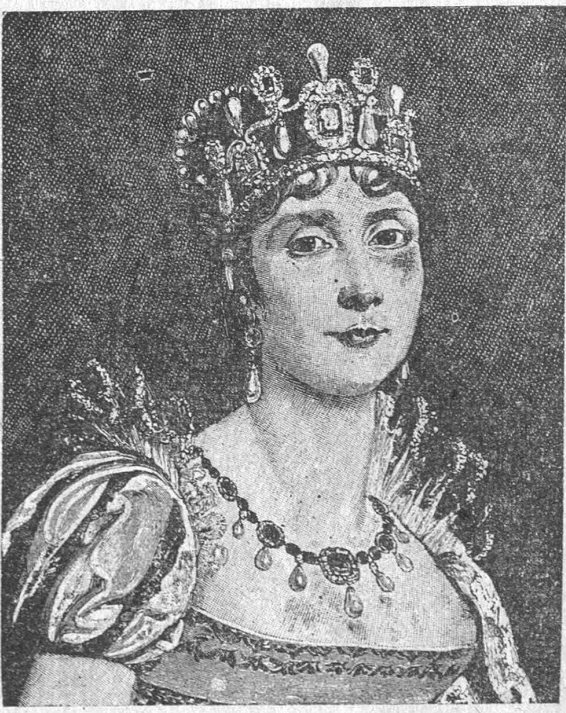
The Empress Josephine, Napoleon's wife