climate does your health the gravest harm."
Napoleon replied, saying: "This state of things will not last much longer, my boy. My end draws near. I cannot live much longer..."
His last hours
May 3, 1821:
From this day on, the Emperor
no longer spoke to anyone. Only from time to time did disconnected words and phrases escape his dying lips. Thus, whenever the doctor gave him sweetened wine, he would repeat after every sip these words, repeating them with the sweetness and innocence of a child:
"Good, good, very good..."
He is very weak. He has not strength enough to refuse anything, but accepts all that is given him, submissively. He would sneeze, and say: "Marchand, you lucky rascal!..."
He would keep silent for a long while — and then suddenly cry out:
"What is my son's name?!"
And Marchand would answer him: "Napoleon!"
His death
May 5, 1821:
The Emperor could not open his eyes. He is more like a corpse than anything else. His chest is covered with the saliva issuing from his mouth. The windows of the room are open.
The doctor arrives, and lays his fingers on his stomach to examine it; it sounds like a drum. From six to a quarter past six he sneezes and moans with pain. He looks to the left, but his eyes see nothing.
At eight in the morning deep groans arise, whistling. They seem to the listener to come from a
machine, not from a human body. A tear rolls from the edge of his left eye. I wiped it away for him. Arnott marvels at the Emperor's attachment to life.
Between half past ten and eleven, stillness. He breathes quietly. His whole body is without motion,
though in the depths of his eyes there are faint movements. But life has lost its last traces.
*
And at 39 minutes past 5 on the afternoon of that same day, Napoleon died.
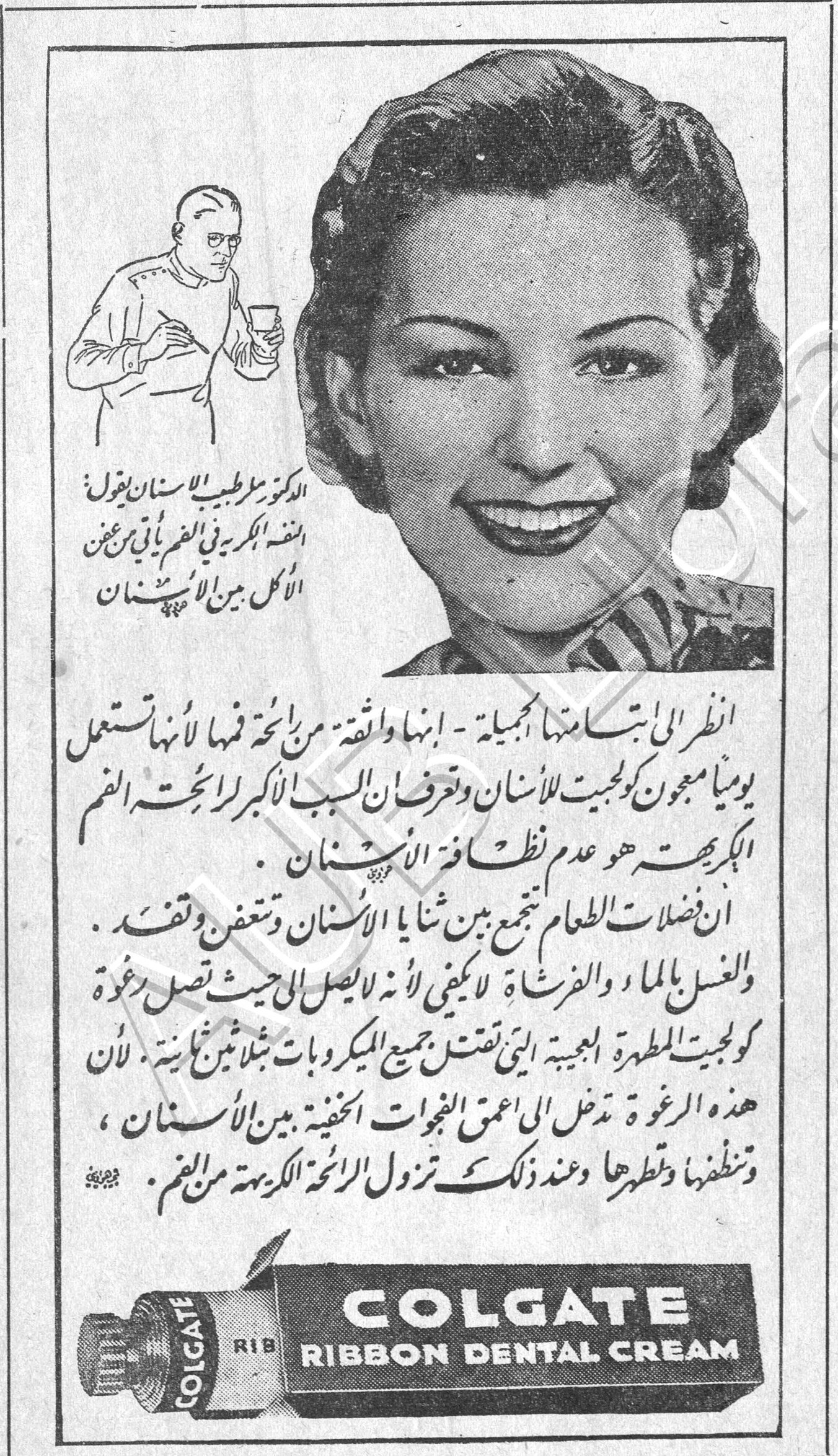
COLGATE RIBBON DENTAL CREAM
The doctor—the dentist—says: the unpleasant odor in the mouth comes from the very food lodged between the teeth.
Look at her beautiful smile—she is confident of the freshness of her breath, because she uses Colgate dental cream daily and knows that the greatest cause of bad breath is unclean teeth.
Food remnants gather in the crevices of the teeth and rot and spoil. Washing with water and a brush is not enough, for it does not reach where Colgate's wondrous antiseptic foam reaches, which kills all germs like a burning fire. For this foam enters the deepest hidden hollows between the teeth and cleans and purifies them, and then the unpleasant odor vanishes from the mouth.