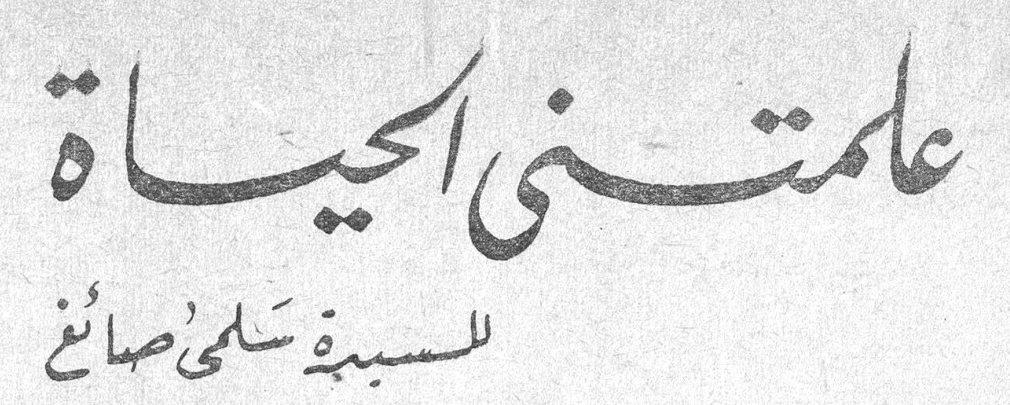
At the opening of this year the writer Salma Sayegh looked out upon a new decade of the decades of life, and the director of the women's section at the Near East Station proposed that she broadcast to the women listeners of the Arab world something of what life had taught her. She said:
Here I am, turning to look back — looking back on a lifetime of which far more has gone than remains. Here I am, gathering up my sincerity, my fidelity to truth, and my desire for the good; gathering a longing to turn away from evil, and an unbroken devotion to the highest ideals; here I am, gathering all this into a bouquet of roses whose petals I scatter, to fly to every house in Lebanon and to every chamber in the world that holds a woman who speaks this Arabic tongue of mine.
Life has taught me that work is the blessing of blessings, and that the misery of the present world was brought upon it by those classes that feast on a loaf drawn from the earth by the sweat of the destitute!
Life has taught me that motherhood gives and does not take — if we reckon that it gives oceans and takes drops. I have witnessed this bounty in everyone around me and in every country I visited as searcher and student, and the reckoning has never once gone wrong! My grandmother gave my mother oceans, and she carried what she had been given to her children — I the fourteenth among them — and in my turn I gave all that I was given to my daughter, and here she is, building from her own life the life of her son. Each of us four women was gifted and giving, and what was taken from the mother was — always — a debt paid to the taking child, not to the giving mother. From this, from this denial of self, mankind has wreathed the word "mother" in a halo of sanctity. I have passed in my life by dozens of happy mothers and hundreds of forsaken mothers, and I never heard a wretched, wronged mother but she was murmuring something like a prayer:
"Lord, gently! Turn this torment of mine into grace and fair patience, for bitterness in a mother's heart comes down as a curse upon the heads of the children!!"
*
The days have taught me that woman is body and
soul, and that the life of the body has an imperious law; that repression turns to despair, and if the elements of exile and loneliness gather round it, the pain becomes merciless and unresting; and that the best thing a woman can do whom life has denied a natural right in which the beasts and the insects and the plants find happiness — I say the best thing such a woman can do is to take up some humane work by which she may turn from her hunger for love and for motherhood, provided she keep for herself intervals of diversion, whether in an art, or in travels, or in innocent amusements.
*
Life has taught me that the ideal morals — those with which life grows sweet, the life of a man and a woman who live in one house and die in one house — are not confined to women apart from men, nor to men apart from women. I have known in my life women fit to stand as beacons of guidance, and I have known men beyond reproach — yet I have come away with this conclusion: that the number of virtuous women is greater than that of virtuous men. Out of ten women — for example — I count eight virtuous; out of ten men I count five. And among those who fail in this sifting, the moral balance tilts toward the women's side. For all women are sacrificers upon the altar of motherhood, and therein lies their distinction.
And the men??
I say it without laying my hand upon my heart, for I am bold in speaking the truth. The men — after I set aside those who make up the chosen elite — he among them who is not weak is a hunter, a wrecker of decent sheltered homes; and he who is chaste may be a gambler; and he who is safe from gambling may not escape the disease of drink; and he who is no drunkard may be a miser; and he who is no miser is one of those spendthrifts whose conduits pour only outside their own door!! And he who is delivered from the evil of squandering may carry in his blood a germ of that... that which brings forth that poor, sickly offspring... the hell of women and of mothers!
A man may escape all these plagues; but one plague he will never escape, and that is selfishness.
Travels have taught me that homelands are deadly,