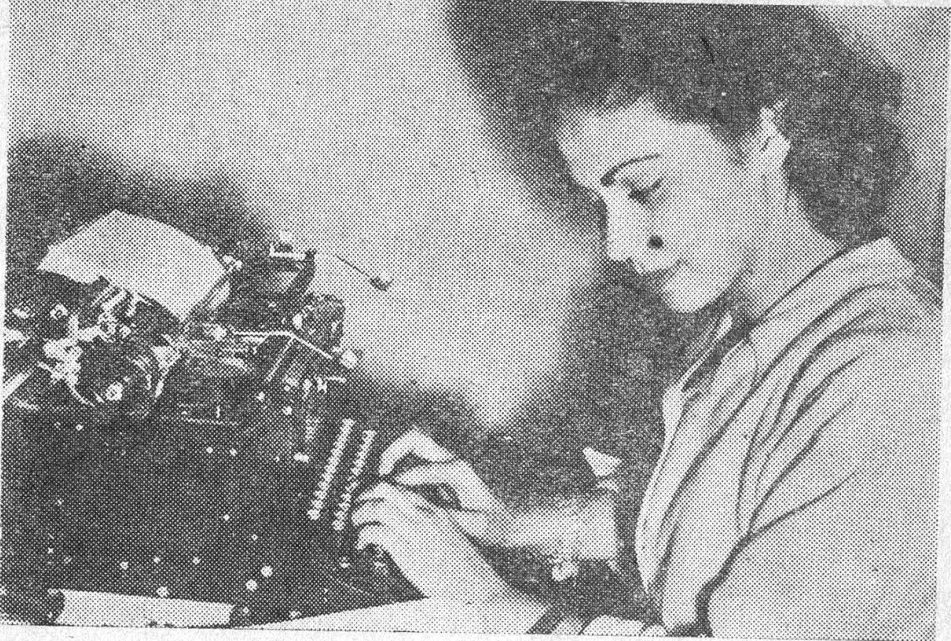
Miss Georgette Bassoul at her work in the office of the Tapline company.
How does the young girl live in our country today? On what foundations are her personality and her judgment built? What are her opinions on life? On learning? On marriage? On politics? On religion? Etc....
— 2 —
Georgette Bassoul entered the arena of life when she was still sixteen years old. She completed her elementary studies at the Lazarist school in Beirut, then studied English for a year at the American School for Girls, and also trained at typewriting. After that she worked as an employee of the Iraq Petroleum Company in Beirut, drawing a monthly salary of 192 Lebanese liras. Her pay then rose until it reached 260 liras.
When the company's offices moved to Tripoli, Georgette was given the choice between resigning and moving to work there, and she chose to keep working. So she moved to Tripoli and lodged in a nuns' convent, spending the weekend in Beirut. Even so, she felt a strange loneliness at being far from her family, and she preferred to resign and return to Beirut before five months had passed since her move.
Meanwhile the Tapline company was receiving the applications for work that poured in upon it, so Georgette sent in an application and received the letter of acceptance after two months had gone by, during which she learned to type on the Arabic typewriter.
Two years have now passed since she joined the
Tapline company as an employee specializing in typing on the Arabic typewriter, and today she draws 320 Lebanese liras a month.
I asked Georgette whether her passage from school life to independent work had required an effort to adapt herself, known as she is for her quiet, shy nature. She answered that she was uncomfortable at first, for what a distance lies between the merry life of school and a job that demands bending eight hours a day over the typewriter. She would tremble and blush if one of the clerks, of whom there were many scattered about the office, spoke to her. But with the passage of time Georgette grew used to her work and came to feel that she profits from it in various ways, which she enumerated to me, saying: "I feel that the benefits of my work are not confined to drawing a salary each month. Relying on myself has made me feel ease and stability, because I am not a burden on anyone else for my living — indeed I contribute to the family's expenses. And do not forget that work outside the home enables a girl to become acquainted with different kinds of people, which strengthens her personality and softens her temper."
Georgette is the third member of a family made up of three girls, a mother, and a father who formerly worked in the dyeing trade but was struck by an illness that has kept him from work for fifteen years.
Each of the sisters contributes a share toward providing the household's needs. The eldest works as a typist at the Bank of Syria and Lebanon, and the second works at the same bank.