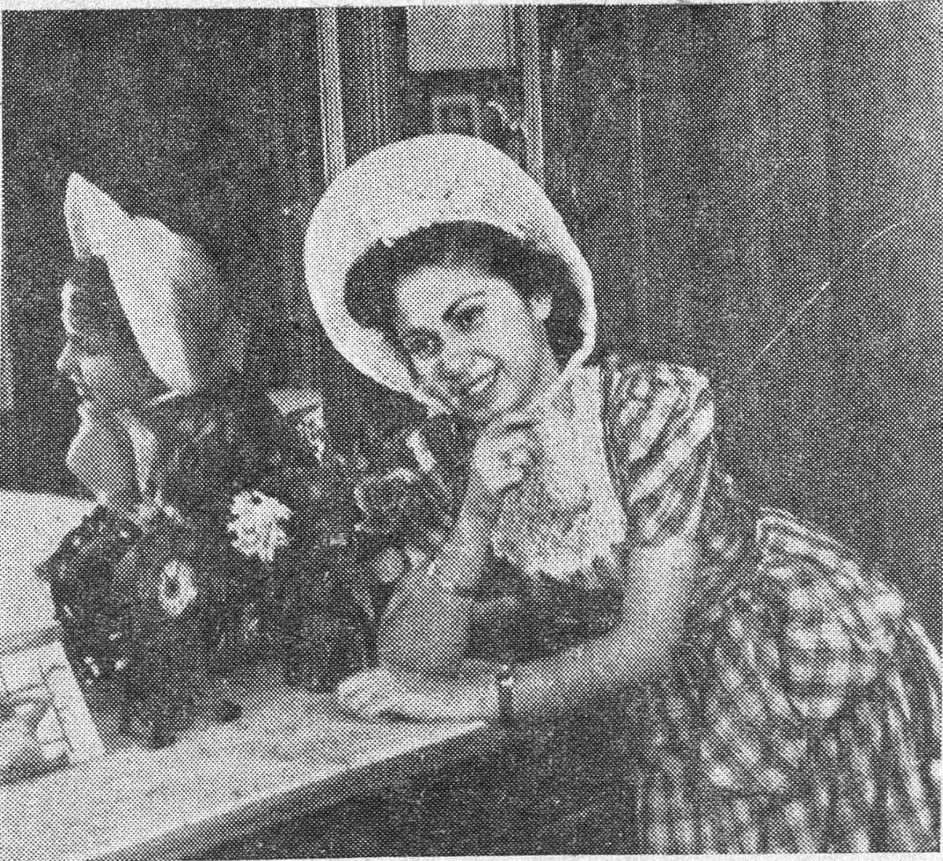
"... If a young man asks to make my acquaintance, I invite him to our house... instead of going out with him in secret..."
Georgette is thrifty in buying what she needs. She does not dispose of her salary as she pleases, but gives the whole sum to her mother, and her personal monthly spending does not exceed twenty liras, which she lays out on a few extras and on the price of a cinema ticket. As for her clothes, her mother is the one responsible for choosing what she needs; and since she spends the greater part of her time at work, she keeps to simple clothes made up of several skirts and colored wool sweaters. Her clothes for formal occasions consist of a wool dress, a suit and a broadcloth coat, and a pretty hat, in addition to various accessories. She has a passion for beautiful clothes, but contents herself with the simple among them, according to a limited budget.
I asked her how she spends her free time, and she complained that her life runs on a single rhythm. She goes to her office on Hamra Street at eight in the morning and stays until noon. Since her house is near the office, she takes her midday meal at home, then returns quickly to continue her work from one o'clock until five in the afternoon, after which she goes back home to rest for an hour. Her two sisters will have returned from their work as well, and the three talk together while Georgette knits herself a wool sweater. Then she takes up a French women's magazine and reads the chief news of fashion and household management, or goes to the market with her companion. The whole family gathers around the supper table, and she usually takes to her bed at half past eight in the evening.
As for Sunday, which is her holiday, she goes to church to attend morning Mass, then returns home with her friends, and they gather around the radio to listen to the Arabic section of the listeners' request program on the Radio Beirut station. She spends the afternoon either going to the cinema or exchanging visits with family and friends.
I asked Georgette whether the young man in our country knows how to behave with a girl who works outside the home, and she assured me that the young men she works with at the company show her every respect. She drew my attention to the fact that the girl herself has an influence on how a man behaves toward her: if she knows how to keep her dignity, he shows her every regard and treats her as a colleague in the office.
Georgette refuses to go out with the young men of her acquaintance, because her milieu is still traditional and considers a girl's going out with a young man a defect in her upbringing. She then mentioned to me that she dances only at rare family parties. And though her mother allows her to attend such occasions, she refrains from telling her father, for he is never lenient in this respect.
Her family shows open-mindedness in allowing her to choose the man of her future, and she told me the following: "If a young man asks to make my acquaintance, or to call on me, I invite him to our house, where I can come to know him closely in a clean family atmosphere, instead of going out with him in secret."
But Georgette has not yet chosen the one she loves. She requires of the man of her future that he possess a measure of intelligence and culture, and that he have the magnetic charm of the well-known actor Tyrone Power. She prefers that he have an independent profession by which he can support the household without making her prop it up by working outside the home. And since she holds fast to the duties of her religion, she makes it a condition that he be of the Maronite rite. Nor did she hide from me her attachment to the teachings of the Church, her monthly communion and confession, besides her daily stop at church on her way to work.
When I asked her about her interest in the country's affairs and its politics, she shook her head, saying: "I do not understand, and take no interest whatever in, the events and developments of any kind that happen in the country. I never read the newspapers, Arabic or foreign. My reading is confined to French magazines and storybooks." And though she reads Arabic well, she attributed her not reading in it to her having been accustomed since childhood at school to reading in French only.