This magazine, which speaks in the name of the women of Lebanon, takes care to preserve in its pages the manifestations of the activity of the women's organizations, all of which called one another together after the summer holiday to mount a new peaceful offensive for the recognition of the rights of the Lebanese woman as a citizen, bearing what man bears and possessing what he possesses.
And there is a word that must be said, imposed upon us by the first duty laid on anyone who wishes to stand in the ranks of frank and truthful journalism:
We say, to the men and women who criticize the work of the Executive Committee, accuse it of acting on its own, and reproach it for pursuing the effort alone without the other organizations, that in everything it has done the committee has done more than custom imposes and courtesy approves. After the call of the Kataeb women's organization to a general meeting held at the Kataeb House on April 12, 1950, a large number of societies answered the invitation and another number ignored it; at that meeting it was decided to invite the absent societies to a second meeting, held on April 27, 1950, so that those who had missed the first meeting might attend the second.
At this second meeting the committee was elected, and it was decided that it should be independent of every party and every society, and that its presidency should rotate.
After this frank and truthful word, which accords with the facts, this magazine asks all the women's organizations and all the women of Lebanon to join hands and help spread the idea of comprehensive support, for the good of Lebanon first and for the good of woman.
As for what happened after the summer holiday, we summarize it in these lines taken from the report of Mrs. Ellen Rihan, which she read to the women's delegations at the great meeting held on February 5 at the Officers' Club. She said:
On December 18, 1950, a meeting was held at which it was decided to call on His Excellency the President of the Republic to win his support. On December 26, 1950, the second meeting was held; it was convened immediately after the disorders that swept the country during the two holidays, so the committee was taken up with the weightier matter over the weighty, and sent telegrams of strong condemnation to the highest authorities, asking that the use of weapons be forbidden. This telegram had its good effect, and telegrams poured in, encouraging and thanking.
In the first week of the new year, that is from January 1 to 7, 1951, Woman's Week was held, and publicity was spread in the newspapers and over Radio Lebanon —
In the same week the Mother of Lebanon, the Marquise de Freige, sent a telegram of support.
On January 4 the committee held a meeting that
included: the president of the Beirut Merchants' Association, the delegate of the Physicians' Syndicate, the delegates of the Private School Teachers' Syndicate, the delegate of the Farmers' Union, the delegates of the Students' Committee, the president of the Chamber of Commerce and Industry, the president of the Industrialists' Association, the head of the Press Syndicate, and the delegates of the Federation of Labor Unions. The heads of the Engineers' Syndicate and the Pharmacists' Syndicate excused themselves from attending, agreeing in advance to whatever resolutions might be adopted.
Those present drew up a telegram asking for the recognition of woman's rights, and it was sent to His Excellency the Prime Minister.
And on January 5 the committee met with the Ustads Wadih Naim, Ahmad al-Barjawi, and Habib Abi Shahla; Sami Bey al-Solh and Ustad Emile Lahoud gave their support in absentia.
On January 9 a delegation carried to His Excellency the President of the Republic and to His Excellency the Prime Minister a petition asking that a bill be drafted granting woman her political rights and that it be referred to the Chamber of Deputies. The petition included the following question:
"Why did the Lebanese government sign the Charter of Human Rights? Why did it invite the international Commission on the Rights of Woman to hold its conference in Lebanon, and then neither act by the charter nor carry out the recommendations of the conference?"
On January 22 and on the 28th the committee met with the Ustads Said Akl, Subhi al-Mahmasani, Muhyi al-Din al-Nsouli, and Sheikh Pierre Gemayel,
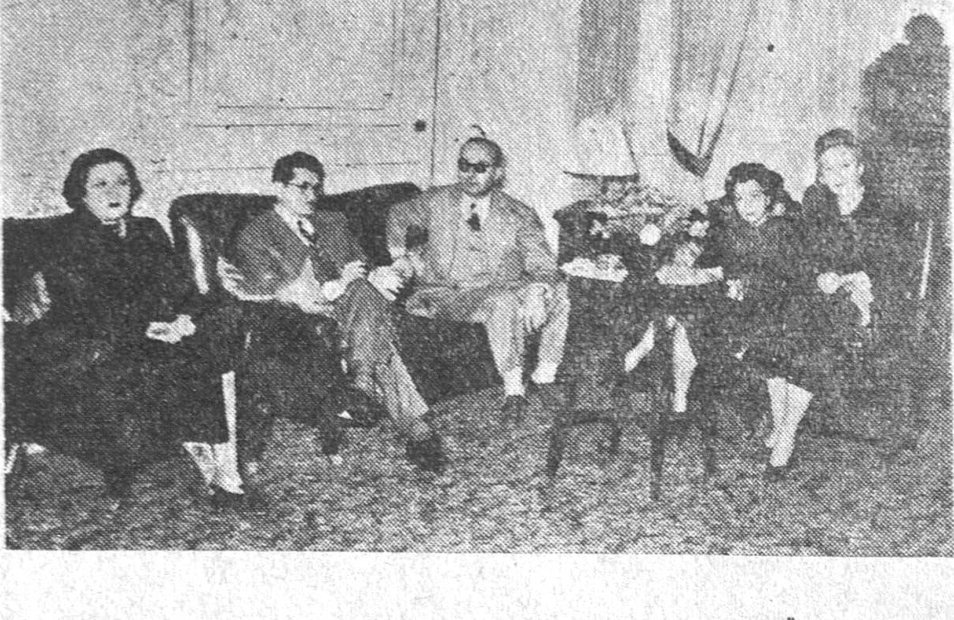
The press conference at the house of Mrs. Laure Tabet. From the right: Mrs. Laure Tabet, Miss Vidal (journalist), Mr. Makhlouf, Mr. Rashid Shuqayr, Miss Ibtihaj Kaddoura.