
Among the men of art are those who took nature as their inspirer; others took war, or the sea, or toyed with light and shadow. But among them too are many who drew their inspiration from woman in what they painted, and their canvases came as the fruit of their relations with a company of women at whose characters and identities the prudish bare their teeth and knit their brows whenever these are mentioned in their hearing.
For the artists' relations with the inspiring "models," who were to them not wives but mistresses, were in most cases not innocent... and the artists did not seek to hide this truth or disguise it. Yet some of them, like Rembrandt, would not have hesitated to marry his mistress had circumstances allowed.
Still, there is in the canvases, in spite of all that, an innocence and a purity which we — and the prudish themselves as well — cannot but acknowledge and savor. For this reason the canvases have lived immeasurably longer than the glib tattle about the women who inspired them; and for this reason those mortal women have been made immortal, and will remain immortal so long as there is in the universe a color to be seen and a taste to be felt...
The custom, in the history of art and the lives of artists, is that these men suffer every kind of torment and disappointment for years, long or short, after which they reach the threshold of glory, and fame rises in their sensitive hands.
With Rembrandt the pattern was reversed. After enjoying a brief spell of fame, he had to spend the rest
of his life wretched and miserable.
By the year 1656 Rembrandt had lost his first wife, his stately mansion, and his friends and patrons in Amsterdam, and was living in the filthy poor quarters. There was no one with him, to share that life of misery, but a dark-complexioned country girl, with a fresh face and a full figure, sadness traced in her eyes, named Hendrickje Stoffels. She came to his house a servant, and settled in it a mistress. She was illiterate, and in large measure simple and silly, but she understood the reach of Rembrandt's genius, and she was faithful as a saint, and consecrated herself to him.
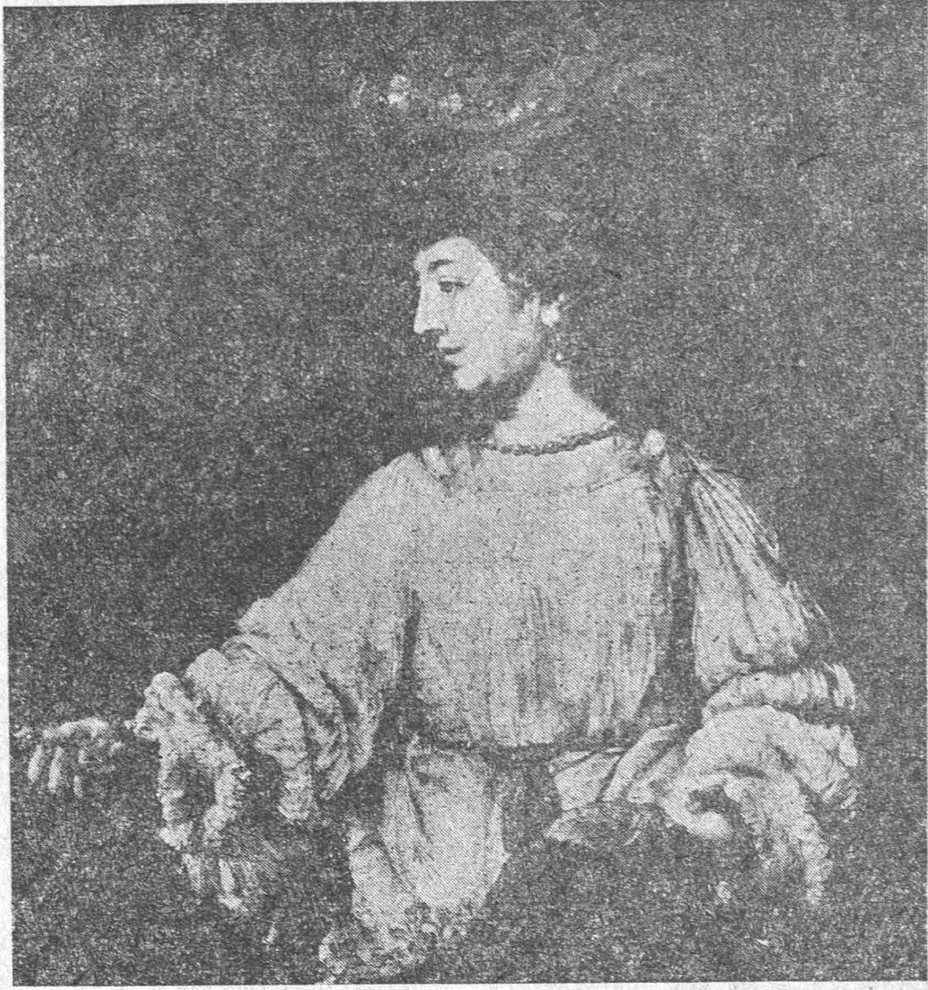
Rembrandt loved her more than he loved fame and more than he loved money, and he painted her over and over again: he painted her in the guise of Venus, of Flora, and of Bathsheba, and he took her as the model for his two masterpieces, "A Woman Bathing" and "The Painter's Studio." In her he was painting the woman whose beauty is not confined to outward appearances — the woman in whom tranquility is embodied, and from whom the fears of life fall back slain.
And Hendrickje stayed with him, caring for him, nursing him, washing the dirty clothes on which he used to wipe his brushes! She bore him a daughter. And it is worth recording that her love for the artist, and her esteem for him, reached such a point that it moved Rembrandt's son by his first wife to respect his father's mistress and grow attached to her, just as his father respected her and was attached to her.
A servant girl in the guise of the goddess of flowers — blessed be beauty... Hendrickje Stoffels as Flora. (Rembrandt)
As moths hover about candles, so do tales hover about the life of Francisco Goya. His life, from his birth in Spain to his death in France at the age of 82, was a chain of events and adventures: in it were duels, and street brawls, and flights from the authorities, and affairs of the heart. But the outstanding event of his whole life was his love for the Duchess of Alba, the greatest woman in the Spain of her age, who possessed a benumbing beauty, a fortune beyond reckoning, a string of titles, and a spirit that was all freedom and abandon. A contemporary French marquis described her in these