— 1 —
Myths... religion and poetry:
In another quarter of this shore, there dawned in the history of civilization that fragrant treasure in which the elements of religion and faith were fused with the elements of art and poetry, and which, from its birth and for thousands of years afterward, was an inspiration to some of the world's most magnificent artists, who under its inspiration composed the finest poetry, wrote the most beautiful stories, penned the most terrible tragedies, set down the greatest epics, carved the most splendid statues, and painted the most radiant pictures — by this treasure I mean mythology, that is, those myths of which no nation's history or literature has been free, however much they may differ in rank — in beauty, meaning, influence, and immortality.
In myths, religion and poetry are bound together. Indeed, I go further than this, and declare that a people's myths are its ancient theology, the foundation of its beliefs, and the sum of its faith. My purpose now is not to analyze how religion and poetry are knit together in these myths, but to set forth the fundamental impulses that led man to create mythology, and that afterward left him able to find matter for his poetry and all his art only in this religion in which he believed, and that made him bestow this overflowing legacy upon the civilized nations of the earth, so that the artists of every age return to it, to find in it — without believing a word it contains — the authentic inspiration of their art, the fertile pasture of their imagination, and the spacious horizon of their meditations.
The first impulse toward them... ignorance:
Let us carry our thoughts backward, and retreat centuries into the history of man, to that period in which man was a child in his awareness and understanding, deficient in his experience and knowledge. He would see the various phenomena of nature and stand before them open-mouthed and dazed, at a loss how to explain them when he contemplated them or pondered their secrets. His son would ask him about them, and he would fall silent, unable to muster an answer. He did not then possess what we now possess of natural, astronomical, and
practical knowledge, nor had he anyone to guide or direct him, whether person or book.
He saw the sun appear on the eastern horizon every morning and cross the sky from bound to bound, bringing blessings to the whole world — for there is no life without it, and to the crops, which without it would wither and waste away — while at the same time carrying destruction to a man, his crops, and his cattle, should its blows grow excessive and the heat of its blaze increase.
He saw the moon glittering in the heart of the sky at the evening of every day, lighting the darkness; and it loves concealment, so it hurries away in flight when the coming of day draws near — and no sooner has it turned its back than the dawn comes strutting in, showing itself in the twilight for a moment and fleeing in its turn before the sun invades the universe with might and dominion.
He saw death, that black specter, swallowing the sweet and the bitter alike; like a terrifying cavern to which mankind is led, at whose door every wish collapses, and in whose void all other
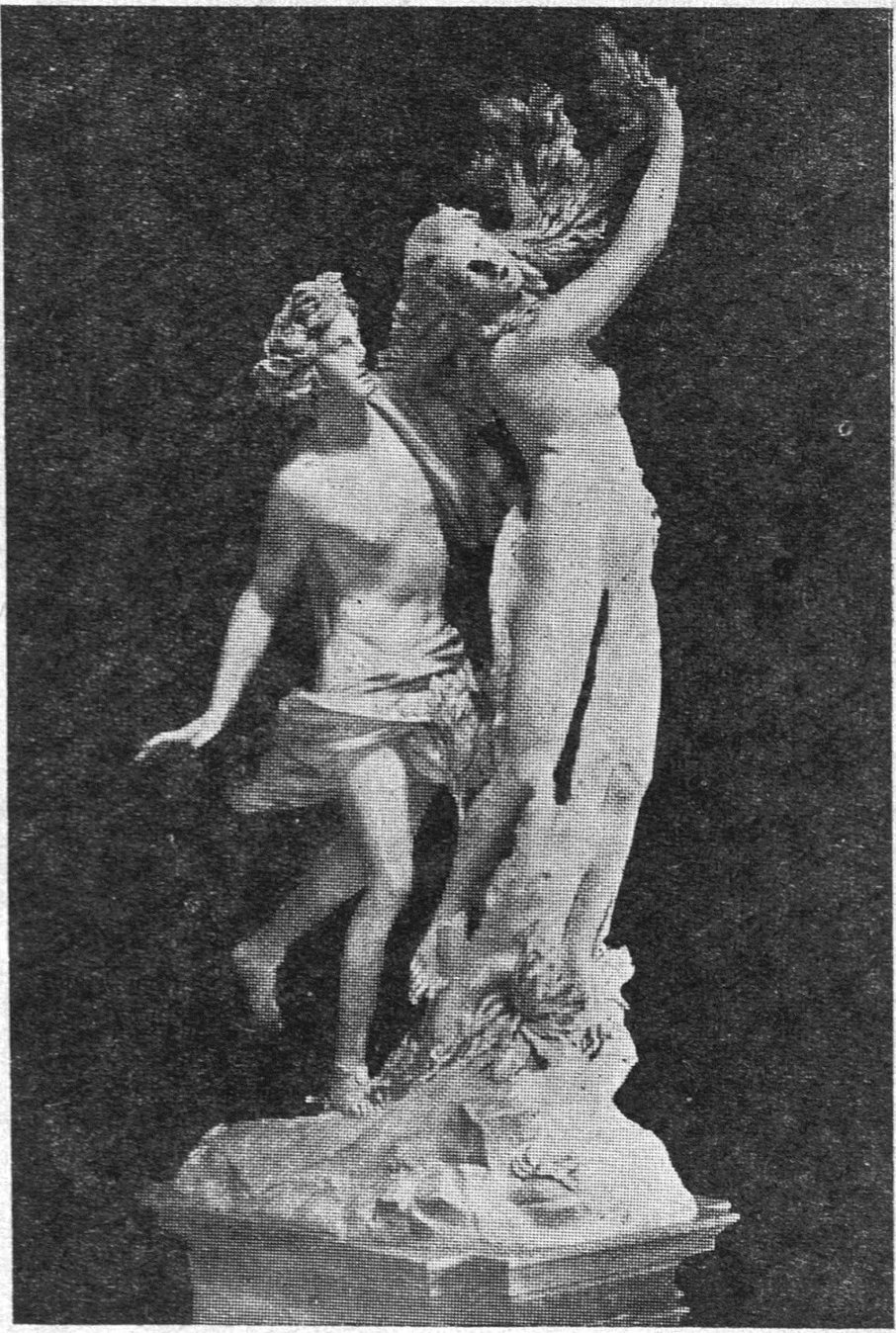
Among the fragrant myths of the Greeks is the myth of Apollo and Daphne... He loved her and she fled from him, so he pursued her. And when he caught hold of her she turned into a laurel tree, from whose leaves he plaited himself a wreath...