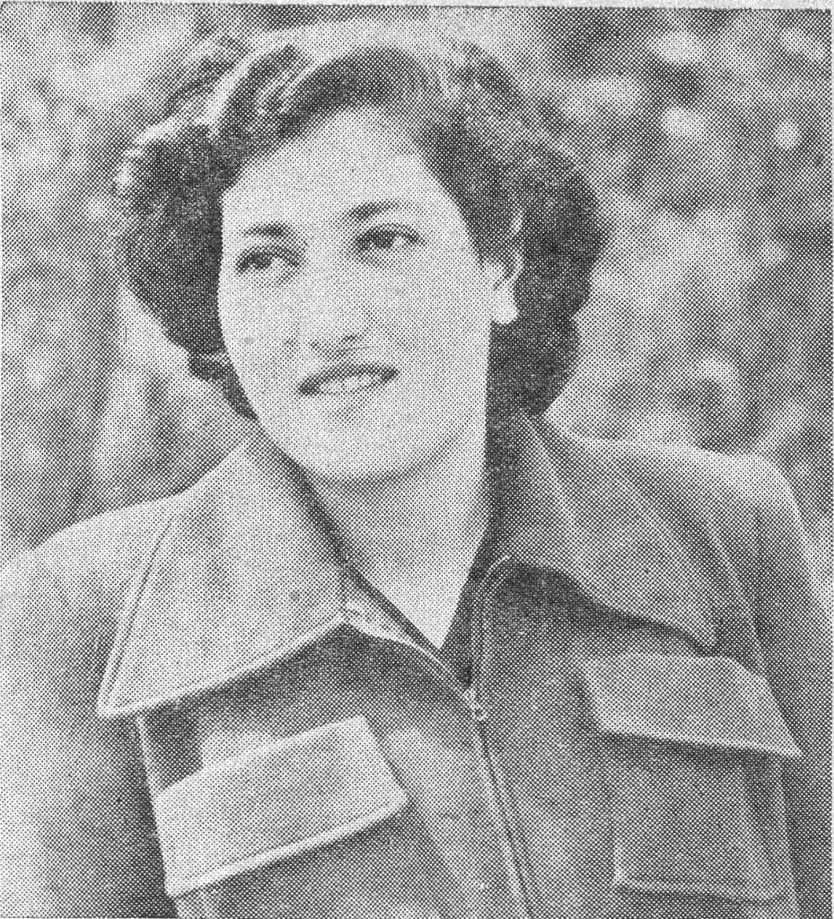
Nursing honors a woman, as motherhood does...
So says Najla Matar.
such as embroidery, knitting, and sewing.
Najla greeted this year, her third and last, with determination to go forward in her work and confidence in her ability.
The theoretical lessons in it are confined to three subjects: the science of "anatomy of the brain," taught by Dr. Manoukian; the course on "mental diseases," given by Dr. Avzian; and the course on "mental derangement," given by Dr. Shukri. These three physicians are specialists in mental diseases and work in the same hospital.
As for her daily working hours, they are subject to a strict schedule, and are distributed as follows: Najla takes over the Webster ward from the night nurse at seven in the morning. This ward holds thirty-five patients who are nearing recovery, and by day she is responsible for the proper running of things in it, assisted by another colleague and four attendants.
Najla supervises the serving of breakfast to the patients, and when they have finished eating it is nearly half past eight, so she goes in her turn to take her own breakfast in the dining room reserved for the staff and the nurses. Then she returns to her work in the same ward, cleaning the rooms and observing each patient individually; by then it is twelve o'clock, and she goes to attend the nursing lesson, staying until one o'clock. Then she takes a period of rest until half past five, when she returns to her ward, where she supervises the distribution of the supper and the preparing of her patients for sleep. Then she hands over her responsibilities to the
night nurse, returns to her room, takes her supper, and settles down to study her lessons.
I asked Najla whether, during her day's work, she could manage the patients' affairs without the doctor's help. She said: "The patients show a calm that lets me talk with them, and we usually exchange stories, happenings, and anecdotes; sometimes I take some of them with me to the cinema, if the doctor permits it. If one of them is seized by an acute fit, I try, with my colleagues, to calm her, and I call the doctor only in exceptional cases — as happened once in a violent quarrel between two patients. We heard screaming in one of the rooms and hurried there, and behold, one of the patients had been seized by an acute fit and had fallen upon her neighbor, showering her with blows. We separated the two, but we could not quiet the patient's frenzy until we called the doctor and he relieved her with a special injection."
It also happened to her once that she went in to a patient who had recently come to the hospital and was in the third month of pregnancy, and saw the signs of miscarriage plainly upon her, without the patient being aware of what was happening to her. The doctor came at once, and the patient was moved to the clinic for treatment.
The nurses' service is confined to the women's division, for the men patients have a special division served by the male students of the said nursing school.
Najla received her first fundamental lesson when the head nurse interviewed her privately and proceeded to give her instructions on how to handle insane patients. It was hard for her that day to understand what her teacher meant by the necessity of reconciling gentleness on the one hand with severity on the other. But experience afterward taught her how to reconcile the two, and she learned how to guard against a patient's frenzy and anger without being harsh with her.
Often Najla is standing, talking quietly with one of the patients, when a sudden, acute fit of frenzy seizes the woman and she springs at Najla, trying to strike and slap her. At once Najla closes with her and pins her hands behind her back, thus paralyzing her movement until one of the attendants comes to her aid.
*
At the end of the first year, Najla moved on to training in the treatment room, where she records the patients' condition under treatment by insulin and by electric shock. She remembers how she trembled and leaped from her place when she first saw the signs of convulsion on one of the patients during his treatment by electric shock.
Exhausting as her work is, Najla shows an interest in what is happening around her in the country: she follows the news in the Arabic daily papers, and