When Florence Nightingale broached to her family her resolve to enter the nursing profession, panic took complete hold of her mother... And this is not strange, for in 1845 panic was bound to master any mother whose daughter thought of committing such a hazard! For the nurses of that day were known for filth, dissipation, and moral depravity...
Florence was well aware of all this, but she was determined to change it from one condition to another, for she perceived the lofty mission that awaited her — a mission whose effect would embrace the field of nursing and the army, and whose blessings would be enjoyed by common soldiers and great commanders alike.
Tears burst from her mother's eyes, and she afterward confided to a friend of hers: "It is as though I were a duck that has hatched a wild goose!..." No — that Florence was no wild goose. One well-known writer said, in a biography of her: she was an eagle!
Many writers, when they took up the sacred mission to which Florence Nightingale dedicated herself, have asked: what could her motive have been? Perhaps the only correct answer is the one reached by an American authoress, Cecil Woodham-Smith, who has written a book about the great heroine, published last month in some four hundred pages, after a search through the original old letters and documents that took six whole years. The answer is this: when Florence was sixteen years old, "voices" kept sounding within
her, assuring her that God had appointed her for a special mission.
But those voices did not make plain to her the nature of the mission. They continued to visit her in obscurity until she reached her twenty-fourth year — yet she did not carry out what she had been appointed to do before her years numbered thirty-three. In the meantime her life was an exact copy of the life led by the girls of the upper class in Victorian society. Her father was devoted to the arts and crafts, and her
mother was a prominent figure in society. As for Florence, who was slight of build with chestnut hair, she adored social gatherings and dances, and was fond of outings and travel, which led her on long journeys across the European continent. It was natural that she should catch the eye of suitors, and many of them gathered at her door. Among these was Richard
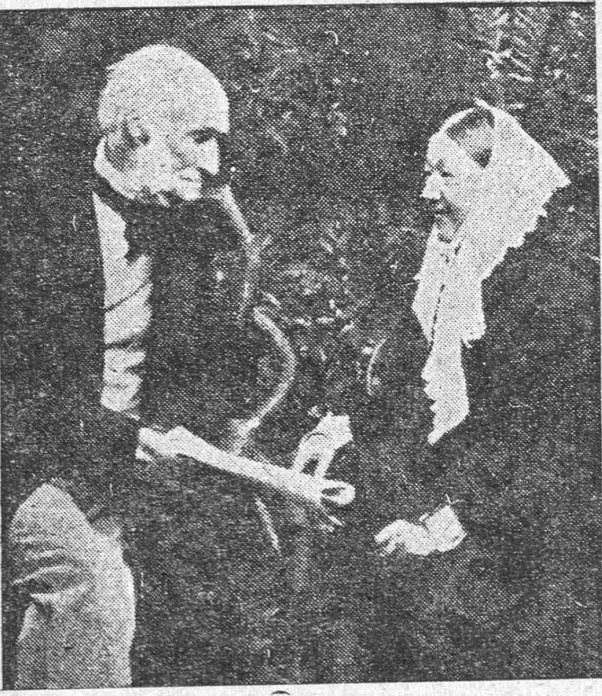
Florence Nightingale with Sir Harry Verney (1889); he had been one of the suitors for her affection in her youth.
Milnes, known at that time for his poetry and his love of good works and charity.
But there was something Florence was doing, alongside all that has been mentioned, of which the others knew nothing: she kept a full diary, containing an authentic and marvelous picture of herself — of herself not only as she was in the eyes of others, but as she was in her own eyes as well; not only of
what she did, but also of what she ought to do — and not to do!
In her diary Florence would reproach herself, from time to time, for forever trying "to shine and glitter in society." She would imagine herself the wife of Milnes, whom we have just mentioned — but her dreams of marriage were built upon what she and her future husband might do together in the field of charity and good works. And when night fell, she would retire to her room, and there pore over the reports published by the government hospitals, reading them from cover to cover by the faint light of candles. She wrote in her diary: "My mind is wholly absorbed in the sufferings that man endures; they surround me on every side... And all the people I meet, I find worn down by care or poverty or disease."
And when these humane thoughts began to take command of her mind and heart, she set about preparing herself for the lofty mission she had for some time been yearning to undertake. We see her beginning to free herself from all the social bonds imposed upon her, and