divorcing the pleasures she had been fond of, one after another — including Richard Milnes himself: "the man I adored," as she described him in her papers. And when the reader of the diary reaches the period in which Florence resolved once and for all to leave the world of pleasures and join the ranks of service, he reads in it these lines:
"Today I am thirty — the age at which Christ began his mission. From now on, no more childish things. No more love. No more marriage. From now on, Lord, let me think only of Thy will. Lord, of Thy will."
She was thirty-three years old when she took over the direction of a home for the care of "sick women in distressing circumstances." This event is a decisive stage in the history of Florence Nightingale, and in the history of English — and then of the world's — hospitals. For from the moment she set her hand to the plow, she never looked back. Despite the many vexations to which she was exposed, and the opposition of the great doctors and the men of the army, she went on striving and struggling until she was enabled to cleanse the English camps in the Crimea of their abundant filth. So she became "the Lady with the Lamp," who worked now as a sanitary officer, now as a sergeant over the stores, and was at every hour a saint — she became a world heroine, whose story the nations told; Queen Victoria decorated her with a lofty order, and she wished she might have a say in the War Office!
But Florence did not stop, in her
ambition, at the limit of wishing... So she formed her own private War Office, which included the Secretary for War himself and a number of great doctors, poets, and men of science. Despite her failing health, and though she was an invalid and on the threshold of death, she managed within six months to write and compile a thousand pages of reports and information on the state of the English hospitals in the Crimea. From her sickbed she directed her assistants, drew up their plans, and prepared the means of defense against opponents.
And victory began to yield to her. The War Office set about revising the traditional organization; the military camps and hospitals were rearranged on sound sanitary lines; and schools of nursing were founded. Then she turned her attention to India, drawing up for it a sanitary code, and before her death she saw the drainage and irrigation projects put into actual practice there.
The work was grinding, but she was stronger than it. Yet a good number of her most devoted assistants fell by the way, and died. When one of her great assistants died, Florence Nightingale almost blamed God for having interrupted the course of "the work." But she reined in her feeling — and wrote in her diary: "I must remember that God is not my private secretary...!"
As for her, she neither flagged nor weakened, and she lived long after that, until she saw her dreams fulfilled and her bare hopes clothed in the garments of reality. Her house came to swarm with great
and honored visitors, and became a place of pilgrimage for the country's great men and its thinkers.
In 1906 her mind began to fail, and the light faded from her sight. And on August 13, 1910 — Florence Nightingale having then passed her ninety-first year — the same "voices" came to her again, and God called her for the last time —
And as had been her habit all her life long, Florence heard the call, and answered it.
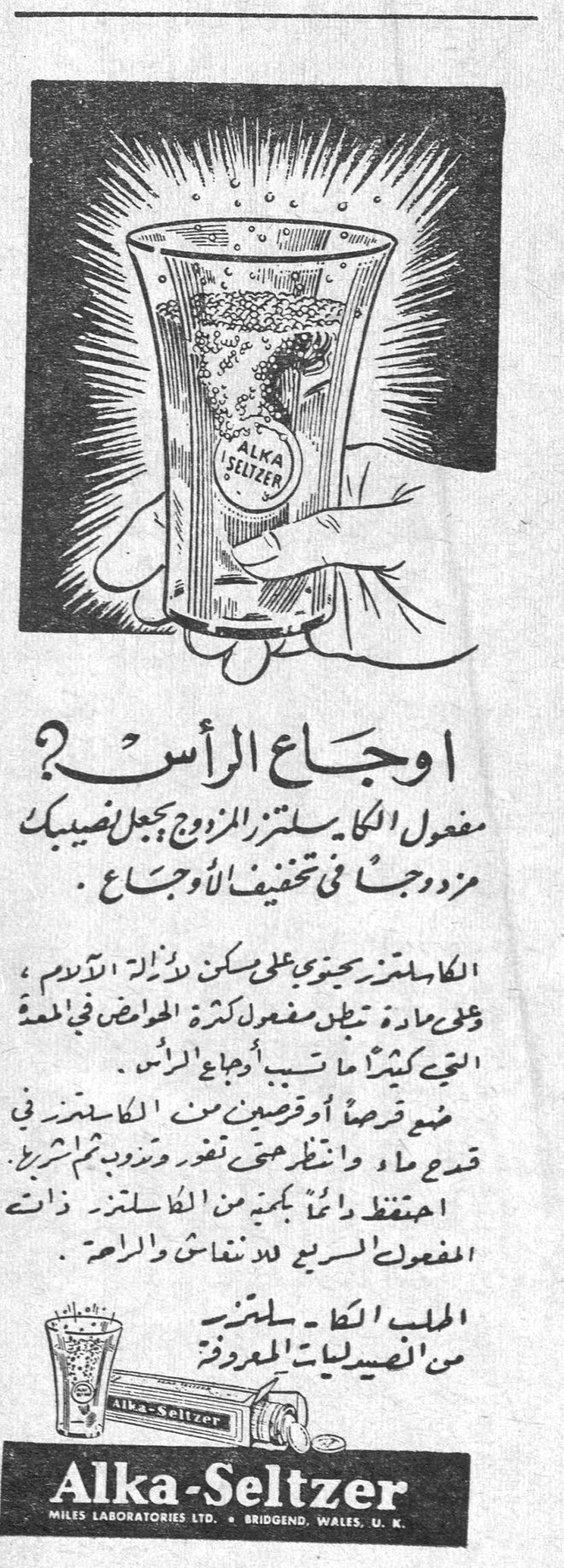
Headaches?
Alka-Seltzer's double action works doubly on your distress in easing the aches.
Alka-Seltzer contains a soother for pains of the head, and a substance that neutralizes the effect of excess acids in the stomach, which so often cause headaches.
Drop one or two tablets of Alka-Seltzer into a glass of water, wait until it fizzes and dissolves, then drink.
Always keep a supply of fast-acting Alka-Seltzer on hand, for vigor and comfort.
Ask for Alka-Seltzer
at the well-known pharmacies
Alka-Seltzer
MILES LABORATORIES LTD. — BRIDGEND, WALES, U.K.