This is what woman accomplished in the first era of her emancipation. When, after the First World War, the League of Nations was formed and centered in Geneva, its statutes drawn up by the apostles of peace — foremost among them President Wilson — among the most telling provisions of its charter was a law making woman the equal of man in all duties and rights; that was in 1919. Woman was thereupon given the full right to elect and to be elected to any post within the said League, and her position was strengthened in an institution which in that era carried its own particular weight. In the special professional and cultural fields, woman had been given before that date rights commensurate with those of man: in 1876 she was permitted to practice medicine, law, engineering, or any liberal profession on an equal footing with man. But the practice of purely political work was forbidden her, and the doors of the diplomatic corps and of the responsible ecclesiastical offices were closed in her face; to this very day woman in England — the pioneer in the field of the women's cause — cannot perform any ecclesiastical function within the established Church.
But despite the promises of the League of Nations, woman's possibilities remained confined within narrow fields, and she went on receiving less than man in the way of pay and rewards, even when she performed the very same work. If we look back a little into history, we see that when the Industrial Revolution swept over Europe and need required the employment of thousands of women in the mills and factories, woman's lot in this was at first shameful, and she was treated with much violence and cruelty — as the books of literature have handed down to us, picturing woman as a deficient creature whom life wrongs with every shade of humiliation and abasement and loads beyond her strength and capacity.
The Industrial Revolution left its evil mark on woman, for it brought her out to the factory — exposing her health and her family to dangers. But at the
same time this revolution helped to spread the idea of equality and of giving woman her full rights, for it enabled the struggling woman to call public opinion's attention to many social laws that raise the standing of the worker, woman or man.
The League of Nations, together with the International Labor Office, took to enacting laws to lighten the hardships borne by the worker
and granted woman certain privileges, taking into account her limited capacity for
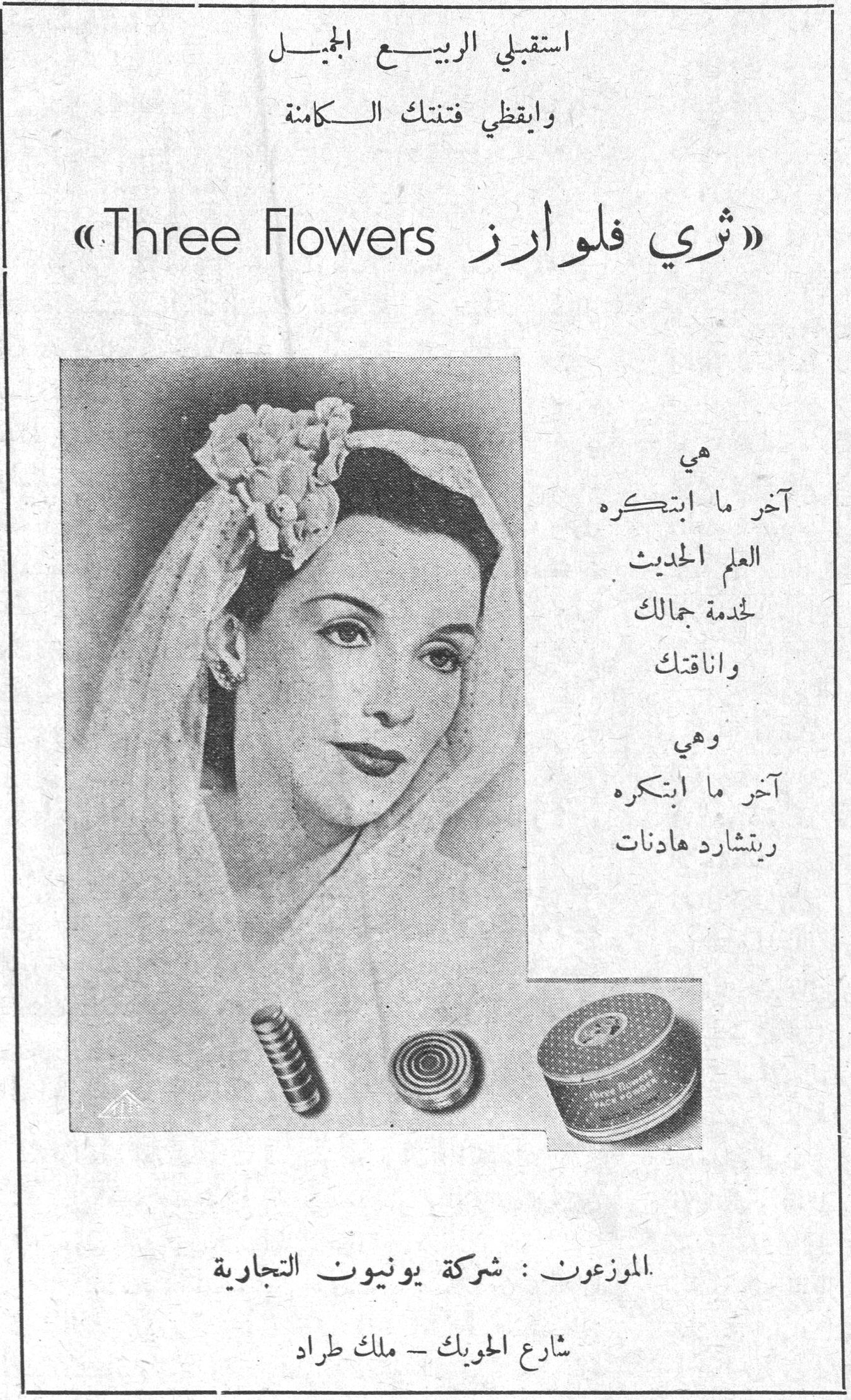
Three Flowers
Greet the beautiful spring and awaken your hidden charm
“Three Flowers”
is the latest creation of modern science in the service of your beauty and elegance
and the latest creation of Richard Hudnut
Distributors: The Union Trading Company
Howayek Street — Trad Building