down the breadth of the Thames, in rebellion against regulations and statutes — it was like a violent assault that shook the pillars of Britain. The Prime Minister of the day, Lord "Asquith," was among the fiercest opponents of the women's cause, but his opposition and that of his supporters went for nothing before this overwhelming wave of public opinion rallying to right and justice.
In 1913 the government tried to find a solution it could rest content with while preserving its dignity: it appointed from the members of the House a committee to cooperate with the supreme women's council, and this committee, under the chairmanship of Lord Lytton, submitted its first report, insisting on the necessity of giving woman her full rights. Then, when the sun of 1914 rose, and the European atmosphere grew electric, and black clouds gathered foretelling a savage war, woman's agitation subsided in England as it subsided in the other countries; she united for the sake of the national interest, and during the years of the war woman proved that she is man's greatest helper, standing by him and holding fast with him before calamities and horrors — and this stand of hers had the farthest-reaching effect on the clear victory she won some years later.
No Quarter
Yet the campaign of emancipation did not for all that come to a complete halt; the meetings and the petitions went on. At one of these meetings, while one of the fervent speakers was uttering fiery words on the necessity of complete emancipation and its effect on the country and on woman's spirit, Lloyd George, then Prime Minister, stopped her and began to speak calmly, deliberately, and with much patience of the need to go slowly, to leave this problem to an unnamed day, and for woman to concern herself with the present situation — whereupon our fervent speaker could do nothing but rise and say: "If you were my husband, I
would slip you poison!" And Lloyd George answered her with the calm and deliberation for which he was known: "If I were your husband, madam, I would slip the poison to myself!"
The Right to Vote
In 1917 Lloyd George's government gave the full right to vote to married women and housewives of thirty years of age and above, and in 1918 woman was granted the right to stand for Parliament; the first woman elected to the English
Parliament was the Countess Astor. Then in 1928 a new decree was drawn up, granting woman all political, civil, and social rights and closing the history of a stubborn war that woman had waged for her complete freedom. Most of the European countries acknowledged this law with surpassing speed; Spain lagged behind,
and France, Italy, Greece, and Switzerland. The lag of the Latin countries sprang from their fear of the power
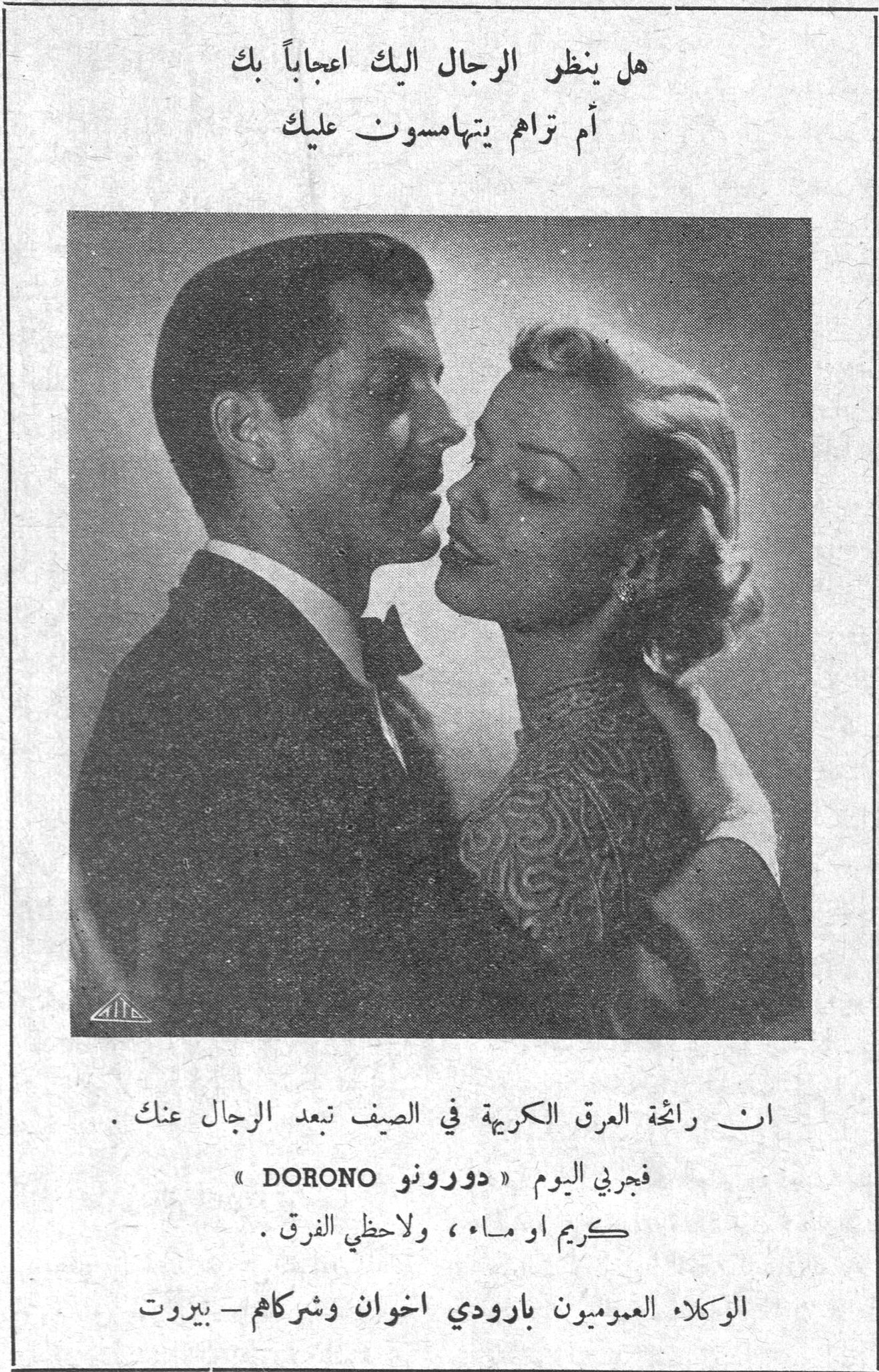
Dorono
Do the men look at you in admiration — or do you find them whispering about you?
The unpleasant odor of perspiration in summer drives men away from you.
So try today “DORONO,”
cream or liquid, and notice the difference.
General agents: Baroudi Bros. & Co. — Beirut