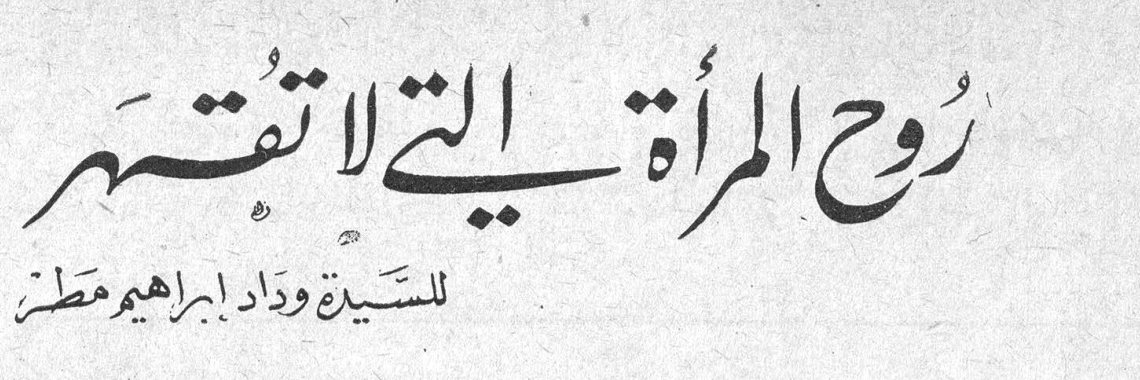
History preserves the names of a handful of men who overcame the hardships of life and reached the summit of glory in spite of their infirmities, thanks to their spiritual courage and to the presence within them of a living ember of an unconquerable spirit. There are illustrious names whose bearers reached the peak of glory despite the bodily ailments they suffered: there is Homer the Greek, who despite his blindness left to posterity and the generations the "Iliad" and the "Odyssey" as an immortal heritage; and there is the English poet Milton, who wrote "Paradise Lost" and his masterly poems after he had lost his sight. In our Arab history stands out Abu al-'Ala' al-Ma'arri, author of the "Epistle of Forgiveness," that splendid gem which he wrote while hostage to his two prisons. And among contemporaries shines the name of Dr. Taha Husayn, who has gleamed in the sky of Egypt and the world of the Arabs, for he was able, by the light of his inner sight, to overcome the darkness of his eyes.
It is no secret that when hardships fall and adversities blow, people divide into three parties. One party collapses before hardship and crumbles beneath the hammers of the days and the harsh blows of fate. A second party flees the field and retreats before adversity, taking refuge in an ivory tower or holing itself up in a secluded hermitage. And the third party — a minority, alas — find in hardship that which kindles the fire of resolve, tempers character, and quickens the spirit of courage and daring; you see them, despite their infirmities and their adversities, mastering their circumstances and rising above the crises that surround them.
Yes, we often hear of those pioneers among men, of that band of adventuring heroes who have been entered in the register of the immortals. Yet only rarely do we hear of women who have recorded such a spirit of courage and daring as men have recorded. They existed in the past, and they exist — thank God — in our midst now; and here is a company of them who have cut their way through to a life of glory, eminence, and triumph. No wonder: every nation has its great women and its immortal heroines. Space would fail me were I to attempt to count the names of those who have gleamed in the sky of glory, and of those who have played the roles of their lives with unconquerable spirits and unbending souls. I shall confine myself to mentioning three of them, plucked from different lands and disparate ages.
Let me begin with Madame Curie — that diligent student and discoverer of the element radium, the marvel of the twentieth century. The page of her life is filled with courage and intelligence, and teeming with every color of daring and steadfastness. However we turn that life over, we touch the qualities of nobility and heroism: in her mind, scientific thought; in her heart, the genius of lofty feeling; and in the story of her life, immortal stands of sacrifice and struggle. She spent four years with her husband Pierre Curie in a laboratory exposed to the rains and the blasts of heat, carrying out experiments, refining stones, and smelting materials. She performed hundreds of experiments and treated thousands of tons of pitch until at last she arrived at that elixir whose discovery astonished the world, for it paved the way for momentous discoveries that led to the discovery
of atomic energy, which has changed the features of modern history palpably.
Let me mention in second place Babushka, or "the little grandmother," as the Russian peasants called her in the days of the tsars. The heart of that lady was wide enough to embrace all her countrymen: wide enough to love forty million Russian peasants who groaned under the weight of ignorance, poverty, and oppression. For the sake of those tormented ones of the earth Babushka suffered what she suffered of pain, and bore what she bore of hunger, homelessness, prison, and exile. Her life was a chain of tragedies, for she spent most of the years of her life banished in the vast wastes of Siberia. Yet despite those adversities that stormed in her face she remained bright of countenance, working and sacrificing for the sake of those tormented ones. Her spirit went forth to its Creator from a village near the city of Prague, when she was ninety years of age, carrying to Him her complaint of man's injustice to his brother man.

The New Chen Yu
CHEN YU
• Keeps its quality for a long time
• Dries quickly
• Its colors are magical and alluring
• Its new brush makes it easy to apply
For fingertips and for lips