2
Man beheld nature and all that is in it, but he was ignorant of the meaning of everything; his ignorance led him to curiosity, which fused with fear of nature and of existence — above all of death and of spirits — and so he took refuge in magic. These negative impulses drew him on to take a positive stand, whose whole concern was to reassure his frightened soul and to quench his thirst for knowledge. So he began to explain things in a manner suited to his mentality and consonant with his inward inclinations.
And when the foregoing impulses had ripened and man set about explaining, he did not know (as we now know) that he was embarking on one of the most majestic of man's works in all the ages — on the creation of myths. We must understand some of the positive factors that united with the negative ones and gave the myths the form we know, the form in which the ancients believed, especially the Greeks and the Latins.
Giving the phenomena of nature their souls:
Man's understanding was limited and the range of his thought feeble, so he looked upon all the phenomena of nature as he looked upon the men and animals around him: he saw some as a man, some as a woman, some as an animal, and he fancied that everything in existence had a soul, as he himself did. Yet he acknowledged that the soul of these beings was immortal, that it did not wither as he withers when he dies — for he had observed their perpetual endurance while he perishes, their constancy while he fades away. Hence arose man's deification of the phenomena of nature and the various beings in existence: from giving them souls, regarding them as human, and bestowing on them the gift of immortality.
For this reason he saw the sun as a god, the moon as a goddess, and the stars as lords, and he believed that in every river there was a god and in every tree an immortal soul. And since the sun was the greatest of the heavenly bodies and the one with the most influence upon people, livestock, and crops, and since man's fear of it exceeded his fear of any other body, his veneration of it surpassed his veneration of all the rest: he sanctified it, worshipped it, and wove around it the greatest of the myths. We find the sun in most of the myths of the ancients; indeed, some scholars of mythology hold that all the myths are but different
versions of one fundamental myth about the sun, and that the "Iliad" itself is nothing but a sun myth!
Exaggeration of facts and belief in marvels begot the myths of the heroes:
Just as giving the phenomena of nature human souls — gods — was a foundation in the process of creating the myths, another element was at work in it as well: the exaggeration of historical events and the belief in marvels.
A child sees a strange happening he is not accustomed to seeing, and it affects him; and when he recounts what he saw, we find he has added to it, enlarged its details, and given it a terrifying or astonishing or thrilling shape. Such was the case of ancient man: he magnified heroism and sanctified the hero who distinguished himself in battle, and he would speak of him, telling his tales and magnifying his valor, so that not many years passed before this hero was surrounded by a halo of tales differing plainly from the original and from the reality. Moreover, ancient man believed in fate and in miracles, and held that in one side's victory over another in battle there was a part played by fate and carried out by marvels. This belief in beings possessing more than human power led man to create new myths, different from the myths concerning the phenomena of nature: the myths of the heroes.
And since man believed that everything had a soul, he gave these heroes and these unseen powers souls of their own, and so they became persons, and consequently gods or demigods. And he elaborated further:
These heroes intervene unseen in the affairs of
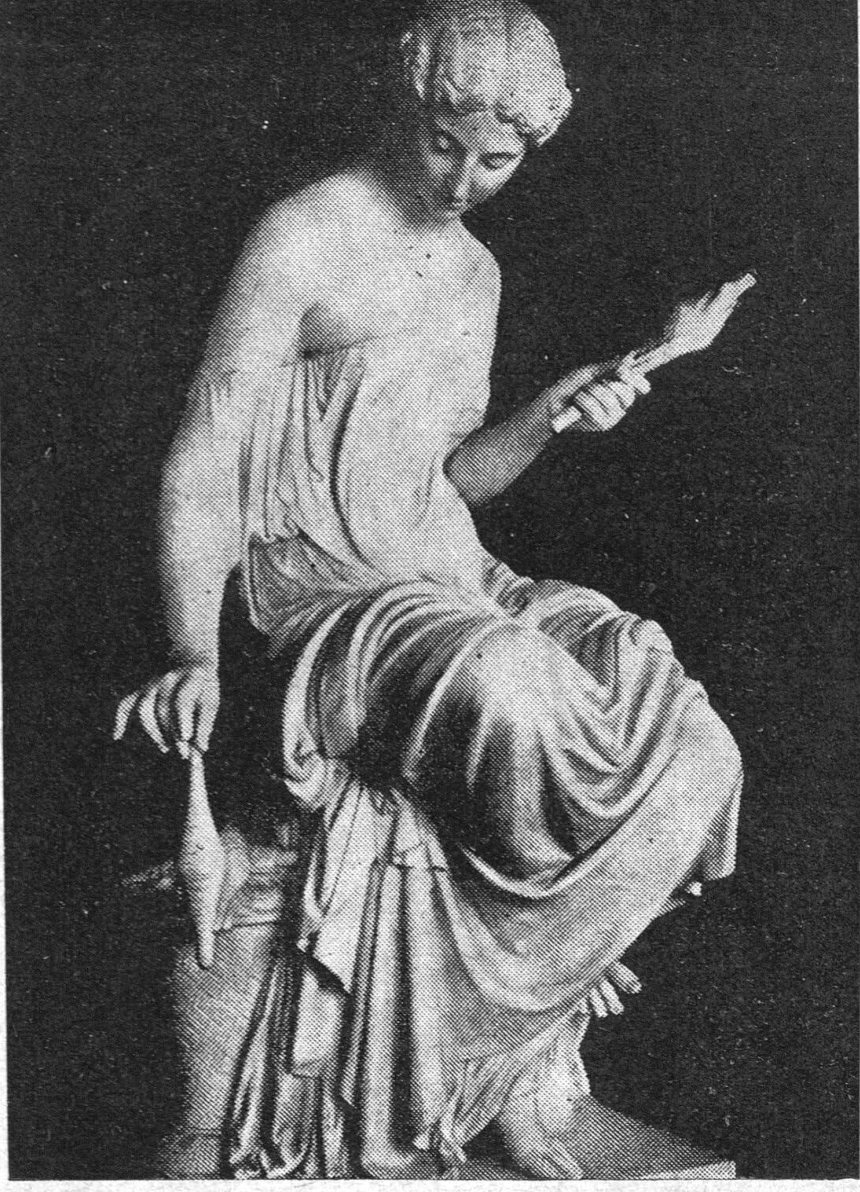
Arachne defied the goddess of wisdom with her art, so the goddess grew angry with her and turned her into a spider...