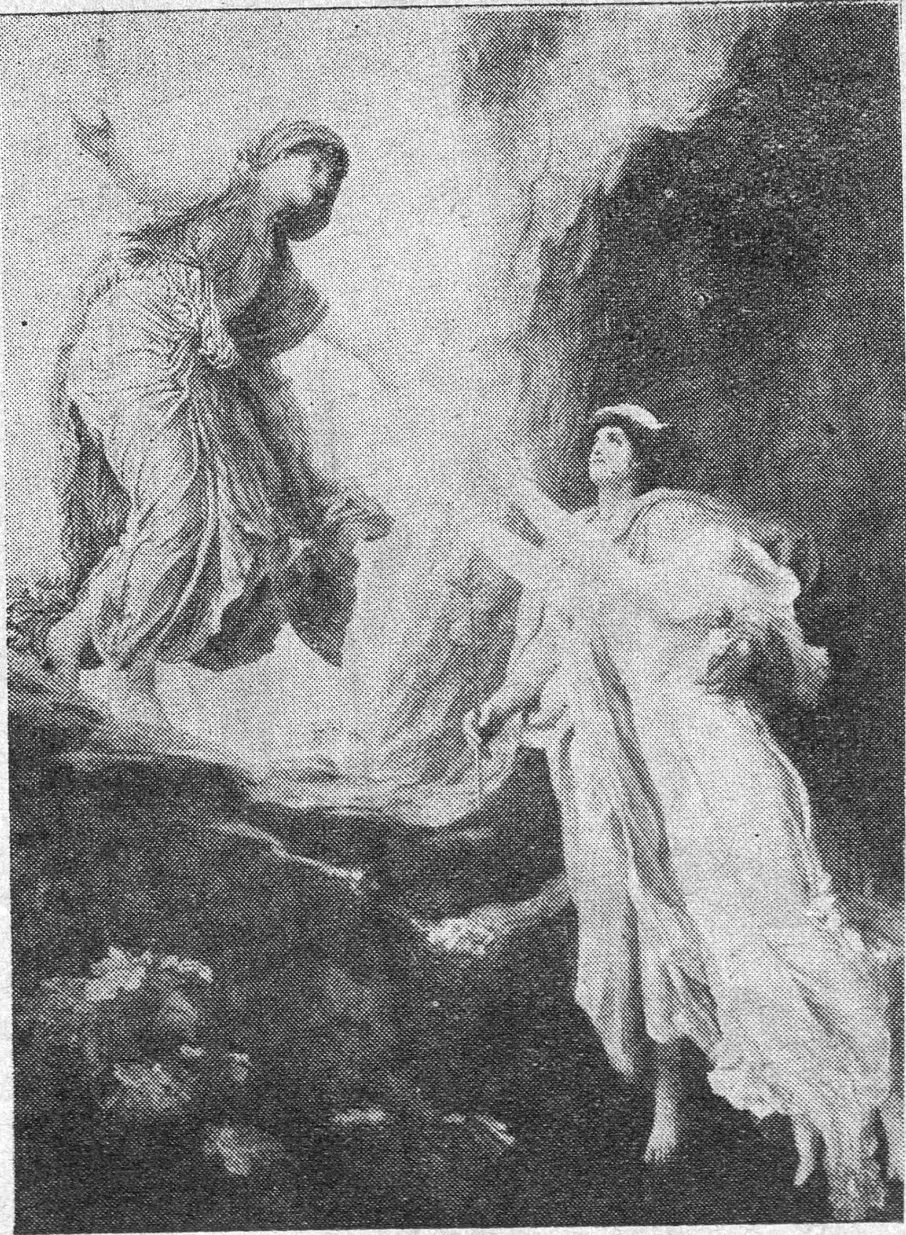
Persephone came back, and restored life to her mother Ceres, and spring to the earth...
men; they are therefore midway between the gods and men, and — according to the thinking of naive man — they are the sons of the gods who married the daughters of men.
The "names" of the phenomena of the universe turn into "gods":
Man gave each of his many gods a name: he called the sun "sun" and the moon "moon" and the dawn "dawn," and all these became particular proper names pointing to beings that we know as inanimate and that he knew as possessed of divine souls. But the meanings and conceptions of these names evolved, and this evolution was an important factor in creating the myths and giving them the form they have now. It happened as follows:
Scholars differ in fixing the place where the Indo-Europeans lived, among whom mythology first dawned; yet they nearly all agree that they dwelt in India. In India, then, man began to think for the first time about the phenomena of the universe: he revered them, feared them, and needed to know them; so he gave them human souls, believed in them as his gods because he had glimpsed their power and their immortality, and called them by their names as they stood in his language. Just as we call the sun "sun," he called it "Phoebus," and so on. And as this heavenly body came to have a soul and became a god, it came to have a name — Phoebus, the very name it had borne before it was deified. But the Indian tribes began to disperse; they struck out across the horizons, each settling in some region, and some of them came and dwelt in the land of Greece. They preserved the beliefs they had held before, went on deifying nature, and the names of the gods remained as they had been, even though the language changed perceptibly from the original. With the passing of the days these names remained in use as proper names, and their meanings were lost. After a time they no longer knew that "Phoebus" was an ordinary word meaning "the sun," and so they thought it was the proper name of the sun as a god; and all the myths that had earlier been woven about the sun, and which they themselves reworked, became myths about a heavenly god named Phoebus, not about the sun as an astronomical body that gives life, rises, and sets.
Say the same of the names of the other gods: they were transformed from ordinary names used for the phenomena of nature into names belonging to gods embodied in the phenomena of nature. The names became gods (as the Latin saying has it: "the names, nomina, became gods, numina"), and the myths were created as we know them today. Thus we read that "Phoebus" was the son of "Leto" and that he was born in "Delos"; and we understand from this, as the Greeks understood, that this god was the son of that goddess and was born in that place. But these three words have meanings in the Indo-European tongue in which the story was first composed, and if we go back to them we find the myth means this: that "the giver of light" was the son of "darkness" and was born in "the land of illumination"!
The Greeks polish the myths with their sense of beauty and their borrowing:
Thus, then, the myths came to be. Man invented them spontaneously in ancient times in a remote
corner of India, but the Greeks polished them and set their imagination and their sense of beauty to work upon them, bringing them out as we know them. Anyone acquainted with Greek culture — philosophy, poetry, mathematics, tragedies and comedies, art and science — can appreciate the element of beauty that people bestowed. Beauty had its influence in the creation of the myths: the Greeks transformed them from dry stories describing the universe and nature into tales full of beauty, love, imagination, meanings, magic, and splendor. And most of the myths we possess and call classical — it was the Greek genius that labored to beautify them and heighten their luster.
Elements from outside entered the Greek tradition, adding to the number of the myths and giving them new touches and beauties: some came from Crete, some from Egypt, and some sweet ones from these very shores, like the two myths of Adonis and Cadmus.
The myths began as religion and ended as art:
Man was now at ease; he had explained everything, persuaded himself that he knew and was not ignorant, that he was reassured and unafraid, and he had sated the full range of his love of knowledge. So he believed in gods and goddesses and heroes, in fate and in revelation — and all of that
by way of