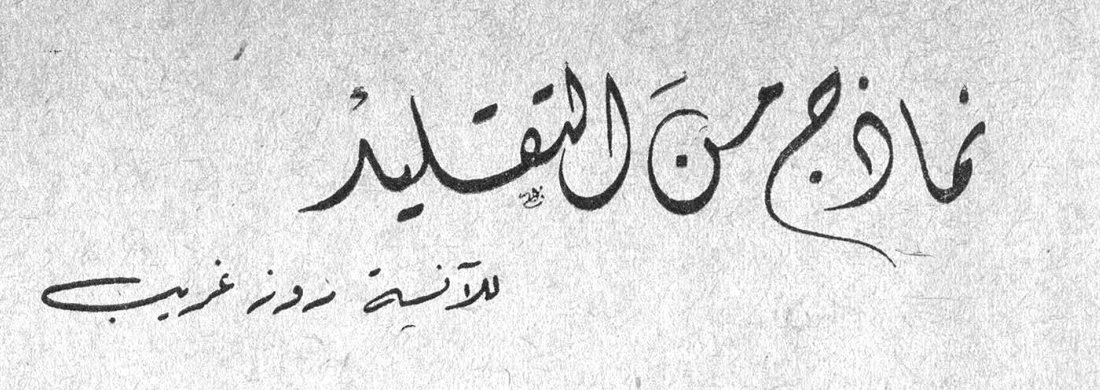
In our culture we stand between two currents of imitation: imitation of the ancestors, copying their ways of living, of writing, and of thinking; and imitation of the Westerners in these same respects. Imitation is good if it suits our age, our environment, and our needs — if we know what is fit to be imitated, and how to digest what we borrow and transform it into our own being until it becomes part of us. But blind or parrot-like imitation, which takes no account of the needs of environment and age, is a rejected imitation that stirs pity or ridicule.
If I could reach every student, boy or girl, in Lebanon, I would ask him to make this his motto in writing: "Beware of ready-made molds and secondhand ideas. Free yourself! Write what you see or what you think, and do not repeat phrases picked up by ear and opinions in circulation!" My experience with students of both sexes shows me how badly this principle is neglected in our schools. Our students write nothing but the current run of sayings, as though the motto of most schools were to encourage imitation and banality in their students.
Nor are the schools alone in encouraging taking and copying because it is easier to come by; this is also the habit of many of our newspapers and magazines. Some translate without indicating the source; some borrow foreign opinions and try to spread them in our country, claiming that the ailments the West complains of are the very ones we complain of
— and how far apart are their ailments and ours! Let me give you some examples of blind imitation:
"Save the family!"
There lately arose in the West a movement to save the family and to encourage marriage and motherhood. It has several causes: among them, the decline of population in the wake of the successive wars; among them, the loosening of the family's bonds and the scattering of its members following the industrial revolution, which emancipated woman and compelled her — together with husband and children — to leave the house and work outside, so that the members of the family came to be dispersed, some in the schools and some in the factories and workplaces; and the independent spirit grew in them — the wife's independence of the husband, and the children's independence of the parents, thanks to independent work. On the other hand, woman's liberty increased, and the young men's inclination toward marriage weakened, out of desire for a free life. The conservatives saw the family's very existence threatened, and they rose to its rescue, crying woe and ruin; their movement met with some success, but they could not halt the march of history nor stand in the way of human development.
Following the rule of imitation, that Western movement found favor in the hearts of some journalists and pen-wielders among us, who set about writing on the subject of the family and mother
hood, claiming that the existence of the family among us is threatened thanks to woman's liberty and the turning away of young men and girls from marriage — and all the rest of those delusions.
The truth is that woman among us still drags the chains of the past, which deny her civil and political rights. And the woman who works outside the house has come to labor under two burdens — her work outside and her work in the house — unlike the Western working woman, whose husband helps her with the housework. As for the young men's turning away from marriage, its cause is straitened means, which sometimes drives them to postpone their marriage until forty. And as for the family and motherhood, they are in the best of health: they do not complain of too few births, as in the West, but of too many births, and of poor care of them.
If those journalists, and those who follow their course, were fair, they would reverse the verse in their inquiry and cry out with the tongue of the rising generation: "Loosen from us, rather, some of the family's chains! We believe that man cannot live alone, and that the members of one family must cooperate; but that does not mean charging them with more than they can bear.
"Loosen from us, rather, some of these chains that make it lawful for parents to contract for their daughters a marriage in the parents' interest and not in theirs; and to impose upon the son a marriage that pleases the members of the family but does not please him; and to require the young man who has wedded a girl to accept that he is marrying, along with her, the mother and the father and the brother and the maternal aunt