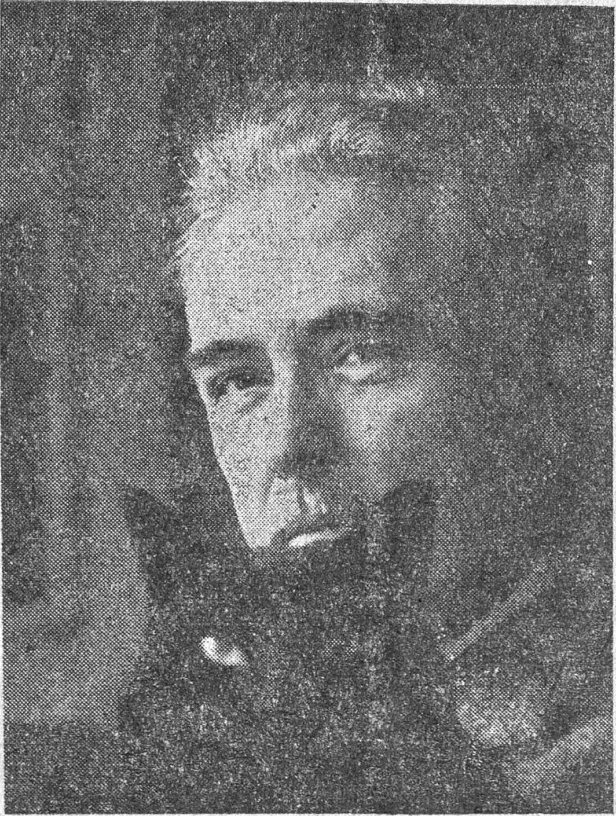
The poet-critic R. P. Blackmur, dean of the great literary circle at Princeton, with his cat "Proctor," as famous in the university as some of the professors!
Present-day literature in the Anglo-Saxon world is passing through a great renaissance such as it has not known for generations. And the primary elements of literature — poetry, drama, and criticism — have two principal homes to which the credit for its flourishing and richness belongs: Blackmur's circle at Princeton in America, and Leavis's at Cambridge in England.
As for Princeton, it currently holds such brains as no other comparable spot in the world can boast. In addition to the university that bears its name, the town contains the Institute for Advanced Study, where the greatest scientist of the entire twentieth century works: Albert
Einstein. The university and the institute have made Princeton the focus of scholars' eyes wherever they may be, and it has become the foremost center for mathematical and physical research. There is also the Westminster school of music, among whose teachers are a number of the greatly gifted. And there is a number of world-renowned lecturers who come to it one after another, such as Hu Shih, the greatest of China's men of letters; Robert and Gaby Casadesus, the two most famous musicians; the well-known historian Arnold Toynbee; the first poet of this half of the century, T. S. Eliot; the philosopher Jacques Maritain; the physicist Robert Oppenheimer; the novelist John O'Hara; and others besides. And if we have named these great ones, it is not to neglect saying that there is a number of other personalities who, if they fall short of these in fame, fall short of them not at all in genius and weight — some of them connected with the university or the institutes, and some dwelling in the town so as to remain within that literary and intellectual milieu, and so that their names may be mentioned along with its name!
What has endeared Princeton to these men is that this town, which holds no more than 16,000 souls, offers ivory towers if the resident wishes them, and connection with the outside world if he wants it — for it lies but an hour's journey from New York.
In Princeton there are places of amusement where some of those
"great ones" gather from time to time — theaters, tennis courts, and swimming pools. But there is no salon or intellectual forum that imposes itself and brings together the city's prominent intellectual personalities. This regrettable lack, however, is made good by certain occasions at which they meet one another, and meet others among the "lesser ones" in whom the contemporary poetic, literary, and intellectual renaissance is centered.
Foremost in standing among these occasions is the "Pure Literary Circle," led by two men of contemporary letters: R. P. Blackmur, chief of the school known as the school of the New Criticism, and Francis Fergusson, the specialist in dramatic literature. Both are among the pillars on which the fine literary magazines of America rest — those known as the "little magazines," because the literary character that prevails in them puts them within reach of the small elite alone! And the circle they conduct is known in the world of Anglo-Saxon letters as the most intricate of all literary circles, the most devoted to art, and the most abundant in benefit and value. It is worth mentioning that the students of the university — even those specializing in literature and those in its graduating classes — have no right to attend this circle; indeed, not even whoever wishes among the university's own professors may become members of it. Belonging to it is restricted to a small number of the masters of letters and of writers, especially poets, known for their creative production — and their admission is subject to Blackmur's personal approval.
It is worth recalling that Blackmur received no schooling at a university or college, and that despite his fame in the first degree