as a poet, he is known by the name of "the critic of critics," and as "the greatest and most eminent of those versed in the literary and critical life of America." His method in criticism rests upon treating the literary text itself, without concern for the other aspects that come on the margin of the text, and upon dissecting texts with an ample, scientific dissection which at times comes close to the world of science and mathematics.
Princeton is a university for men and does not accept women! But Blackmur pays no heed to the university's constitution, and does not disdain to admit the well-known women of letters to his circle when he finds them. It will please the readers of this magazine to know that our great poetess Nazik al-Malaika is now a member of his circle.
*
As for England, the literary renaissance is centered not in the comparatively young universities but in the old universities that have become part of the English — say rather the world's — heritage, and most particularly in the University of Cambridge. Cambridge, as is well known, comprises a number of colleges, as most universities do. And if we hold that the renaissance of contemporary literature is centered there, we mean specifically one particular college among its colleges: Downing, which is never mentioned without the name of its greatest personality being mentioned with it — the critic F. R. Leavis. A poll recently taken at the university showed that Leavis is the teacher dearest to his students' hearts and the one with the greatest influence upon them. Many writers and men of letters hold that when the history of English literature
between 1935 and 1955 comes to be written, Leavis's name will be the most brilliant name of that era, and it will become plain that he is the man of letters with the greatest influence on literature and the greatest hand in directing it.
Leavis is the proprietor and
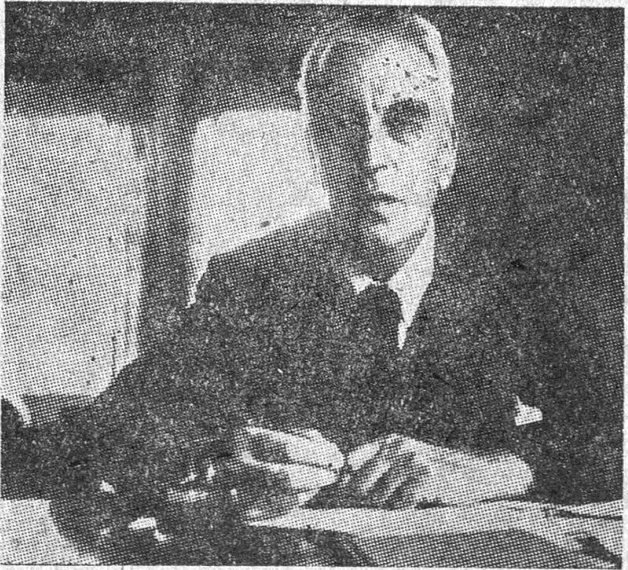
The most famous historian, Arnold Toynbee.
editor of the well-known critical magazine Scrutiny, which was and remains a war without quarter upon the ailments of literature, without regard to the personality or the station of the writer. For this the literary feudalism made war on the man and his magazine — so that you would not find it in the bookshops, and if you did come upon it, it was in the drawers, hidden away with the lewd books! He is the author of "The Great Tradition," which is counted among the finest works of criticism and guidance in our age.
Downing College is young if measured against the university's other colleges; it stands a little apart from its sisters, and its courts are distinguished by an abundance of peacocks frolicking in them. Downing is known as a Bohemian college that departs from the accustomed in its social ways; therefore those of the knitted brows look at it askance, and refuse to let those who join it (especially its literary circle,
which parallels Blackmur's circle to a far degree) enroll in the haughty aristocratic clubs! Indeed, the other colleges do not regard it with much satisfaction, calling it the academy of the corrupted, and calling Leavis the corrupter of youth!!
But this prejudice is one thing, and the reality — which even those men do not deny — is another. There is no dispute that Cambridge today, thanks to Downing College and its literary circle, and thanks to them alone, is the home of a comprehensive literary renaissance in England — a renaissance resting on strong and singular foundations, which have stood firm in the face of difficulties; much good has come of it, and much more is yet hoped for.
*
In Princeton and Cambridge are two circles for poetry, criticism, and the humanities, which cause English literature to enjoy a great renaissance — and cause the world to acknowledge that literature is still in good health!
Woman: Body and Soul
The long-awaited book has appeared
Woman:
Body and Soul
By Dr. Georges Hanna
Publishers
Dar al-Ahad — Beirut
To be ordered from the publishers
Price per copy
500 piasters, or 230 millimes, mils, or fils