one he had called "Across the Death-Line." When he returned to his hut in the evening, he found a sum of money on his table as the price of that novel. And what he did was to build with that money a room in his hut, which he made a hospital for the sick. To this very day he spends out of his income of fifty thousand dollars on charitable projects, keeping only a little of it to provide for his own living.
And seeing among the people an ever greater eagerness to buy his novels, he set about showing the world, in his many useful writings, the harms of filthy places.
It was his habit to write at night, when everyone was sunk in sleep, until the break of dawn.
Through this great diligence of his, in 1924 his gifts and his sound opinions came to light, and the Japanese people adopted them; they had a telling effect and won the desired acceptance in its society — among other things, the government wiped out from six great Japanese cities all the filthy, pestilent quarters.
The change that came over Kagawa's life, raising him from an ordinary servant of the poor to a great social reformer, took place in 1914, when his friends asked him to leave the country and go to the theological seminary at Princeton to complete his studies there. When he returned again to Kobe he joined the society of the (Labor Movement); but the times were hard, and the workman toiled the whole span of his day and received only a meager wage.
So Kagawa wrote at that time criticizing the treatment of the workers, and proclaimed: the workers are not commodities to be bought and sold; they are
persons in their own right, and they must be granted their full rights. Thereupon the workers went on strike, and they compelled Kagawa, their champion, to march with them in a demonstration whose result was that the police seized him, beat him, and threw him into prison for thirteen days. On coming out of prison he found that the Communists had spread
word of him among the strikers that he was a foolish man and a tool in the hands of the workers. And they agreed in saying that the best way to break the power of the men of money was to break the machines. So there gathered about
1,500 men, all armed with iron implements and the like, and they drew near a great yard without
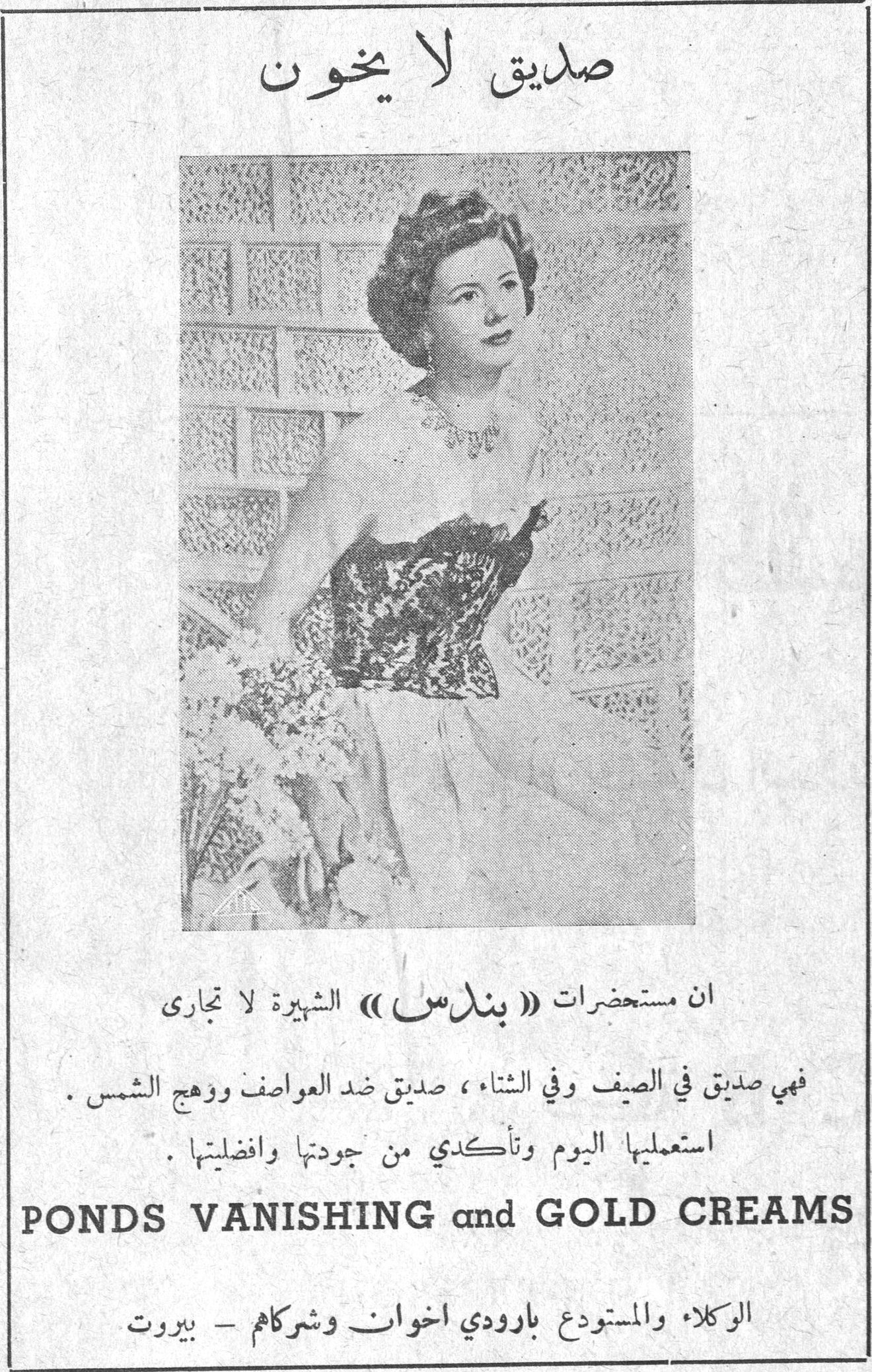
A Friend That Does Not Betray (Pond's)
The famous "Pond's" preparations are unrivaled
They are a friend in summer and in winter, a friend against storms and the blaze of the sun.
Use them today and be assured of their quality and superiority.
PONDS VANISHING and GOLD CREAMS
Agents and depot: Baroudi Bros. & Co. — Beirut