"The work we are founding today, gentlemen, knows no parties or nationalities or religions or states; it is nothing but the lightening of misery and pain, and the succor of the suffering and the wretched."
She then reviews the activity of the Lebanese Red Cross society, mentioning its eighteen free dispensaries, its branches in the various cities, the school of nursing attached to it, the sewing workshop, and the Junior branch.
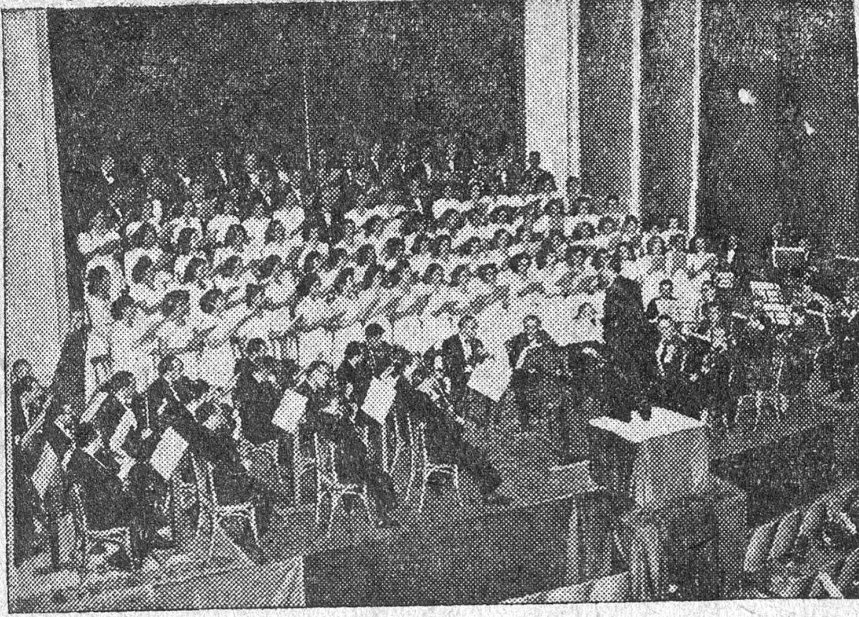
The choir of the Lebanese Academy under the direction of Mr. Alexis Boutros
On the twenty-second of March, airplanes left the soil of Lebanon carrying some seventy young women and young men under the direction of Mr. Alexis Boutros, president of the Lebanese Academy, to make an artistic and cultural journey to Egypt.
I shall not attempt to recount the stages of our journey, for the newspapers in Lebanon have described it at length. Nor is there room for me here to tell of the successful concerts, attended by thousands of admirers, whether at the American University or in the great houses of worship of Cairo, which left the finest of impressions upon souls.
I shall not recall in detail what the newspapers of Egypt, in all their colors and languages, wrote in appreciation and admiration.
Did not our souls grow larger and our hearts open on the day we entered the beautiful house of our Legation, and received from its noble lady and master a generous share of encouragement and hospitality?
Did we not feel a supreme inward joy on the day we all sang for the homeland before the green cedar raised aloft on the banks of the Nile?
Yes — our souls grew larger too on the day Mary Kahil opened to us her enchanting palace, and we carried away a spark of the radiance of her faith in the beloved East, and of her lofty esteem for the constructive works in Lebanon.
But our journey to Egypt held deep meanings, rooted in the very core of the idea which, twelve years ago now, moved Alexis Boutros to found this choir and to foster it with care, sacrifice, and effort. For the spiritual motives that drove us to sing with overflowing vitality, and with a faith to shake mountains, spring from the delight of joining the integrated whole and working with it in a spirit of loyalty and devotion.
It was not Alexis Boutros's purpose merely to acquaint us with the immortal pieces of music; his purpose from the beginning was that we should live with him within the integrated order, each of us feeling that he is a living part of the living whole.
Does not each of us give his single voice in order to hear the hundreds of voices joined to his single voice? And did not each of us feel that he is a part completing the whole, and that his contribution, however small, has its own value in the work of the whole?
And does this work of the whole stand except by straining powers and gifts to the farthest limits of cooperation and solidarity? The ideal choir, then, is the one in which the individual dissolves, denying his individuality before the highest aim — and is there anything in existence more precious than working with the group, for the sake of the group?
Among the merits of choral music, too, is that it is within reach of all; any individual whatsoever can take part in it. It requires no prior preparation, and demands of whoever wishes
to join it no special study, as the orchestra, for example, demands. All that is needed is a sincere desire for orderly work, and a desire to press on toward perfection. And this in turn guarantees the desired result, once it is supported by the precise instructions and interpretations we enjoy when we study the immortal musical pieces at close hand before we hear them.
How greatly we in the East — we who have been known for individual withdrawal — need organized collective works in the world of art, as in all the other fields of positive activity. The West learned before us the value of the close-knit whole, and today, through its captivating artistic heritage, we wish to learn it too.
How happy we shall be on the day we see in Lebanon tens of choirs, gathering hundreds — nay thousands — of the young, coming to know the delight of truly working, and of singing together, as one complete and solid unit.
We returned from Egypt after our practical experiences had mingled with the monuments of the civilization of the glorious past; we returned believing that the constructive heritage will carry us upward, despite the confusion that sweeps the practical world today. And it remains for us in Lebanon only to strengthen our faith in this constructive heritage, and to march in its train — not as individuals, but as a whole united in aim and goal.
And how intense was our delight when we learned that our conductor had received, in the wake