with her concern with social work outside the home. Hence arises the problem of the correct reconciliation of these two cares. Despite this clash I think she has managed, more than others, to reconcile in some measure the work inside the home and outside it, and that owing to three basic secrets in her life. First: the practical administrative organization inside the home, where every hour has its own program. Second: the complete cooperation among the members of the family in the service of the home — even in the washing of the dishes! And third: her personal energy, which enables her to attend to the home and to press on after public service or the pursuit of a livelihood outside. But this remains, in my view, the problem of problems in the social life of the American woman today.
As for the cultural side, the American woman enjoys complete equality in education. All the doors of learning and specialization are open before
her, whether in the government institutes or in the private schools and universities.
And from the graduates of the higher institutes of learning is formed the "American Association of University Women."
And in every field of learning and specialization we see examples of women who have distinguished themselves by their mental capacity — we find woman a professor, a physician, a judge, a lawyer, a worker in communications, a writer, and a journalist. Perhaps the two doors of novel-writing and journalism are those the American woman enters most, and for this we constantly hear the names of the famous women novelists such as Willa Cather and Margaret Mitchell, or of journalists such as Anne O'Hare McCormick or Dorothy Thompson or Marguerite Higgins, who lately won a great annual prize for her precise reports in the Korean War. These writers have world fame.
From these fleeting pictures we clearly conclude that the American woman, despite abundant difficulties that have confronted her and confront her still in the clamorous present age, has nevertheless realized a full portion of the perfection of her humanity and of her equality with man in dignity and rights, and has taken part in civilization's constant creative act, endowing her own world and the wider world with living works.
And if we hold against the American woman a certain mechanicalness in her way of living and a certain excess in the imitation of man, with the harm this brings in some degree to her perfection as a woman, her great virtue for all that is that she is a resounding voice in her society, a fundamental pillar in the life of her country, and an effective agent in deciding the destiny of her nation.
And we — how does the woman among us look at herself, what is her ambition, what are her hopes,
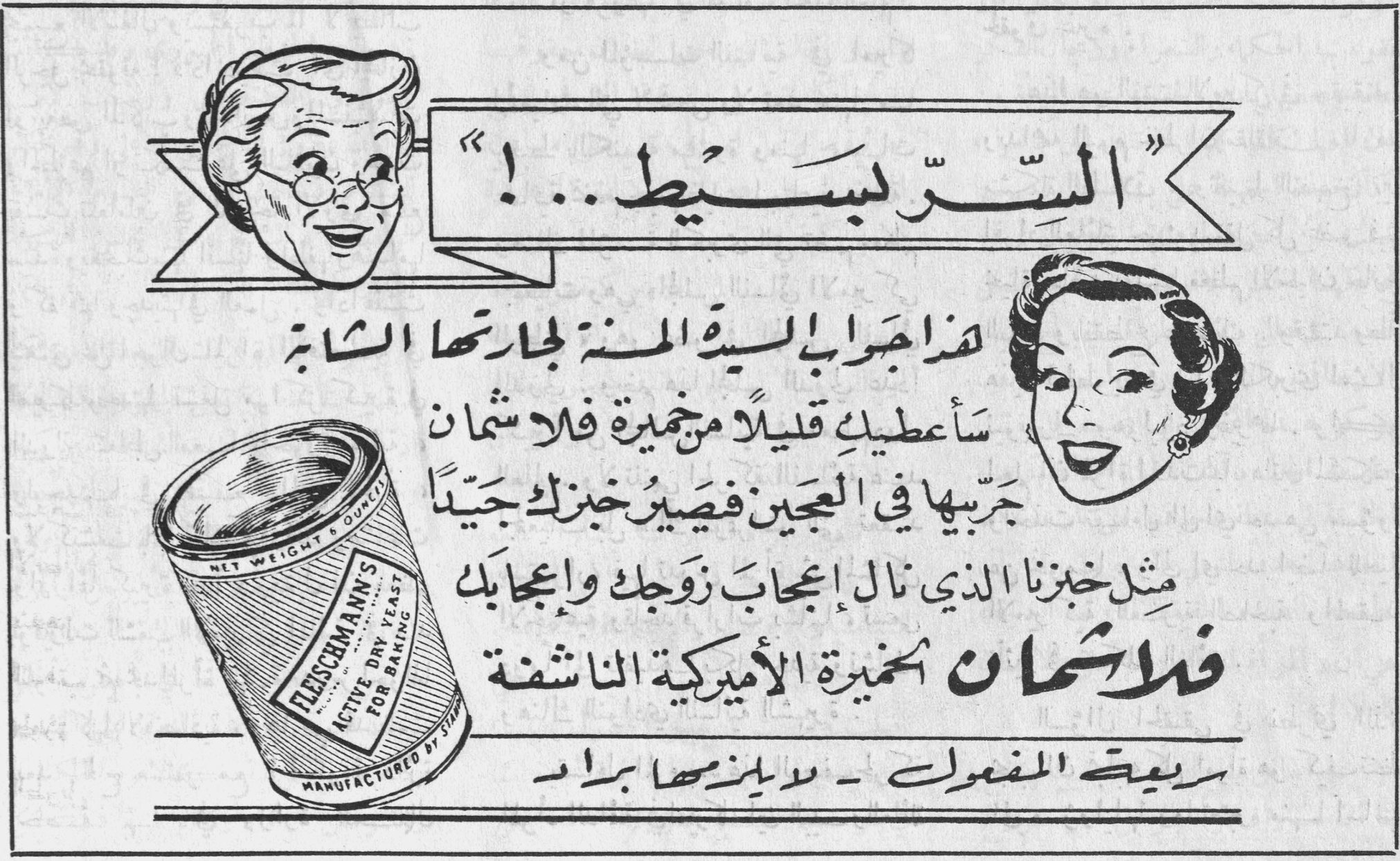
"The Secret Is Simple...!" — Fleischmann's Yeast
"The secret is simple...!"
This is the elderly lady's answer to her young neighbor:
I will give you a little Fleischmann's Yeast. Try it in the dough, and your bread will turn out as good as ours — the bread that won your husband's admiration, and your own.
Fleischmann's — the American dry yeast
Fast-acting — needs no refrigerator