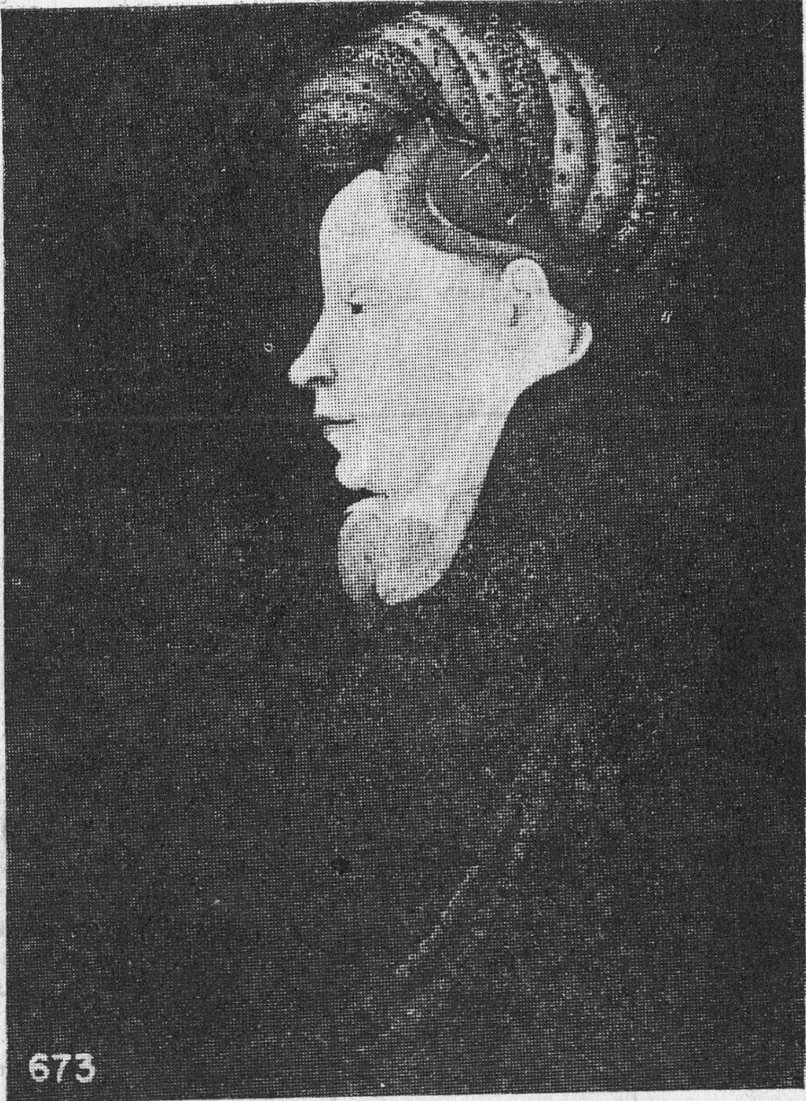
673
• We are now in Italy, in the fifteenth century, when the European Renaissance had begun to dawn — in the Italy you know today, which was then a collection of independent states, such as Florence, Venice, Naples, Milan, and others.
"Portrait of a Lady" — this is the title of the artistic painting displayed above these words. Pisanello painted it around 1415, and in it he left us a display of the aristocratic dress of his day. The collar is high; the artist insisted on bringing it out, although it was not common at that time. The hair is raised upward, arranged toward the front, and ends in a braid. Simple pins are used for adornment — the ladies of Holland took this idea from the Italian women, and the use of pins became widespread among them. The gown is blue, embroidered with gilded purple, and at its top is a circle of jewel-studded buttons in place of the long necklace.
• We are still in the same country and the same century.
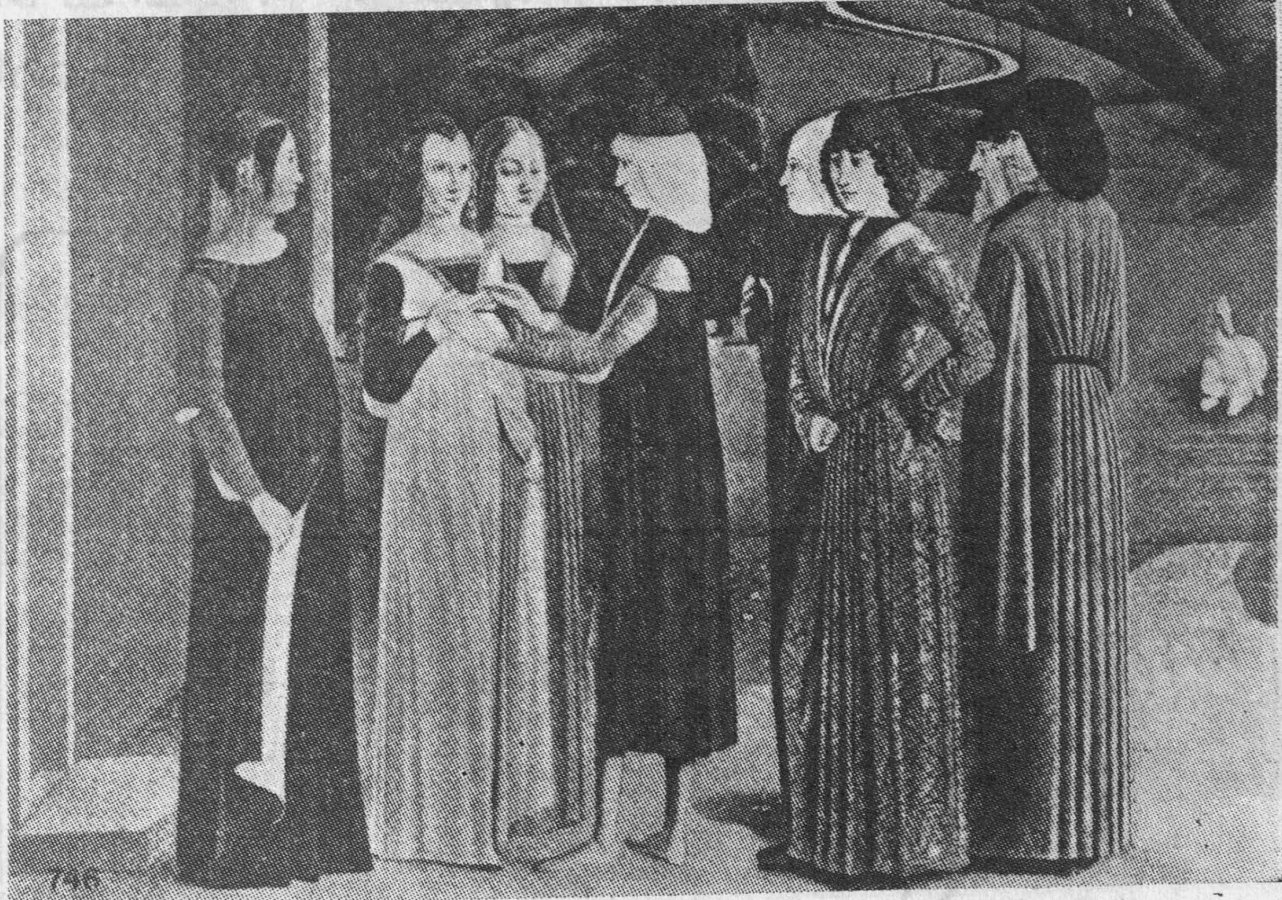
A painting, which may be by the brush of Moroni or by that of Michele da Verona, whose subject is "The
An illustrated survey of women's fashion in Europe and America as it developed over 500 years of time.
In it we present artistic paintings from France, Italy, Germany, England, Spain, and America, from the opening of the fifteenth century to the end of the nineteenth century just past, from which we may gather the feminine beauty of those lands and ages, and the development of elegance and dress.
Betrothal of Jason and Medea." He painted it in 1470.
The idea is mythological, but the artist naturally cast it in a contemporary mold, so his women and their costumes are the women of his own age and their costumes. The women wear coverings on their heads, and beneath them small flat caps. Their hair ends in braids that swing before the ears. The sleeves are finely made. Two large buttons fasten the skirts in front.
746