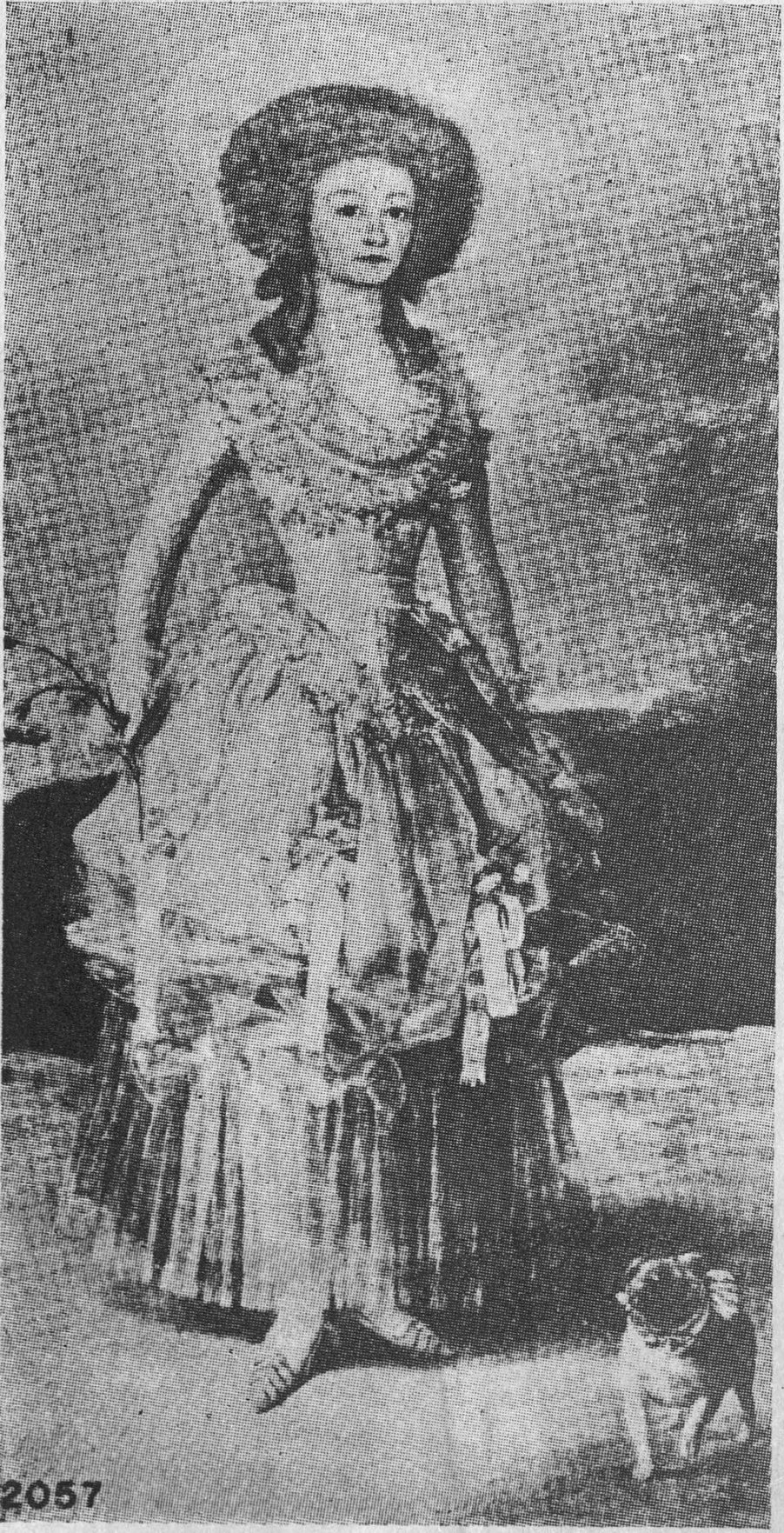
• We are now in Spain, in the eighteenth century.
In 1790 the great artist Goya painted this portrait of the Marquesa de Pontejos.
Powders are used in moderation. The hair has begun to come down more and more upon the head, and a braid of it swings beside each of the ears. The dress is gray, with a tinge of pink upon it. The sleeves are long and cling to the arms. The collar is wide and ornamented. The skirt is rounded and full. The shoe is finely made, in the shape of a triangle, the toes thrust forward.
The heir to the throne is on the left; he has no personality, and is very weak before his father the King. The Princess his wife is on the right, Bavarian by origin; she was not possessed of any great beauty, but she was attractive and kind of heart, and she loathed the court and spent her time reading or lis
'Amr ibn al-'Ala' said: The most knowing of men about women is 'Alqama ibn 'Abada, the physician, where he says:
If you ask me about women, then truly I am learned in women's ailments — a physician: When a man's head grows gray, or his wealth grows scant, he has no portion in their affection; They want abundance of wealth wherever they know it to be, and the bloom of youth is a wonder in their eyes.
And from Mu'adh ibn Jabal: You have been tried with the trial of adversity, and you endured; but I fear for you the trial of prosperity — and that is women: when they deck themselves with gold, and wear the mantles of Syria and the striped stuff of Yemen, they weary the rich man and burden the poor man with more than he can bear.
And 'Abd al-Malik ibn Marwan said: Let him who would take a slave girl for pleasure take a Berber; let him who wants her for offspring take a Persian; and let him who wants her for service take a Greek.
2057
tening to music. With them are their three children, and between them hangs the portrait of the King. The table was made of silver, and cost nearly seventy thousand dollars (25 thousand Lebanese lira).
All of them wear embroidered brocade. The coats are finely tailored and cling to the body, with buttons and pockets. The shoes are very high. One of the children wears a wig, and the other two wear turbans. The Princess's dress is simple, representing the traditional tendency in the aristocracy of her day; it reveals her bosom far less than the gowns then in use at court. Her hair is braided, some of its braids falling over her face.