The evening of Thursday, June 14, 1951, was the appointed time of the debate session called by the Education Bureau of the Kataeb Women's Organization.
At the appointed hour the invited guests, men and women, streamed in from the various organizations and associations, and especially the leaders of the women's movement in Lebanon, until the courtyard, for all its breadth, was packed with the audience.
In a free and easy atmosphere the national anthem was sung; then Miss Dr. Nihad Nasr mounted the platform and delivered the address of the Women's Organization.
The floor was then opened to the debaters. Mrs. Dr. Jamal Karam Harfush spoke, opening her address with an act of faith in the freedom of man and in his ability to find a way out of the present critical world impasse, by acquiring the essential needs of the spirit and by union with all mankind; and she called for Lebanese men and women — as individuals, as a nation, and as part of God's free world — to be enabled to recognize the essential things and cast off all that is not essential.
She then ranged, in a splendid defense, over woman's right to equality with man, resting her case on nature, on the San Francisco Charter, and on democratic society's need of woman; and she pointed to woman's distinctive capacity for social reform, by drawing man back from his total absorption in material display, at the prompting of his selfishness and greed, toward
competing in the service of the public interest.
The speaker then went on to enumerate the practical means by which woman may obtain her political rights: first, from the legal side, such as the necessity of applying certain articles of the constitution and amending certain laws; and second, from the general side, forming a public opinion to strengthen the Lebanese front which sees an absolute necessity, for the national interest, in affirming the principle of equal rights and in working for its complete application, in a manner faithful to the spirit by which democratic systems proceed. She divided the opinion to be won into three: women's public opinion, the parliamentary blocs, and Lebanese society in its broadest and most general form; and she went on to enumerate the methods aimed at traversing each of those stages — some of which have been used up to today, and which ought to be used to win what is sought, in the service of society in all its classes and quarters.
After her, Mr. Wafiq al-Husami mounted the platform and asked whether it would be preferable for the Lebanese woman to obtain the right of municipal suffrage first and then the rest of her political rights, or to obtain her political rights whole and undiminished at a single stroke. He opened his answer by painting a historical and social picture of woman and her political and civil rights in bygone ages — and of the beginning of the women's renaissance in demanding her civil, social, and political rights, and the opposition it met from man — and then arrived at an
ardent defense of woman's right to take part in political life, pointing out that the hesitation which stands in the way rests on no sound foundation, for taking part in political life will not remove woman from her home, occupying but little of her time; and in this she will not differ from the crushing majority of men, who attend to politics only in their leisure, since those who make a profession of it are in any case a few, and such will be woman's position too. Her exercise of political rights will occupy her only a small stretch of her leisure hours; why, then, distinguish between woman and man?
The speaker asked how people could oppose granting woman her political rights while we see unanimity on the education of girls: the father or the husband or the brother refuses to have them ignorant and idle, and sends them to schools and colleges, to the playing fields and the marketplaces — and then
refuses and opposes granting them the right to vote and to be represented.
He ended his address by appeal
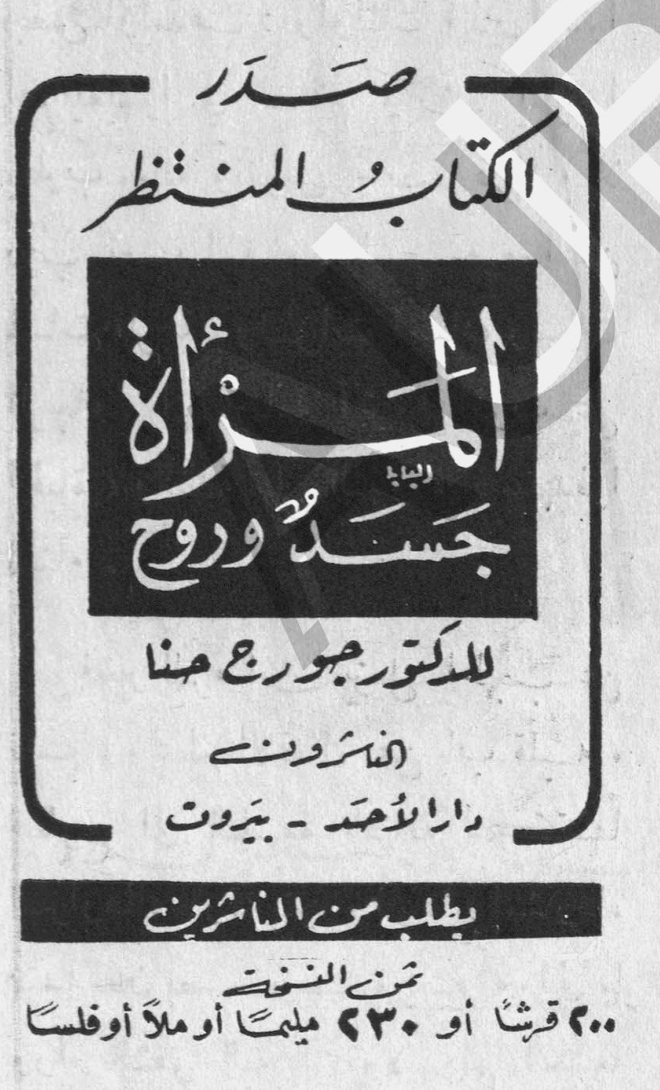
Woman: Body and Soul — by Dr. Georges Hanna
Now published:
the long-awaited book
Woman:
Body and Soul
by Dr. Georges Hanna
Publishers:
Dar al-Ahad — Beirut
To be ordered from the publishers
Price per copy:
200 piasters, or 230 millimes, or fils