In the wake of the American occupation of Japan, the Japanese woman entered a new era.
It is true that Japan — since the late years of the last century — had begun to copy the civilization of the West. But this copying did not go beyond material things: factories, machines, instruments of war, and applied practical sciences. Japan kept most of its religious and social traditions and its artistic and linguistic heritage. And the Japanese woman evolved only a little beyond her former state; she remained a prisoner of the house and of household tasks, seldom appearing in public places and having little desire for education or work.
The emancipation of the Japanese woman in its present form was part of the comprehensive program of liberation which the American commander MacArthur laid down for the Japanese after his occupation of their country. He took upon himself to purge Japan of the Nazi influence that had taken hold of it, and consequently to turn its old systems upside down. But demolition is worthless without building, and so the General began the operation of setting a new order in the place of the old; and the only order from which he drew inspiration was democracy as the Americans understand it — that is, the Americans' ways in government, politics, living, and thinking.
From that time the position of the Japanese woman came to
keep pace with the position of the American woman in all its aspects. And when we recall that the American woman is the most emancipated of the world's women, we grasp what a momentous development has come over the Japanese woman in a few years.
The complete emancipation of woman takes in four aspects: the cultural, the economic, the political, and the social. All these freedoms fell to the lot of the Japanese woman.
First: cultural emancipation means that the opportunities of culture are open to her as to man, without distinction. It means that the number of girls' schools is not less than the number of boys' schools, that both groups have a single course of study, and that the opportunities of specialization in the universities and the practice of the liberal professions are one and the same for both sexes.
Second: economic emancipation — cultural emancipation is worthless without economic emancipation, which is woman's right to turn her learning to account, to practice her profession, and to profit from her field of specialty, so that she may not remain a burden on man and a weight on society, and so that the benefit of her learning may not be lost to her.
And the Japanese woman — following the example of her American sister — has begun to practice all occupations and to pursue all the professions that man pursues. She takes
employment in the offices of the government, in the offices of the army and the police; she takes up soldiering as a profession; she works in factories, farms, offices, and places of commerce; no one opposes her and no one criticizes her. Her wages everywhere are equal to the wages of her male colleague, and she takes to work with astonishing eagerness — so much so that we may say the rate of work among young women is one hundred percent, while the women of the earlier generation practice social work and enroll in the ranks of the charitable institutions.
Third: political emancipation — by this I do not mean only woman's right to vote, to enter parliament, and to exercise all
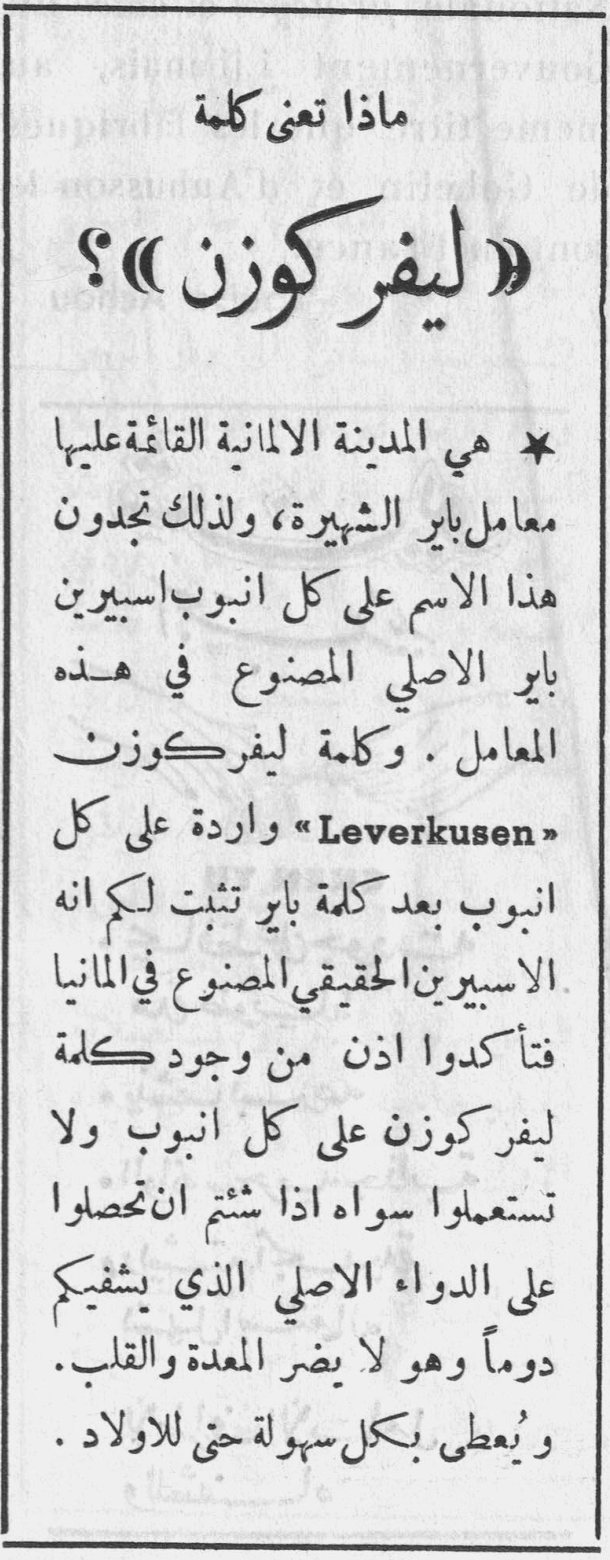
Bayer Aspirin — What Does the Word "Leverkusen" Mean?
* It is the German city in which stand the famous Bayer works — and that is why you find this name on every tube of genuine Bayer Aspirin made in these works. The word Leverkusen, appearing on every tube after the word Bayer, proves to you that it is the true Aspirin made in Germany. Make certain, then, that the word Leverkusen is on every tube, and use no other if you wish to obtain the genuine medicine that always cures you; it does not harm the stomach or the heart, and it can be given quite easily even to children.