political rights. I mean also her equality with man in civil law and the law of personal status. That is, she is his equal in the right of divorce, the right of
testimony before the courts, the right of inheritance, and the right of keeping the children. In case of divorce the court decides the question of the children and hands them over to the party more fit to rear them and care for them, whether that be the father or the mother. In a single word, Japanese law gives woman absolute equality with man, and it does not lighten the penalty of a killer when he kills in defense of honor.
Finally, the social side —
The Americans did not touch certain social traditions which the Japanese people cherish — religion, for instance, and dress, and the like — but they emancipated woman socially, in the sense that they gave her the freedom to appear in public places, in clubs, in places of amusement, without people glaring at her or pursuing
her with belittlement. And they strove to establish social justice among the population by enacting laws that protect the workman, the workwoman, and the child, and safeguard the rights of labor. They made the basic labor law one and the same for women and men, and added to it special laws for protecting woman from hard labor, caring for the expectant mother, and helping working mothers by caring for their children in special institutions during their absence.
And since the Japanese have the custom of amusing themselves in the company of the serving girls, or girls of entertainment, whom they call "Geisha Girls," the Americans left this custom to them; but they did justice to woman by giving her the right to keep company with young men in places of amusement and public places — and the right to seek divorce from the husband who is unfaithful to her; that is, to pay him back like for like.
Whoever saw Japan six years
ago and then returned to visit it after the revolution which the Americans wrought — above all in the life of woman there — would stand amazed at the speed and the success that have accompanied the course of that revolution.
But his amazement vanishes when he verifies two things: first, the skill the Americans showed in designing the revolution, organizing it, and carrying it out — for all their work went forward according to a drawn plan; second, the good response shown by the Japanese woman, and her readiness to accept the new freedoms, to bear their responsibilities, to plunge into the battle of life at man's side, and to perform her new duties in the fullest manner.
All this is proof that woman, if she is given her legitimate rights whole and undiminished, is not inferior to man in capacity and strength; and that the countries which deny woman these rights — like our Arab countries, for example — suffer a great loss.
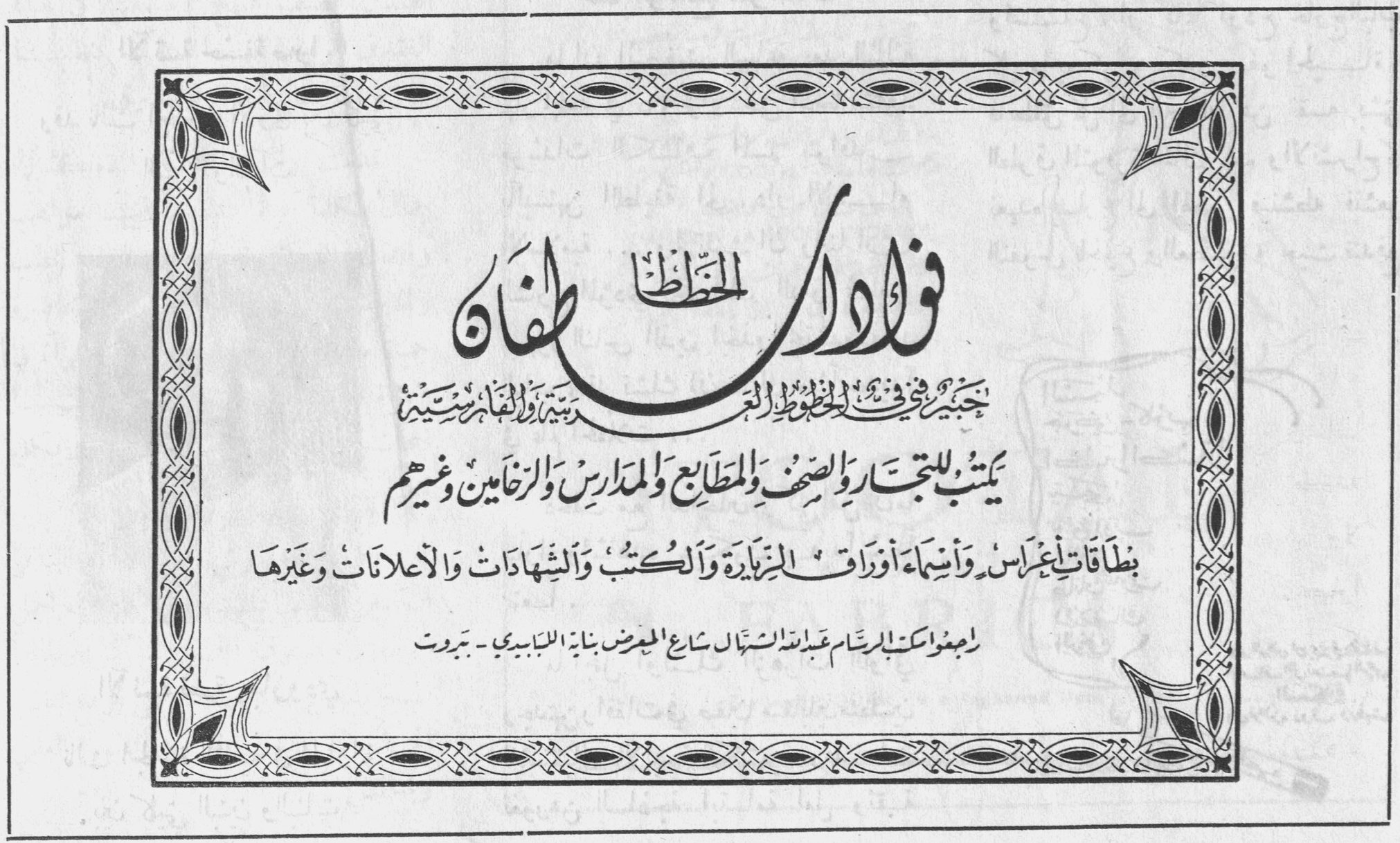
Nadako Taffan
The Calligrapher
An expert in the art of Arabic and Persian scripts
He writes for merchants, newspapers, printing presses, schools, decorators, and others:
wedding cards, names on commercial papers, books, certificates, advertisements, and more.
Apply at the office of the artist Abdullah al-Shamal, Al-Maarad Street, Yabiri Building — Beirut